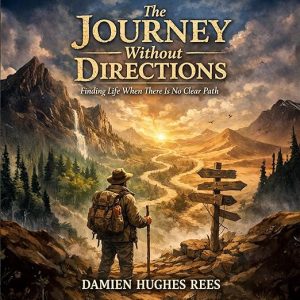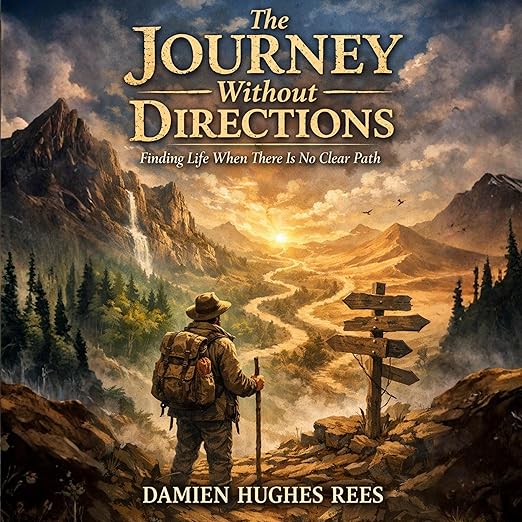
When I encounter a one-hour audiobook, I approach it differently than I approach a twelve-hour narrative. The contract between writer and listener changes at that length. There is no room for accumulation, for the slow building of a world or a character. Everything must be doing its work immediately, in plain sight. Damien Hughes Rees's The Journey Without Directions, released in March 2026 and narrated by Jimmy Trisler, operates in this compressed space, and what it produces is something closer to extended prose poem than conventional personal development content, despite its genre classification.
The book is listed under relationships, parenting, and personal development, but that categorization is somewhat misleading. The writing in the synopsis alone suggests a sensibility more literary than self-help: "Pavement roads that had been worn down by years of walking were resonating with the sound of feet. Buses whined at stops, and store owners yelled at people who came early." This is not the language of habit formation or productivity systems. It is the language of someone paying close attention to the texture of a city as a way of paying close attention to interiority.
Quiet Restlessness Disguised as Personal Development
The book is structured around a departure, a man leaving without a plan, without a map, driven by a "quiet restlessness that wouldn't go away until he had to move." What unfolds is less a narrative of what happens after he leaves and more a meditation on the conditions that produced the departure: the years of rule-following, the calibrated safety of every decision, the "quiet tiredness that made it hard to feel things over time without being seen." That last phrase captures something that personal development writing almost never articulates this precisely, the way that institutional compliance doesn't destroy emotional life but muffles it so gradually that you don't notice the loss until you're far into it.
The book has no reviews on Audible at time of writing, which is partly a function of its recency and partly perhaps of its unusual profile, it does not fit neatly into the categories in which listeners typically browse. There is no comparable title to point toward, no established readership to draw on. What exists is the prose itself, and the prose is doing something worth attention: it is using the personal development format as a container for literary introspection about a universal experience, the gap between the life you've been building and the life you actually want.
Trisler's Pauses Do as Much as His Words
Jimmy Trisler's narration is well-matched to the material. The text has a deliberate, unhurried quality that could easily tip into lethargy in the wrong hands, but Trisler reads it with a concentrated attentiveness that keeps the prose alive. He understands that the pauses matter in this kind of writing, that the silence around a phrase like "It was like watching his own life go by without him" is as important as the phrase itself. In audio, that attentiveness to pace is the difference between a meditation that lands and one that drifts.
At one hour exactly, the book asks very little in terms of time commitment. It is the kind of audiobook that might be listened to in a single sitting, perhaps twice, in the way that one reads a poem or a short essay multiple times to allow different elements to surface. The first listening gives you the emotional shape; subsequent engagement lets the specific images and observations accumulate meaning. Whether this is a book you return to will depend on how much you find in the prose on first contact.
No Frameworks Here, Only a Feeling Named
Listeners who come expecting conventional personal development content, frameworks, strategies, actionable takeaways, narrative structure with a clear arc, will not find them here. The book offers a different kind of value: the validation of a feeling rather than instruction in what to do about it. The restlessness it describes, the gap between compliance and authenticity, is rendered in enough detail to feel like recognition rather than abstraction. But listeners who want their reading time to produce a plan or a practice will need to look elsewhere.
There is also a question of readerly investment that a one-hour audiobook raises in a specific way. The brevity means that structural or prose weaknesses, if present, are more visible than they would be in a longer work where good and uneven sections balance each other out. The writing here is consistently of a literary register, but listeners sensitive to overly abstract or heavily figurative prose should know the book operates entirely within that register rather than offering a counterweight of narrative clarity.
Best for Fans of Meditative Prose Essays
Listeners who are drawn to literary nonfiction, meditative prose essays, or writing about the phenomenology of restlessness and departure will find this a compact, intelligent addition to that shelf. It suits readers who have found conventional personal development books too prescriptive and are looking for something that articulates a feeling rather than proposes a solution. Listeners who want narrative momentum, practical guidance, or comprehensive self-help treatment should look elsewhere, this book is concerned with the quality of the experience of being in the state it describes, not with getting out of it efficiently. For those on its wavelength, an hour is enough time to make a real impression.
Frequently Asked Questions
Given that there are no reviews yet, how can I assess whether this audiobook is worth the listening time?
The synopsis prose itself is the best signal, the writing quality evident there reflects the book's register throughout. Listeners who respond to the specific images and observations in the synopsis (the early morning light, the quiet restlessness, the watching of one's own life) will likely find the book worth their hour. Those who find the prose style overly abstract should not expect it to become more concrete inside.
Is The Journey Without Directions aimed at a specific demographic or is it broadly applicable?
The protagonist is male, and the specific experience described, of a man who has followed family, work, and self-imposed rules into a kind of emotional numbness, is rendered in that register. The underlying feeling, however, is not gender-specific, and the experience of compliance-as-slow-muffling speaks to anyone who has built a life on others' expectations and found themselves somewhere they don't quite recognize.