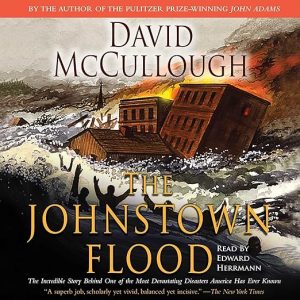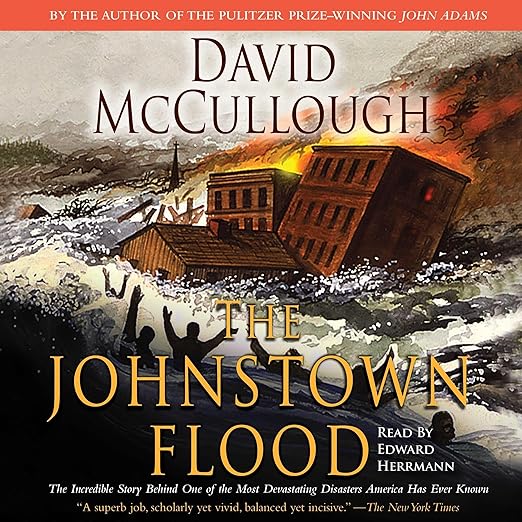
I listened to The Johnstown Flood during a stretch of rainy evenings that felt, in retrospect, appropriately atmospheric. David McCullough's account of the May 31, 1889 collapse of the South Fork Dam and the wall of water that killed more than 2,000 people downstream is the kind of narrative history that makes you forget you are not reading a novel. The Gilded Age tableau McCullough constructs, industrial wealth building a private resort above a booming coal-and-steel town, ignoring the warnings of engineers about the integrity of the dam that kept their lake in place, reads with the inevitability of tragedy. Which is, of course, exactly what it was.
This is McCullough's first book, published in 1968, and it established the template for everything that followed: the meticulous research, the social texture, the moral frame held steady without becoming didactic, and the prose that moves at the pace of a thriller even when it's describing actuarial tables. The partnership between McCullough and narrator Edward Herrmann, who would go on to collaborate on several of McCullough's major works, is one of the signal narrator-author pairings in American narrative nonfiction audio. Hearing Herrmann's measured, warm authority render McCullough's sentences is an experience that has not diminished in the nearly twenty years since this recording was released.
What We Made of It
The central argument of The Johnstown Flood is carried not in a thesis statement but in its structural logic. The South Fork Fishing and Hunting Club, whose members included Andrew Carnegie, Henry Clay Frick, and Andrew Mellon, names that would have resonated differently in 1968 than they do now, but that were already totems of industrial wealth, had purchased the old dam and rebuilt it hastily to create a private lake for their resort. Engineers had raised concerns about the modifications to the dam's spillway. Nothing was done. The dam held. Then, on a May afternoon in 1889, after a season of heavy rain, it didn't.
What follows McCullough's account of the catastrophe is not just the flood itself but the aftermath: the attempts to deflect responsibility, the legal outcomes that resulted in no one being held accountable, the national scandal that produced relief efforts and then faded without structural change. One reviewer quoted a survivor's words that McCullough centers: We think we know what struck us, and it was not the hand of Providence. Our misery is the work of man. That line does more analytical work than a chapter of argument could manage, and McCullough's gift is in finding and deploying it precisely.
Why Listen to The Johnstown Flood
Edward Herrmann's narration is, in the most literal sense, irreplaceable. He died in 2014, and his recordings of McCullough's books stand as the definitive audio editions of some of the most important popular history produced in the second half of the twentieth century. His voice has a quality that is difficult to describe, authoritative without sounding institutional, warm without being sentimental, that matches McCullough's own authorial presence as closely as any narrator-writer pairing I can think of in the genre. The nine hours of this audiobook feel shorter than they are, which is the mark of both the prose and the performance working together at their best.
The sound of the recording, from a 2005 Simon & Schuster Audio release, is clean and functional rather than modern-production-polished. This is not a drawback for material of this kind. There's something appropriate about a slightly older recording for a book about nineteenth-century history, the audio doesn't distract, and Herrmann's voice needs no production enhancement.
What Might Not Land
One reviewer noted that the historical account doesn't connect explicitly to later American disasters, the missed opportunity to draw lines between the Johnstown negligence and, say, Hurricane Katrina or industrial safety failures of the twentieth century is one that some readers feel. McCullough is writing social history rather than policy analysis, and he trusts the reader to make those connections without being told to. That trust is both a strength of his approach and, for some readers, a frustration.
A reviewer from outside the American context, the French reviewer who described it as reading like a novel but underpinned by thorough research, identified something real about the book's genre position. It is popular history in the best sense: scrupulous enough to be trustworthy, readable enough to reach a general audience. Listeners who want academic historiography, extensive footnoting, competing scholarly interpretations, explicit historiographical positioning, will need to look elsewhere. But as an introduction to the Johnstown disaster and the Gilded Age social dynamics that produced it, this remains the definitive account.
Should You Listen to The Johnstown Flood?
This audiobook is ideal for listeners who want to understand American history through specific events that reveal broader dynamics rather than through sweeping survey. If you've enjoyed other McCullough titles, The Great Bridge, 1776, The Path Between the Seas, this early work shows where those later books came from. It's also a natural companion to any interest in Gilded Age America, labor history, or the legal and ethical questions around corporate accountability that have never fully resolved. The Herrmann narration, for listeners who have experienced it on McCullough's other books, is reason enough on its own. For newcomers to McCullough, this is as good a place as any to begin, and the compact nine-hour runtime makes it an accessible entry point into his longer works.
Is this audiobook a good entry point for listeners who haven't encountered McCullough's work before?
Yes, and in some ways it's a better starting point than his later, longer books precisely because of its compact nine-hour runtime. The Johnstown Flood demonstrates all of McCullough's core qualities, the social texture, the novelistic pacing, the moral frame, in a contained narrative. Listeners who find they want more of this should move to The Great Bridge or John Adams next.
Edward Herrmann is associated with several McCullough recordings. Does his narration here differ from his work on the later, longer books like John Adams?
The performance is consistent in quality, though the subject matter shapes the emotional register somewhat. The Johnstown Flood has more immediate dramatic content, the flood itself, the human stories of individual survivors and victims, which gives Herrmann's narration some moments of genuine tension that the more political biographical work doesn't always provide. Fans of his narration on the longer books will find this a satisfying, if more compact, example of the same partnership.
Does The Johnstown Flood explore who was held legally responsible for the disaster? Were any of the South Fork Fishing and Hunting Club members ever prosecuted?
This is one of the book's most sobering revelations. McCullough documents the outcome clearly: despite the evidence that the club's modifications to the dam directly caused its failure, and despite the clear human cost of 2,000-plus deaths, no member of the South Fork club was ever held legally liable. The legal doctrine of the time, combined with the political and economic power of the club's membership, insulated them entirely. McCullough treats this not as an aberration but as a characteristic expression of how Gilded Age America distributed accountability.