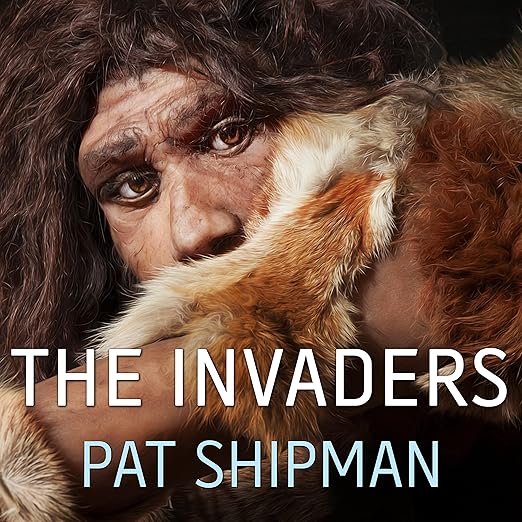
Neanderthals held Europe alone for roughly 150,000 years before modern humans ever arrived, and within a comparatively short window afterward, they vanished entirely. This audiobook edition of Pat Shipman's The Invaders chases the actual mechanism behind that disappearance rather than settling for a vague gesture at climate change, and her sharpest claim, that an alliance between early humans and the first domesticated wolf-dogs tipped the balance, is the kind of specific, testable argument that separates real science writing from a truism.
Invasion Biology Reframes Neanderthal Extinction as a Squeeze
Shipman's central move is borrowing a framework from an entirely different field: invasion biology, the study of what happens ecologically when one species colonizes territory another species already occupies. Applied to the Neanderthal question, that lens reframes extinction as a slow squeeze rather than a single dramatic event, geographic range shrinking, populations fragmenting into isolated groups, genetic diversity draining away, all driven by direct competition with a growing human population rather than any single catastrophe.
The wolf-dog hypothesis is the book's most distinctive and memorable contribution. Shipman argues that a partnership between early humans and those same early domesticated wolves gave humans a decisive hunting advantage over large Ice Age game at exactly the moment climate change was making both species more vulnerable, not long after Neanderthals themselves began disappearing. It's a genuinely fresh angle on a question that popular science has approached from nearly every other direction already.
The extinction question itself has stayed genuinely open for a remarkably long time; the synopsis notes the first Neanderthal bones were identified back in 1856, which means researchers have been actively debating this exact question for close to a century and a half without full resolution. Shipman's book enters that long-running debate with a specific, falsifiable mechanism rather than another restatement of the general climate-change explanation, which is precisely what makes it feel like a genuine contribution rather than a survey of existing positions.
Invasion biology as a field normally studies far more mundane cases: an introduced plant or insect species outcompeting native ones within a modern ecosystem. Applying that same framework backward across tens of thousands of years, to one hominin species displacing another, is a genuinely unusual move, and it's part of what makes Shipman's argument feel like real interdisciplinary work rather than simply borrowing a fashionable label from a more trendy field.
Donna Postel's Untested Fit for Dense Science
I could not track down a prior narration credit for Donna Postel, so this is a genre-fit assessment rather than a confirmed reputation. Dense popular science loaded with specialized terminology (genus Homo, genetic diversity, invasion biology jargon) needs a narrator who can move cleanly between technical precision and narrative momentum without letting either one flatten the other, and that's the specific demand this book places on its reader.
Reviewer Mamlukman offers a useful gauge of accessibility, describing themselves as 'the legendary "general reader" who academic authors used to write for in the good old days' and crediting the book with delivering 'new (to me) ideas on almost every page.' That's a strong signal the material stays approachable across seven hours and twenty minutes despite its technical subject.
Shipman writes in a confident, case-building register rather than a neutral textbook tone, actively arguing a position rather than simply cataloguing findings, and that distinction matters for narration. A reader has to carry real conviction through the argumentative passages while still handling dense technical vocabulary cleanly, a genuinely different demand than narrating a purely descriptive science text would place on a performer.
Popular science books built around a single unifying thesis like this one typically alternate between two registers: citing hard genetic and archaeological evidence, then shifting into narrative reconstruction, imagining what daily competition for the same hunting grounds might actually have looked like on the ground. Moving cleanly between those two modes without either one undercutting the other's credibility is a real narration challenge distinct from simply reading facts aloud clearly.
Miscategorized as Home and Garden, Genuinely Speculative
This listing carries genre tags that don't match its content at all; browsing listeners shouldn't be thrown off by miscategorization here. This is squarely popular science and prehistory, not home and garden content, and the mismatch is worth flagging plainly so the right audience actually finds it.
Reviewer RTM calls the central argument 'very speculative but fascinating,' and that qualifier is worth taking seriously. Shipman's wolf-dog hypothesis, while carefully argued, remains a genuinely contested theory within paleoanthropology rather than settled consensus, and the book rewards listeners who are comfortable with that kind of open scientific debate rather than expecting a tidy, uncontroversial conclusion.
One Argument Among Several, Efficiently Made
Reviewer Fred Collins offers a brief but useful endorsement, calling it simply 'a good read' for anyone 'curious about early humans and predecessors of dogs.' Relative to its subject, the book stays notably efficient and focused compared to the sprawling, multi-hundred-page doorstoppers that dominate popular science publishing, a real advantage worth knowing about if runtime length alone has been a barrier to this genre for you before.
It's worth knowing going in that Shipman's competition-and-displacement thesis is one of several explanations circulating in paleoanthropology for the Neanderthal disappearance, alongside interbreeding and absorption theories other researchers have argued for. The book makes its own case forcefully, but a listener wanting the full landscape of current thinking on this question should treat this as one strong argument within an active debate, not the final word.
The title itself is doing pointed work: from a strictly Neanderthal-centered point of view, modern humans are the invaders of the story, not the other way around. That's a deliberate inversion of the usual triumphant framing around human evolutionary success, and it signals early that Shipman is interested in competitive ecology rather than a flattering origin story for our own species.
Skip for Settled Answers, Stay for the Argument
Readers of accessible evolutionary science, anyone curious about the deep history of dog domestication, and listeners who enjoy a tightly argued single-thesis popular science book over a broad survey will get real value here.
Listeners who enjoy other accessible accounts of human evolutionary history and origins more broadly, not just Neanderthal-specific material, will find Shipman's central argument connects naturally to that wider body of popular science reading.
Dog owners and anyone specifically interested in the deep history of domestication, not just human evolution generally, will find Shipman's wolf-dog argument satisfying on its own even where the broader Neanderthal-extinction framing interests them less.
Skip this one if you want settled, uncontested scientific consensus rather than one researcher's argued case; go in aware this is a specific thesis, not a neutral survey of the field. Listeners with zero patience for genetics or archaeology terminology may also find certain stretches dense despite the book's general accessibility.
- Voice: Donna Postel doesn't appear to have earlier narration credits on record; the material demands clean movement between technical precision and narrative pacing across a genuinely specialized subject.
- Big ideas: Neanderthal extinction, invasion biology, early human-dog partnership
- Atmosphere: Curious, argumentative, accessible
- Worth it?: A sharp, specific piece of popular science for anyone curious about how modern humans actually outlasted the Neanderthals.
Is this audiobook a work of settled science or an argued theory?
It's an argued thesis. Shipman's wolf-dog hypothesis is carefully evidenced but remains genuinely contested within paleoanthropology, and one reviewer calls it 'very speculative but fascinating' rather than uncontroversial fact.
Does this audiobook require a science background to follow?
No. One reviewer describes themselves as the general reader academic authors used to write for and found new ideas 'on almost every page,' suggesting the material stays accessible despite its technical subject.
Why is this audiobook categorized under home and garden or politics and social sciences?
That appears to be a listing error. The actual content is popular science and prehistory focused on Neanderthal extinction, not gardening or political analysis, so don't let the category tags mislead you.
How does this audiobook explain the role of early dogs in Neanderthal extinction?
It argues that humans partnering with the first domesticated wolf-dogs, around the same time Neanderthals began disappearing, gave humans a decisive edge hunting large Ice Age game during a period of climate stress on both species.