Is She the Danger, or in Danger?
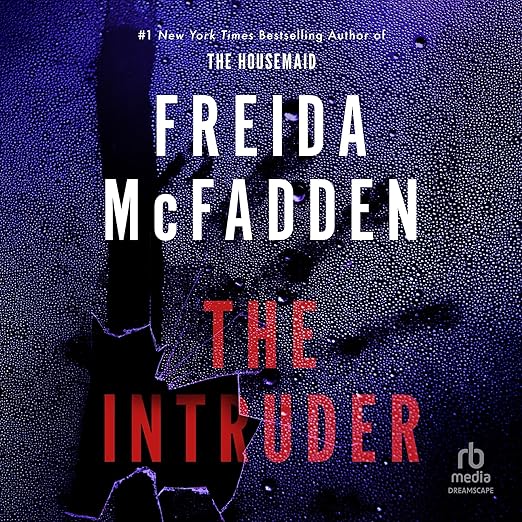
Casey's cabin during a hurricane is already a constrained and pressured space before the girl appears at the kitchen window. Freida McFadden, the author of The Housemaid and one of the more reliably efficient thriller writers working at scale today, builds The Intruder from a single high-concept premise and commits to it completely. The audiobook, narrated by Joe Hempel, runs eight hours and nineteen minutes, which is about right for the claustrophobic scope of the story: a wilderness cabin, a storm, an unexpected visitor covered in blood and clutching a knife, and a night that keeps getting worse in systematic stages. This is a book built for consumption in a single sitting or a long drive, and the pacing makes that experience available.
McFadden's reputation rests significantly on her ability to introduce characters whose self-presentation cannot be fully trusted and then peel back the discrepancy at precisely calibrated intervals. The Intruder deploys that skill in an unusually contained environment. The girl outside Casey's window is presented as a threat from the first moment, but the precise nature of that threat keeps shifting as the audiobook progresses. Is she the danger, or is she in danger? Is her silence protective or menacing? McFadden sequences the revelations so that each answer generates a new question, which is the fundamental mechanism of the genre done properly.
The Hurricane Traps Casey as Secrets Unspool
The hurricane setting earns its place in the story beyond atmosphere. McFadden uses the storm as a genuine structural constraint: Casey cannot simply leave, cannot easily call for help, and cannot make reasonable risk calculations because the outside environment is as dangerous as whatever is inside with her. The isolation is not manufactured through convenience but through a set of conditions that the reader accepts as plausible from the start, which makes the subsequent escalation feel earned rather than contrived.
The girl's secret, which the synopsis tells us she will kill to protect, is handled with appropriate restraint in its revelation. McFadden does not withhold information arbitrarily but she does control the rate of disclosure carefully, releasing what she needs to at each narrative beat without over-explaining. This is harder than it looks, and it is where a lot of thriller writers at the commercial end of the market go wrong: they either reveal too much too early (eliminating tension) or withhold too much too long (frustrating the reader). McFadden has the calibration working here, which is one reason the audiobook generates the kind of readerly inertia that reviewers describe as impossible to stop.
Hempel's Control Outpaces a Looser Final Act
Joe Hempel's narration is well-suited to this material. He plays Casey's perspective with a controlled anxiety that tracks the actual threat level of each scene rather than projecting uniform dread throughout. The pacing in the cabin sequences is particularly good: Hempel slows into moments of genuine danger in ways that amplify tension without tipping into melodrama. For a novel that depends heavily on the listener's willingness to believe in Casey's cognitive state under pressure, this is important casting work.
Reviewers describe the book as difficult to put down from its opening pages and praise McFadden's sustained control of suspense through the central section. One critical note that appears in the reviews is that some plot elements in the later sections feel random rather than inevitable, which is a fair observation about the third act. McFadden's setup is tighter than her resolution, and there are moments in the final quarter where the causal chain between earlier revelations and later events is less logically tight than the first two-thirds suggested it would be.
Familiar McFadden Patterns, Fresh for First-Time Readers
Readers who have spent significant time with McFadden's back catalog will recognize structural patterns here that she has deployed before: the unreliable presentation of a threatening figure who may be victim rather than villain, the isolated setting that eliminates escape as an option, the timed reveals that reframe what has already happened. This is not a criticism of The Intruder so much as a note that McFadden has a signature approach, and this novel is firmly within it. For readers coming to her for the first time, those patterns are fresh and effective. For veterans of The Housemaid and its sequels, the experience is somewhat more predictable at the structural level even when the specific content remains engaging.
The third act does wobble in ways that at least one reviewer found jarring. The resolution requires the reader to accept some plot developments that feel more convenient than earned, which is a tension McFadden has navigated more gracefully in other books. The ending itself is satisfying in emotional terms but not entirely tight in logical ones, which for a thriller built on the promise of coherent revelation is worth knowing in advance.
At eight hours and nineteen minutes, the audiobook is long enough to develop genuine investment in Casey's situation but short enough to prevent the premise from overstaying its welcome. The runtime is well-chosen for the material.
Thriller Fans Get Contained, Disturbing Suspense
This audiobook is for thriller listeners who want a contained, atmospherically consistent, fast-moving suspense story with a legitimately disturbing central situation. McFadden's plotting instincts are strong enough to sustain the full runtime and Hempel's narration keeps the tension consistent throughout.
Dedicated McFadden readers who have already consumed The Housemaid series will get a familiar experience rather than a genuinely fresh one, and should calibrate expectations accordingly. But for listeners looking for a reliable, well-executed thriller in the wilderness-isolation-dark-secret tradition, The Intruder delivers what it promises with professional competence and several genuinely effective moments of escalating dread.
- Voice: Joe Hempel delivers both Casey's perspective and the mounting dread of the cabin setting with controlled tension, finding the right register for a thriller that operates on psychological suspense more than action.
- Big ideas: Survival under duress, secrets with lethal stakes, trust in isolation
- Atmosphere: Tightly wound and claustrophobic
- Worth it?: Freida McFadden's wilderness thriller is lean, fast, and structurally sound, though readers who have encountered her earlier work may recognize some of the structural signatures.
How does this audiobook handle the pacing of its thriller structure?
The pacing is consistently strong through the first two-thirds. McFadden sequences her revelations carefully, releasing information at each narrative beat to generate new questions rather than closing old ones prematurely. Some reviewers note the third act feels slightly less tightly plotted than the setup, but the momentum carries through to the end.
Is this a good first audiobook to try if I haven't read Freida McFadden before?
It is a solid introduction. The Intruder is self-contained, moves quickly, and demonstrates McFadden's core strengths in suspense construction and timed revelation clearly. Readers who enjoy it will find the Housemaid books and her earlier standalone thrillers provide more of the same experience with comparable craft.