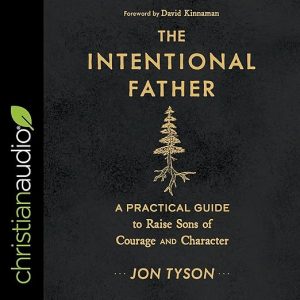
I don't have sons. I want to be transparent about that at the outset, because The Intentional Father is a book that speaks most directly to a specific reader, a Christian father of boys who feels the inadequacy of his own preparation for what his sons need from him. Jon Tyson identifies this gap precisely in the opening pages, naming self-initiation, boys being left to figure out manhood alone in a wilderness of conflicting cultural messages, as the problem his book addresses. That framing resonated with every father I know who has engaged with this material. I came at it from the outside, interested in what the book actually offers and how Tyson delivers it.
Tyson is the senior pastor of Church of the City New York, and The Intentional Father grows from his experience not just as a pastor but as a father who designed what he calls a ten-year journey for his own son, a structured path from boyhood to manhood built around specific activities, rites of passage, and what he names marking moments. The book is slim at four and a half hours in audio, which is a feature rather than a limitation. Tyson is making a practical argument and offering practical tools; he is not trying to write a comprehensive theology of fatherhood. The concision keeps the book actionable.
The book's core premise is that fathers cannot afford to hope their sons will become good men, that hope without intention is not a strategy. Tyson argues for a proactive approach that borrows from ancient rites of passage traditions, from mentorship models both secular and sacred, and from his own experience designing a journey for his son that included specific milestones at specific ages. One reviewer who described his own fatherhood as more reactive than purposeful called the book a monumental wake-up call, which reflects the kind of readerly response Tyson is aiming for.
The Christian framework is explicit and central rather than ambient. Tyson is writing for fathers who share his faith commitments, and the language of raising sons the way God created them to be is the organizing idiom throughout. One reviewer was direct about this: this is a must-read if you care about helping your sons grow up to be the man God created them to be. Another reviewer appreciated the book but noted it seemed to assume a strong prior relationship between father and son, and asked for more guidance on establishing that foundation before launching the structured journey. That's a genuine limitation for fathers who are starting from a more fractured place.
Why It Works in Audio
Tyson narrating his own book is the right decision for this material. The pastoral warmth that reviewers describe, the combination of personal stories and practical advice, encouraging fathers to show up emotionally as well as physically, comes through differently when you are hearing the author's actual voice. There is a quality of person-to-person guidance in the audio format that a narrator hired for the role cannot fully replicate. Tyson's delivery is earnest and direct, as you would expect from a pastor who is used to communicating complex ideas clearly to a congregational audience.
At four and a half hours, this is a book that can be listened to over two or three commutes. That short runtime is appropriate for the content, Tyson has made practical decisions about what to include and what to leave to supplementary reading. The book is designed to be actionable immediately, and the audio format supports that intention. Listeners who engage actively, pausing to think about how Tyson's suggested activities and milestones map onto their own son's life, will get more from the listening experience than those who take it in passively.
What to Watch For in The Intentional Father
Several reviewers noted areas where they wanted more. One asked for deeper guidance on the lead-up to the coming-of-age journey and on how to set a son up for a durable marriage. Another suggested the book would benefit from more explicit pointers to supplementary reading, acknowledging that one book cannot do everything. These are fair requests, and they reflect the book's positioning as a concise practical guide rather than a comprehensive resource. Tyson is clear about this framing: he is offering a starting point and a philosophy, not an encyclopedia.
The masculine and Christian formation language that Tyson uses is specific enough that readers outside that worldview will find themselves at some distance from the book's operating assumptions. Phrases like raising sons of consequence, young men who know what they believe, and standing up against the negative cultural trends of our day carry ideological freight that will be energizing for readers who share Tyson's values and distancing for those who don't. This is not a criticism of the book's content so much as an accurate description of its intended audience and idiom.
Who Will Get the Most From It
The ideal listener for this audiobook is a Christian father of sons who is looking for a practical, structured approach to intentional fatherhood rooted in a faith framework. Grandfathers who want to play an active mentorship role, one of the audiences Tyson explicitly names alongside fathers, will also find the book applicable. Fathers from other faith traditions or secular backgrounds will find the practical ideas around rites of passage and marking moments potentially adaptable, but the framework they are embedded in is distinctly Christian and not designed to translate neutrally. If you are already broadly familiar with Christian parenting literature and are looking for something with a specific focus on father-son mentorship and structured coming-of-age pathways, this book offers a well-organized and emotionally grounded approach. If you want more depth in any particular area, Tyson's suggestion to use the book as a starting point for further reading is the right one.
A Few Questions About The Intentional Father
Is The Intentional Father applicable to fathers of daughters as well as sons?
Tyson writes explicitly about sons throughout, and the rites of passage structure he describes is calibrated specifically to boys navigating toward manhood in a Christian framework. One reviewer noted that while much of the book could be applied to daughters with some adaptation, it is primarily designed for father-son relationships. Fathers looking for equivalent material for daughters would need to look to other resources.
Does the book offer a concrete step-by-step program, or is it more conceptual guidance?
It offers both. Tyson describes specific activities, milestones, and marking moments that he designed for his own son's ten-year journey, and he provides enough structure that fathers can adapt these to their own family context. The book is more programmatic than most Christian parenting literature, which tends toward general principle. That concreteness is part of what reviewers have responded to most positively.
How does Jon Tyson's narration work for listeners who have never heard him preach or speak publicly?
Tyson reads with a pastoral directness that is clear and warm without being performative. He's not attempting a dramatic reading, this is conversational and personal, as if he's talking to a small group of fathers he genuinely cares about. Listeners familiar with his preaching will find the register consistent. Those who aren't will likely find his voice easy to trust and easy to spend four-and-a-half hours with.
The book is described as addressing boys and young men specifically. At what age does Tyson suggest fathers begin the structured journey he describes?
Tyson describes a ten-year journey that ideally begins around early adolescence, roughly ages 12 to 13, and extends through the late teen years, with specific milestones and marking moments distributed across that span. He acknowledges in the book that the entry point matters and that fathers with younger sons have an advantage in starting early. One reviewer noted they wished for more guidance on the lead-up period for fathers with younger children who want to begin preparation before the formal journey starts.