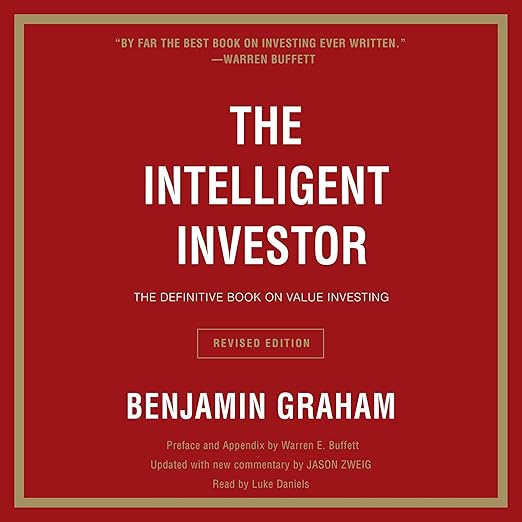
Quick Take
- Narration: Luke Daniels brings clarity and intelligence to dense financial material, pacing Graham’s original text and Zweig’s commentary distinctly enough that the two voices register as separate registers.
- Themes: Value investing and margin of safety, the defensive versus enterprising investor, market psychology and emotional discipline
- Mood: Rigorous and demanding, with a patience that mirrors the investment philosophy it describes
- Verdict: The canonical text on value investing remains essential, and this revised edition’s Zweig commentary earns its place alongside Graham’s original, though the audiobook format asks a lot of listeners who need to track the dual-text structure.
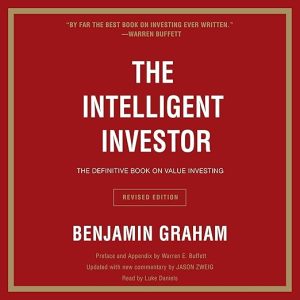
I have started The Intelligent Investor three times across different formats. The first time was a paperback copy I found at a used bookshop that I read with modest comprehension and excessive confidence. The second was a partial listen that I abandoned somewhere around the discussion of bond portfolios. The third time, which was this revised edition narrated by Luke Daniels, I finished, and I think the difference was partly the narration and partly finally having enough financial literacy to follow the argument properly. The book has a way of revealing exactly how much you do not yet know, and that is not a defect.
Benjamin Graham published the original Intelligent Investor in 1949, and the core philosophy, value investing built around the margin of safety principle, has been tested against seven decades of market behavior since then. Warren Buffett’s endorsement, quoted in the synopsis, is not marketing copy; it reflects a genuine intellectual debt. Graham was Buffett’s professor at Columbia and the framework in this book shaped how Buffett thinks about capital allocation. That lineage matters because it situates the text within a tradition of actual practice rather than theory.
Our Take on The Intelligent Investor
The revised edition adds Jason Zweig’s chapter-by-chapter commentary, which updates Graham’s examples with contemporary market references and draws parallels between the mid-twentieth century markets Graham analyzed and the conditions of the early 2000s, when the revision was published. One reviewer describes giving five stars to Graham, three to Zweig, and five to Buffett, which captures an honest assessment: the Zweig commentary is uneven. Some chapters the annotation is genuinely illuminating; in others it adds length without proportionate insight. Luke Daniels handles the transition between Graham’s original text and Zweig’s commentary clearly enough that listeners can track which layer they are in.
The core of Graham’s argument, that the market is a voting machine in the short term and a weighing machine in the long term, and that the intelligent investor’s advantage lies in exploiting the gap between the two, is not complicated in concept but is demanding in practice. Graham is a rigorous writer, not a populist one, and the audiobook format makes the denser analytical chapters require active listening rather than passive consumption. This is not a commute listen unless your commute is very long and very quiet.
Why Listen to The Intelligent Investor
At nearly eighteen hours, this is a substantial commitment, and it rewards revisiting specific chapters rather than a single linear pass. The distinction Graham draws between the defensive investor and the enterprising investor, developed in the early chapters, pays dividends as a framework throughout the rest of the book. Once you have internalized that distinction, the specific stock selection and portfolio allocation chapters become legible in a way they are not on a first encounter.
Luke Daniels is well cast here. His narration is precise without being cold, and he handles Graham’s formal prose style without making it feel dated. For a book whose language reflects the mid-century conventions of financial writing, that is a meaningful contribution.
What to Watch For in The Intelligent Investor
Several reviews note that this book requires multiple reads, or in this case multiple listens, before the framework fully settles. The reviewer who took two reads before grasping it is being honest rather than modest. The concepts are not difficult in isolation but the book layers them, and the later chapters assume a working command of the distinctions established earlier.
The 2003 revision predates the 2008 financial crisis, the rise of passive index investing as a mainstream strategy, and the disruptions of post-2010 market behavior. Zweig’s updates help with context, but neither Graham nor Zweig addresses the indexing argument that has become central to retail investing discourse in the years since. Readers who come expecting engagement with that debate will not find it here.
Who Should Listen to The Intelligent Investor
Investors willing to work for their returns in terms of reading as well as capital allocation will find this a foundational text that has not been surpassed in its specific domain. Complete beginners may want to spend some time with a more introductory personal finance text before arriving here, not because the book is obscure but because its arguments land harder when you have at least a working vocabulary for the market mechanics it describes. Those committed to passive index strategies may find the active value investing framework interesting as intellectual history even if it does not align with their practice.
Frequently Asked Questions
Does Luke Daniels clearly distinguish between Graham’s original text and Zweig’s commentary chapters?
Yes. Daniels handles the transition between the two voices distinctly enough that listeners can track which layer they are in. The dual-text structure requires attentiveness, but it is manageable in audio, particularly if you are familiar with the book’s format before you begin.
Is the Jason Zweig commentary worth listening to or should I skip ahead to Graham’s original chapters?
The Zweig commentary is uneven. Some chapters the annotations add genuine contemporary relevance; others add length without proportionate insight. One reviewer gave three stars to Zweig’s contribution and five to Graham’s original. The full revised edition is worth hearing at least once, but selective re-listening to Graham’s chapters makes sense for subsequent passes.
How relevant is a book from 1949, updated in 2003, to current market conditions?
The core philosophy of value investing, the margin of safety, the distinction between price and value, and the emotional discipline required for long-term investing, is as relevant as ever. The specific examples and market mechanics are dated, and the book predates the rise of passive index investing as a mainstream strategy. Read it as foundational thinking rather than tactical current guidance.
At 17 hours and 48 minutes, is this a practical audiobook or is it better as a physical book?
Both formats have their place. The audiobook is useful for initial exposure to the framework and for chapters where the argument is sequential and narrative. Physical or digital formats are more useful for the chapters with tables and specific stock analysis criteria that benefit from visual reference. Many readers use both.