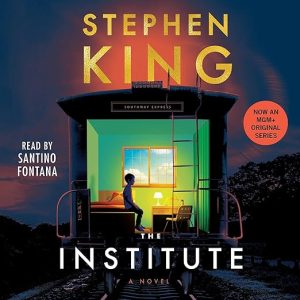
Kalisha's line about the roach motel does more work than any sentence in the description, and it lands differently when a reader has to say it out loud in an audiobook. You check in, she tells Luke Ellis, but you don't check out. Stephen King's 2019 novel about children taken from their homes for their telekinesis and telepathy runs eighteen hours and fifty-nine minutes in Santino Fontana's reading, and the listing carries something most pages on this shelf cannot claim: an award that was given to the recording rather than to the book.
King wastes nothing on the setup. Intruders enter a house on a quiet street in suburban Minneapolis in the middle of the night, murder Luke's parents, and load him into a black SUV. The whole operation takes under two minutes. He wakes in a room built to look exactly like his own, minus the window, on a corridor of doors with other gifted children behind them, and the machinery of the place reveals itself slowly: Front Half, then Back Half, tokens from vending machines for cooperation and something much worse for refusal.
Writing at the end of 2019, one enthusiastic reader put the appeal precisely: the monsters in this one are not supernatural, they look just like you and me, and the children are the heart and soul of the story. That is exactly right, and it is why the book works better than its premise suggests. Mrs. Sigsby and her staff are not demons. They are administrators with a budget and a justification, which is the most frightening thing King has done with an antagonist in years.
What Makes The Institute Worth Hearing
Its strongest reason sits in a line of the copy that most listeners skim past. This recording won the 2020 Audie Award for thriller and suspense. Newspaper quotations sit next to it, from the St. Louis Post-Dispatch and the Boston Globe, and those judge a novel. The Audie does not. It is given to audiobooks, which makes it the rare credential on a product page that is actually about the thing you are buying, and it is worth more here than any of the praise around it.
The novel's architecture also suits the format unusually well. Front Half and Back Half give the story a spatial logic you can hold in your head without a map, and the token economy supplies a running measure of how far each child has been pushed. Institutional procedure, forms and shift changes and euphemism, is dull on a page and quietly awful when spoken aloud in a level voice. Nineteen hours sounds like a commitment until the corridor structure starts pulling.
A five-star filed from Italy in February 2025 says the same thing in six words: it keeps you reading and reading. That is the correct description of this book's engine. It is not a novel of atmosphere or of sentences you stop to admire. The book is a machine built to make you continue, and in audio that translates into finishing chores you had no intention of starting.
Things to Know Before Starting The Institute
The most useful entry on the page splits its verdict into two scores, Story 5 out of 5 and Narration 5 out of 5, and then says nothing further about the second number. That is still the only listener judgment here aimed at the reading itself, and a bare grade is thin evidence. The same September 2025 response carries the page's one real content warning: some readers will not appreciate the political references in the story, though that reader personally did not mind them. Take that as a genuine flag rather than a complaint. King is not being subtle in this book about who he thinks the adults in the room are.
The column's only four-star is worth reading before you commit nineteen hours. Its headline is the whole argument: it won't leave much for you to chew on, but it is still a compulsively readable thriller. That response comes from someone who admits a predisposition toward King and who names Dreamcatcher, Tommyknockers and Gerald's Game as books that did not work, so the qualified praise carries weight. This is a propulsive novel with an ordinary aftertaste, and if you want a book that keeps working on you for weeks afterward, you will finish satisfied and slightly empty.
Prepare yourself for what happens to the children. The description promises punishment that is brutal for those who do not go along, and the book means it. The listing also announces an MGM+ adaptation and reprints award and review copy without ever describing the recording, so almost everything on the page speaks to the novel rather than to the eighteen hours and fifty-nine minutes you would actually be buying.
Who Stephen King Is Writing For
This one lands for listeners who want King in his propulsive register rather than his elegiac one, and for anyone who loved the children of It but has no appetite for a thousand-page reread. The comparison the copy makes to Firestarter is the more accurate of the two: a child with a dangerous gift, an agency that wants it, a chase. It also suits people who like institutional horror, the kind where the paperwork is the monster, and it rewards listening in long stretches rather than fifteen minutes at a time.
Look elsewhere if stories about harm done to children are a line you do not cross, because this one crosses it repeatedly and with detail. Look elsewhere if you want the ambiguity and slow dread of King's quieter work, because this one closes every door on its way out. One more calibration if you are coming purely for the horror label: the terror here is administrative, delivered by adults with clipboards who have decided the arithmetic works out, and that is a colder proposition than a haunted hotel.
Common Questions
Does the 2020 Audie Award apply to this audiobook or to the novel?
To the recording. Audies are given to audiobooks rather than to texts, so the thriller and suspense win named in the copy is a judgment on this production, unlike the newspaper quotations beside it, which review the printed novel and say nothing about how it sounds.
Do all the ratings on this listing reflect the audiobook?
No, and one is obvious about it. A five-star headlined Good print quality reports only that the parcel arrived fast and in good condition. That grade counts toward the 4.6 average across sixty-three ratings while telling you nothing about the story, the reading or the production.