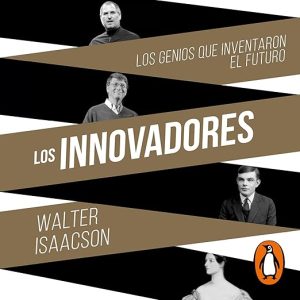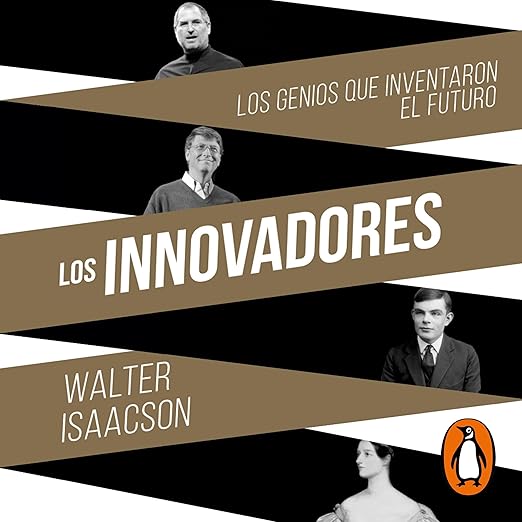
There is a scene that functions as the organizing image for Walter Isaacson's The Innovators: Ada Lovelace, daughter of Lord Byron, sitting with Charles Babbage's mechanical computing engine in the 1840s and writing annotations that constitute the first description of what a computer program could do. Lovelace did not build anything. She imagined something. And she did it in collaboration with Babbage, in correspondence with other mathematicians, in response to a scientific culture that was gradually assembling the conceptual vocabulary she needed. This audiobook, narrated in Spanish by Edson Matus, takes that founding image and builds from it a history of the digital revolution that runs from the nineteenth century to the internet age, and its central claim is that no single inventor made any of it happen alone.
The Spanish-language edition is worth addressing directly. The metadata notes that this audiobook is in Spanish, and listeners who came to Isaacson's work through the English-language Steve Jobs biography or the Einstein study will find the material familiar in structure and intent, but the Spanish production is its own artifact. Matus navigates Isaacson's biographical set pieces, the scenes with Alan Turing at Bletchley Park, Bill Gates negotiating with IBM, Tim Berners-Lee sketching the architecture of the web, with enough dramatic flair to make each figure vivid without losing the connective tissue of Isaacson's argument. At just over nineteen hours, this is an audiobook that asks for commitment, and Matus earns that commitment throughout.
Isaacson's method throughout his career has been to humanize the history of ideas by focusing on the people behind them, their childhoods, their collaborations, their failures, and the social and institutional environments that made specific breakthroughs possible at specific moments. The Innovators extends this method across a wider canvas than any previous book: rather than one life, it tracks a lineage of invention across nearly two centuries. The figures who appear, Vannevar Bush, John von Neumann, J.C.R. Licklider, Doug Engelbart, Robert Noyce, Steve Wozniak, Steve Jobs, Larry Page, among many others, are not treated as isolated geniuses but as members of overlapping networks of influence and collaboration.
The Spanish reviews confirm what the book's American reception established: the content is genuinely compelling across language and cultural context. One Spanish-language reviewer described it as an impassioned account of the great innovators of the digital world, worth reading for anyone who wants a broader vision of what the human mind can achieve. Another found the ebook format flawed but the content captivating, which suggests the audio version, freed from those formatting issues, is the superior way to encounter the material. The narrative structure that works on the page translates naturally to audio, where Isaacson's storytelling instincts, pacing a biographical scene, building to a technological breakthrough, letting the human stakes register before the technical implications unfold, are particularly effective.
Matus Gives the Large Cast Vocal Differentiation
The audiobook format suits Isaacson's method for a specific reason: his books are built around biographical scenes and conversational reconstructions that play better as performed narrative than as text. Matus brings each of Isaacson's key figures to life with enough vocal differentiation to keep the large cast manageable across nineteen-plus hours. The thematic question that the book returns to throughout, what combination of individual talent, collaborative openness, and institutional support produces genuine innovation, is best absorbed over time, and the audio format's temporal dimension suits that kind of cumulative argument.
The Spanish-language production also opens this material to a substantial audience for whom Isaacson's English-language originals are less accessible, and for whom the questions the book raises about creativity, teamwork, and the conditions that produce technological progress have immediate professional and personal relevance. The reviewers' responses suggest that the material crosses cultural contexts cleanly: the excitement about what human minds have built in the digital era is not specific to an English-language audience.
Chronological Portraits Instead of One Deep Biography
Isaacson's scope means that some figures get more attention than others, and listeners who come to the book with particular interest in, say, the early internet period or the personal computer revolution may find the sections on their preferred subjects move faster than they would like. The book is organized chronologically and thematically rather than by depth, so it functions more as a survey with vivid portraits than as a deep biography of any individual. This is not a limitation so much as a design choice, but it is worth knowing: if you want a sustained examination of Alan Turing, for instance, Andrew Hodges's biography remains the reference; if you want to understand how Turing's work connects to von Neumann's and both connect to the engineers at Intel, Isaacson is the right guide.
The third reviewer in the Spanish edition noted formatting problems in the ebook version that distracted from the content. The audiobook is free of that problem by definition, and there is an argument that for a work of this narrative scope, audio is actually the superior format: the connective tissue between biographical episodes is easier to follow when someone is reading it to you than when you are navigating it on a screen.
Nineteen Hours That Matus Makes Feel Less Daunting
This audiobook speaks most directly to Spanish-speaking listeners with professional or personal interest in technology, innovation, and the history of how digital systems came to be, and who want that history delivered as a story rather than as a technical account. Entrepreneurs and people working in technology fields who want context for where their tools come from will find Isaacson's synthesis both accessible and motivating, as the reviewers' responses confirm. Students of history, business, or science and technology will find it a useful orienting survey.
Listeners who want deep technical detail, or who approach the digital revolution as a subject requiring primary sources and academic rigor, will find Isaacson's method too oriented toward narrative and human interest to satisfy those needs. And listeners who prefer shorter audio commitments should know that nineteen hours is a substantial investment, though Matus's pacing makes it feel considerably less daunting than that number suggests.