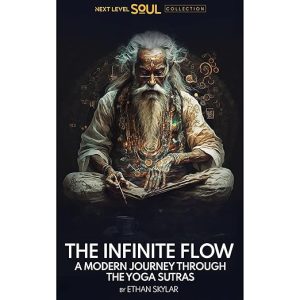
196 Aphorisms Compressed into Under Two Hours
Yoga commentary audiobooks occupy an unusual position in the wellness catalog: they promise ancient wisdom made practical for modern life, and that promise is almost always harder to keep than the marketing suggests. The Infinite Flow: A Modern Journey Through the Yoga Sutras of Patanjali arrives in just under two hours, which immediately sets the scope. Patanjali's Yoga Sutras comprise 196 aphorisms spanning four books, and any guide that covers the full terrain in under two hours is necessarily working at the level of introduction rather than systematic exegesis. Understanding that going in shapes the experience considerably.
The author, Ethan Skylar, belongs to the Next Level Soul Collection series, a publishing framework oriented toward consciousness, personal growth, and spiritual exploration. The audiobook is narrated by Virtual Voice, the AI narrator system, which is a meaningful factor to flag early for any prospective listener. AI narration can deliver information accurately, but the interpretive warmth that teachers of contemplative traditions typically bring to their material, the measured pauses, the sense of someone who has sat with this material for years, is absent from synthetic delivery. For a text built around stillness and interiority, the gap between what the content asks and what the narration provides is wider than usual.
Thematic Chapters Lower the Barrier to Sanskrit
The accessible framing is the book's genuine asset. The Yoga Sutras are dense philosophical material, composed in Sanskrit aphorism form, and their direct translation reads as compressed to the point of opacity for Western readers unfamiliar with the tradition. Skylar's approach, blending the classical teachings with contemporary applications around mindfulness, ethical living, self-discipline, and what the text calls the path to liberation, works to lower the barrier of entry. Chapters move through themes including pranayama, the yamas and niyamas, and meditative states without requiring listeners to arrive with any prior framework.
For beginners in particular, this structure is useful. Rather than presenting the Sutras as a sequential philosophical treatise to be worked through in order, Skylar organizes the material thematically, tying each concept to something a contemporary practitioner might recognize from their physical yoga practice or from broader mindfulness culture. Whether you practice asana regularly or approach yoga primarily as philosophy, the text tries to meet you where you are. Listeners who describe themselves as seekers of personal growth, mental clarity, or deeper self-connection are the core audience, and the book does not pretend to serve anyone else.
Overview Speed Meets Narration That Can't Inhabit It
The brevity is both the book's accessibility and its limitation. Under two hours allows Skylar to introduce the major themes of the Yoga Sutras without the density that might otherwise discourage a newcomer, but it means no single concept receives the development that genuine transformation requires. The text moves quickly through samadhi, through the concept of chitta vritti nirodha, through the ethical framework of the yamas, and because it moves quickly, the listener absorbs an overview rather than a practice. Skylar describes the book as designed for both beginners and seasoned practitioners, but experienced practitioners will find the depth insufficient.
The Virtual Voice narration is worth considering honestly. For meditative and philosophical content, the quality of vocal delivery affects absorption in ways that do not apply equally to all genres. Contemplative material ideally carries a sense of the speaker's own relationship to the content. AI narration is technically competent but delivers equanimity because it cannot do otherwise, not because it has arrived at any understanding. Listeners who find this format sufficient for informational content will manage here. Listeners who expect narration that inhabits the subject may want to seek out a human-narrated alternative or to read the text directly.
Pairs Better with Iyengar Than Standing Alone
The runtime also means this audiobook functions better as a complement to existing practice or reading rather than as a standalone introduction to Patanjali. Listeners who have encountered other commentaries on the Yoga Sutras, whether B.K.S. Iyengar's translations, Georg Feuerstein's scholarly work, or Sri Swami Satchidananda's popular edition, will find Skylar's framing a useful modern repackaging. Those coming to the Sutras cold through this audiobook alone may want to follow it with deeper reading.
It is worth noting that Ethan Skylar's approach reflects a broader trend in contemporary spiritual publishing: distilling classical texts from Sanskrit and Pali traditions into digestible modern frameworks. The Yoga Sutras of Patanjali have attracted this treatment from numerous authors over the past two decades, and the range of available guides now extends from Iyengar's densely scholarly commentary to pop-spirituality repackagings that retain the vocabulary while shedding the philosophical rigor. Skylar's version sits closer to the accessible end of that spectrum, prioritizing clarity and practical application over academic precision. For someone exploring the Sutras for the first time and uncertain whether to commit to a more demanding treatment, under two hours at this level of accessibility functions as a useful orientation.
Yoga Practitioners Get a Brisk Philosophical Primer
This audiobook suits yoga practitioners curious about the philosophical framework behind their physical practice and wanting a brisk, contemporary-language orientation to the Sutras without academic scaffolding. It also works for listeners already familiar with mindfulness culture who want to trace those concepts back to their source tradition. The format, under two hours and explicitly aimed at modern application, makes it a reasonable starting point for spiritual exploration rather than a destination.
Listeners seeking either a comprehensive scholarly treatment of Patanjali or a deeply immersive contemplative experience should look beyond this volume. The combination of short runtime and AI narration limits what the audiobook can deliver in those registers. Approached honestly as an accessible gateway guide, it functions as intended.
Questions Listeners Ask
Do I need prior knowledge of yoga philosophy to get something from this audiobook?
No prior philosophy background is needed. Skylar's approach is explicitly introductory, translating the Yoga Sutras concepts into modern language and contemporary applications that do not require familiarity with Sanskrit tradition.
How comprehensive is this audiobook's coverage of the Yoga Sutras?
At under two hours, coverage is introductory rather than comprehensive. The 196 aphorisms of Patanjali's text are substantial philosophical terrain, and this audiobook works best as a gateway to further reading rather than a complete treatment.
Is this audiobook appropriate for experienced yoga practitioners or only for beginners?
The text claims to serve both, but in practice seasoned practitioners familiar with the Sutras will find the depth limited. It works better as a refresher or starting point than as advanced study material.