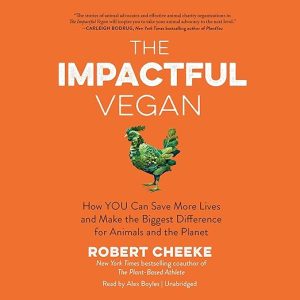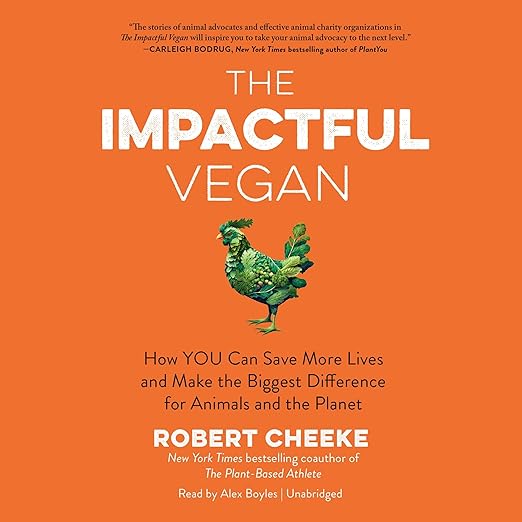
Robert Cheeke's audiobook on maximizing vegan impact lands at a specific and underexplored junction: most people who care about animals know how to feel, but not how to measure. The Impactful Vegan, from the New York Times bestselling author primarily known in vegan fitness and bodybuilding circles, turns out to be a more serious and strategically sophisticated work than his previous output might lead listeners to expect. Cheeke draws directly on the effective altruism movement to build a framework for auditing your own impact, not just for doing something, but for understanding whether what you are doing is actually working. Alex Boyles narrates with the right quality of conviction: he sounds like someone who has read the argument carefully and believes it, which for an advocacy audiobook is exactly the register you want.
An Audit for Which Advocacy Actually Helps
The book's most useful move is its willingness to say that some approaches to promoting veganism and animal rights are not only ineffective but potentially counterproductive. Reviewer Clark, who described decades of vegetarian and vegan living as context for his experience of the book, found this the most striking aspect: that a committed advocate was willing to scrutinize the movement's own methods rather than simply celebrating effort and intention. This is where the effective altruism framework earns its place. The book is not anti-vegan sentiment in disguise, it is an argument that people who care about animals deserve better tools for making a measurable difference than the ones most advocacy culture hands them.
Cheeke's breadth of experience shows in the variety of the material. He covers charitable giving to animal-focused organizations and how to evaluate which ones are making the greatest impact, the role of for-profit vegan businesses as genuine advocacy vehicles, the specific ways that individuals with different resources, time, money, skills, or platform, can identify their highest-leverage contribution. Reviewer Kathleen Gage, who had known Cheeke primarily through his fitness work, noted being surprised by the depth of his animal advocacy experience and the range of organizational relationships he brings to the book. That breadth is real, and it gives the guide a texture that many single-focus advocacy books lack entirely.
Boyles Keeps Eight Hours of Strategy Coherent
The accompanying PDF companion is worth noting for listeners who engage with the book's more data-heavy sections. The audiobook carries all the narrative and argumentative content fully, but any tables, evaluation frameworks, or organizational comparisons that Cheeke provides in visual form will be more useful in the PDF alongside the audio. For listeners who engage with the book primarily as inspiration and orientation, which is how most people will approach it, the audio alone is sufficient and complete.
Boyles' narration handles the pacing of the book's diverse content well. The sections covering vegan influencer strategy and personal brand development for advocates have a different energy than the chapters on organizational effectiveness, and Boyles moves between them without the tone becoming disconnected. For a book that spans from donor evaluation strategy to career alignment to social media advocacy tactics, maintaining coherent energy across eight-plus hours is not trivial, and both the writing and the narration manage it successfully. The chapter on why supporting for-profit vegan businesses matters for animals is one of the most counterintuitive and well-argued sections in the entire book, and it benefits from Boyles delivering it with the right combination of practicality and genuine enthusiasm.
Reviewer Customer noted that the book held attention through its passion, solid information, and fascinating stories of vegan influencers. That combination, structural argument plus narrative illustration, is what makes the book work as a listening experience. Abstract strategic frameworks for maximizing charitable impact would land differently without the stories of people who applied those frameworks and produced measurable results.
Filed as Home and Garden, Built Like Strategy
The book's home genre is listed under home and garden, which reflects something about the commercial categorization of vegan-lifestyle content more than it does about what this book actually is. Listeners expecting lifestyle guidance in the traditional sense, recipes, ethical consumerism checklists, plant-based living tips, will be surprised by how strategic and analytically oriented the content is. That is a pleasant surprise for most, but worth flagging so that expectations align with the actual experience before purchasing.
The effective altruism framework is presented sympathetically throughout, and listeners who have reservations about EA as a philosophy, its prioritization structures, the debates around systemic versus individual change, will not find those critiques engaged with in depth. Cheeke takes the framework as useful and applies it; he is not writing a philosophy text. For readers who want that broader debate, the book would need supplementing with other sources. For those who simply want better tools for making their activism count, the framework is a genuine gift.
Built for Donors Ready to Rethink Their Giving
This audiobook is built for people who are already committed to veganism or serious animal advocacy and want to understand how to make their efforts count more. It is particularly valuable for those who donate to animal charities and have never had a systematic way to evaluate where their money produces the most benefit, for vegan entrepreneurs who want to understand their business as an advocacy vehicle, and for advocates who suspect that some of their current practices may be less effective than they feel in the moment. Listeners who are curious about veganism but not yet committed may find it a motivating listen, though the material assumes a baseline investment in the cause. At eight hours and forty-eight minutes, the book is appropriately comprehensive without overstaying its welcome, and Boyles keeps the energy consistent throughout.
Quick Take
- Narrator: Alex Boyles delivers Cheeke's advocacy with genuine warmth and commitment, the narration feels appropriately earnest for material that is asking listeners to care deeply about what they do next.
- Subjects: Effective altruism applied to animal advocacy, auditing personal impact for animals, vegan business and career alignment
- Tone: Energized and practical, with the drive of an activist who has done the math and wants to share what it means
- Bottom line: A well-researched guide that challenges the assumption that good intentions and high-impact action are the same thing.
A Few Questions About The Impactful Vegan
Do you need to be a committed vegan for this audiobook to be relevant to you?
You will get the most from it if you already have some investment in veganism or animal advocacy, because the book is written as a guide to maximizing impact within that commitment rather than as an argument for adopting it. That said, readers in the early stages of exploring plant-based living or animal ethics will find the framework for evaluating advocacy genuinely useful even if they're not yet fully committed.
How does Robert Cheeke's reputation as a fitness author affect the credibility of this audiobook on advocacy strategy?
Less than you might expect. Cheeke has deep roots in the animal advocacy space, fundraising, sanctuary support, and organizational partnerships, that are separate from his fitness platform. Multiple reviewers who knew his fitness work found the advocacy depth of this book genuinely surprising, and his track record in the movement is longer and broader than his most visible public identity suggests.
Is the effective altruism framework in this audiobook presented critically or is it taken at face value?
It is taken as a useful tool and applied throughout rather than subjected to critical examination. Cheeke uses EA's emphasis on measurable impact and evidence-based giving as a lens for evaluating animal advocacy choices, but does not engage with the broader debates about EA as a philosophy. Listeners looking for a balanced philosophical treatment should supplement; those who want practical application will find the approach productive.