Quick Take
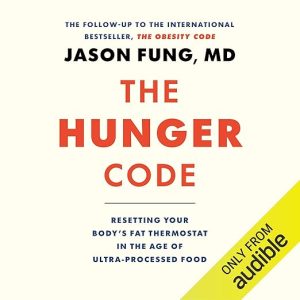
- Narration: Brian Nishii delivers Dr. Fung’s arguments with measured authority, clean professional narration that handles scientific exposition well without losing the book’s conversational register.
- Themes: Physical, emotional, and social hunger; the body’s fat thermostat; breaking the weight regain cycle
- Mood: Evidence-driven and empowering, with an undercurrent of urgency about ultra-processed foods and GLP-1 drugs
- Verdict: A valuable sequel to The Obesity Code that earns its own territory by focusing on why we eat rather than only when, accessible, well-argued, and genuinely timely.
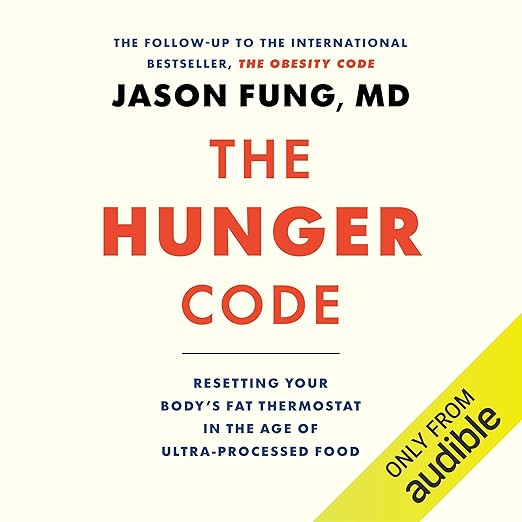
I finished The Obesity Code about three years ago, during a stretch when I was trying to understand intermittent fasting beyond the marketing copy. Dr. Jason Fung’s ability to explain insulin resistance and the hormonal basis of weight gain in terms that hold up to scrutiny without becoming a textbook was, and remains, genuinely impressive. So when The Hunger Code arrived with Dan Buettner’s endorsement and a blurb confirming it as a worthy follow-up, I cleared a few evenings and started from the beginning.
The Hunger Code is a sequel in the most honest sense: it assumes you’ve encountered the core Fung framework, insulin as the central driver of fat storage, the problem with calorie-counting as a weight loss strategy, the case for intermittent fasting, and builds on top of it rather than restating it from scratch. Listeners who haven’t read The Obesity Code won’t be entirely lost, but they’ll get more from this book if they come with the prior framework in place. Brian Nishii’s narration carries Fung’s accessible but precise voice effectively; the book reads like intelligent health journalism rather than either a dry academic text or an oversimplified wellness manifesto.
Three Types of Hunger and Why the Distinction Matters
The conceptual breakthrough at the center of The Hunger Code is Fung’s taxonomy of hunger: physical hunger (the genuine metabolic signal that the body needs fuel), emotional hunger (eating as a response to stress, boredom, anxiety, or grief), and social hunger (the powerful pressure from cultural context, availability, and social norms to eat when you’re not metabolically hungry). This is not a new observation, the emotional eating literature goes back decades, and behavioral economists have documented social eating pressures extensively, but Fung’s particular contribution is showing how all three forces interact with the hormonal system he described in The Obesity Code.
The implications are significant. If weight loss only addressed physical hunger, when you eat and what macronutrients you consume, it would still leave emotional and social hunger largely untouched. This is Fung’s explanation for why dieters who succeed short-term, including those using GLP-1 medications like Ozempic and Mounjaro, frequently regain weight when the intervention ends. The medications address physical hunger powerfully but do nothing for emotional or social eating patterns. It’s a genuinely important point that the current popular discourse around weight-loss drugs often glosses over.
The Fat Thermostat and the Set Point Argument
Fung introduces the concept of the body’s fat thermostat, a biological set point that regulates how much adipose tissue the body attempts to maintain, governed by hormones and metabolic signals. The set point theory of body weight has been in the scientific literature for decades, and its relationship to the hormone leptin is reasonably well-established. What Fung adds here is a clear explanation of how ultra-processed foods, social eating environments, and emotional eating patterns can progressively elevate the set point over time, making sustainable weight loss genuinely harder, not because of moral failure or insufficient willpower, but because the biological target itself has shifted.
This framing is compassionate in a way that’s consistent with Fung’s broader approach and meaningfully different from the standard diet culture narrative that treats weight regain as personal failure. The practical section, three Golden Rules and fifty actionable tips for recognizing and responding to hunger appropriately, follows directly from this analysis, which makes the advice feel grounded rather than arbitrary. Reviewer Stephanie Balch noted that Fung makes hunger feel far more complex than calories or willpower, which is precisely the reorientation the book aims for.
Reading the GLP-1 Moment Accurately
The timing of this audiobook is notable. The emergence of semaglutide and tirzepatide as culturally dominant weight management tools has changed the conversation around obesity treatment, and Fung’s positioning of The Hunger Code in this context is both intellectually honest and commercially savvy. He doesn’t dismiss GLP-1 drugs, their efficacy at reducing physical hunger and producing short-term weight loss is real and documented. But his argument that the drugs fail to address the emotional and social dimensions of eating, and that understanding those dimensions is essential for anyone who eventually goes off medication, is substantively correct and underrepresented in mainstream coverage. The accompanying PDF with additional tips and charts is available in Audible’s library, which is a practical addition for listeners who want to reference the fifty-tip framework in a format they can scan rather than re-listen to.
Who Should Listen, Who Should Skip
Listen if: You’ve read The Obesity Code and want the natural continuation of Fung’s framework, or if you’re currently using or considering GLP-1 medications and want a clear-eyed analysis of what they don’t address. Also excellent for anyone who has experienced the frustrating cycle of successful dieting followed by gradual weight regain.
Skip if: You’re looking for a first introduction to Fung’s thinking, start with The Obesity Code. Or if you want specific meal plans or recipes rather than a conceptual framework for understanding why hunger drives us the way it does.
Frequently Asked Questions
Do I need to have read The Obesity Code before listening to The Hunger Code?
Fung frames this as a sequel, and it works best with the prior context. That said, Nishii’s narration and Fung’s explanatory style mean new listeners won’t be completely at sea. For the full argument, starting with The Obesity Code is worth the time.
How does The Hunger Code address GLP-1 drugs like Ozempic and Mounjaro specifically?
Fung acknowledges their efficacy at reducing physical hunger but argues they do nothing for emotional and social hunger, the other two drivers in his framework. His concern is that patients who stop medication without addressing these other dimensions are primed for weight regain, which aligns with early clinical observations.
Is the accompanying PDF companion worth downloading before listening?
Yes, particularly for the fifty actionable tips section. Audible includes the PDF in your library alongside the audio. It’s useful to have the structured framework in a format you can reference, especially since the tips section benefits from being seen as a list rather than just heard sequentially.
How does Brian Nishii’s narration compare to hearing Dr. Fung speak directly in interviews?
Nishii brings a measured, authoritative tone that suits the material well. He doesn’t attempt to impersonate Fung but delivers the scientific content with clarity. Listeners familiar with Fung’s own speaking style from YouTube or podcast appearances may prefer hearing the author directly, but Nishii’s production is clean and professional throughout.