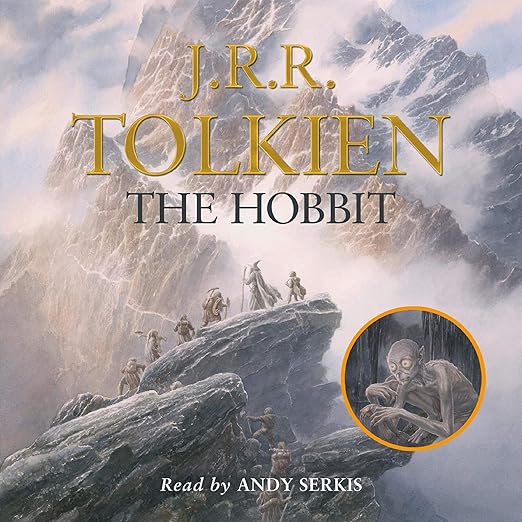
Andy Serkis reads the whole of The Hobbit here, unabridged, ten hours and twenty-four minutes of it, and that single fact is what this audiobook is for. HarperCollins issued the recording in September 2020, and the description leads with the credit rather than with the story, naming Serkis as a BAFTA award-winning actor, director and author before it gets anywhere near Bilbo Baggins. That ordering is correct. The novel has been selling since 1937; the variable in this particular purchase is who is speaking.
The Review
Bilbo Baggins wants nothing from anybody, which is the joke the entire story runs on. A hobbit whose ambitions reach as far as his own pantry finds a wizard and thirteen dwarves on the doorstep and a proposal to rob a dragon, and the description is right to describe the journey as there and back again, because the return trip is the part that carries the meaning. Tolkien wrote a children's adventure that turned into the entrance to the twentieth century's most imitated invented world, and the friction between those two facts is audible in nearly every chapter.
Ten hours and change is close to the natural spoken length of this story, which is not true of every classic that gets recorded. The chapters are episodic, the pacing runs on arrivals and departures, and the telling keeps pausing to explain hobbits to somebody who does not yet know what one is. That address to a listener rather than to a reader was in the text from the first page. An audio edition does not have to argue for its own existence here; it recovers something print has been muffling for decades.
Why The Hobbit Works as an Audiobook
Seventeen months before this recording existed, an April 2019 response made the case for the book more precisely than the marketing does. It prefers The Hobbit to The Lord of the Rings on grounds of proportion, praising setting description that stays the right size, picking out the goblin tunnels of the Misty Mountains and the gloom of Mirkwood, and crediting Bilbo's internal monologues with doing the character work. That is a text appraisal rather than a listening report, and it names the thing a reader has to carry across the whole file: interior comedy, not spectacle.
Thirteen dwarves is the number that ought to worry anybody casting this book. They arrive as a group, they are separated mostly by name and by small habits, and a solo reader has to make a crowd scene function without a crowd. Add a wizard, a hobbit who keeps talking himself out of things, and a dragon the copy calls Smaug the Magnificent, and the assignment across ten hours becomes a register problem rather than an accent problem. Serkis is credited as a director as well as a performer, an unusual pairing on a solo reading, since directing is normally the work of shaping other people's choices. Sample the dragon material rather than the doorstep chapter.
Children are still the audience this was written for, whatever the fantasy shelf has done with it since. The comedy is broad, the danger resolves, and the telling is patient with a listener who needs things explained twice. A family working through it a chapter a night will find the episode structure cooperative rather than demanding. Adults returning after a long gap should expect a lighter tone than memory usually reports back.
The Caveats
Five written responses sit under this listing and not one of them concerns this recording. The most recent English entry runs to six words. Another, from January 2024, carries a title about an eight-year-old's opinion and has no text underneath it whatsoever. A February 2024 response written in French praises the maps, the physical quality of the volume and an interesting little booklet in a deluxe edition, then signs off by saying the reading is still ahead of the writer. None of that is dishonest. None of it is about Andy Serkis either.
Editions are the whole problem, and the oldest entry on the page diagnoses it unprompted. Posted in December 2012, nearly eight years before this recording was made, it opens by warning that reviews of one edition routinely end up attached to another edition's page, then states outright that the subject under discussion is the Alan Lee illustrated paperback, and supplies its ISBN. It is the most scrupulous thing in the column and it is evidence against the column itself. A 4.7 average across seventy-nine grades, on a page whose written portion describes at least two different printed editions, is a number to handle gently.
Nobody should mistake any of that for a verdict on the performance, which may well be superb. It is a warning about the evidence. Anyone choosing between this and another reading of the same text will get no help at all from the aggregate score here, because the material underneath it is grading maps, illustrations and a novel from 1937 rather than a recording made in 2020. The sample is the only instrument on this page that measures what you are actually buying.
The Right Listener for The Hobbit
Households introducing a child to Tolkien have the clearest reason to choose this over a print copy, since ten hours of one voice doing the work covers a great many bedtimes. Adults who know the book well and want an excuse to return should come for the performance rather than the plot, which is the honest case for any new recording of a text this familiar. Listeners meeting Tolkien for the first time as adults will find this the gentlest available entrance, and a great deal shorter than what comes after it.
Owners of a reading they already like can skip this one, because nothing in the text has changed and the argument for a second copy rests entirely on voice. Anyone hoping for the denser mythology should understand that this is the light end of Tolkien, written for children and behaving that way throughout, and that the book it preludes is a different proposition in tone and in scale. Serkis is the reason this edition exists, and grading it on anything else does the recording a disservice.
Key Details
- Performance: The entire reason this particular edition exists, and the one variable the aggregate score on the page is not measuring.
- What it covers: Reluctant heroism, a journey out and back again, greed and dragons, a children's book that founded a genre.
- Feel: Warm, episodic and comic, with the real menace arriving late.
- Our call: The novel needs no defense; judge this purchase on the reading, and judge it from the sample.