Blake J. Harris made his name reconstructing the console wars between Sega and Nintendo, and in The History of the Future he applies the same approach - deep sourcing, novelistic pacing, genuine sympathy for the dreamers rather than the deal-makers - to the founding of Oculus and the revolution that briefly made virtual reality feel not just possible but imminent. The audiobook, narrated by Stephen Graybill across nearly eighteen hours, is an expansive account of how Palmer Luckey went from building VR headsets in his parents' garage to selling his company to Facebook for two billion dollars, and what was lost in that transaction.
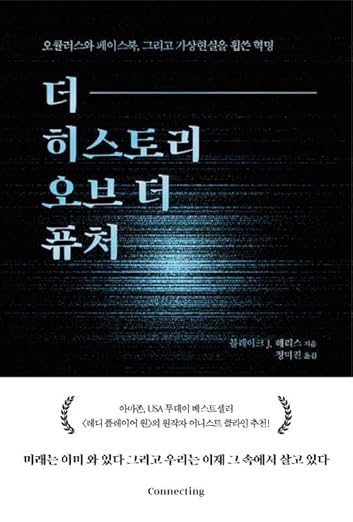
Before continuing: the product synopsis attached to this listing describes a Korean-language edition translated by Jeong Mi Jin. Prospective buyers should confirm before purchasing that they are acquiring the English-language version narrated by Graybill, as there appears to be a metadata discrepancy on this listing that could lead to receiving the wrong edition.
Harris is a skilled popular historian of technology culture, and his method here is consistent with his prior book: get close enough to the key players to reconstruct scenes from the inside, then arrange those scenes to build toward the structural irony that the reader already knows is coming. In this case, the irony is that the company founded on open-source idealism and developer community trust ended up inside the most data-driven corporation on the internet. Harris does not frame this as simple tragedy. He does not let anyone off the hook either, and the Facebook acquisition sequences carry genuine weight precisely because he has spent the earlier chapters making you understand what was being absorbed and why that mattered to the people who built it.
Luckey himself is a fascinating figure to build a narrative around - genuinely visionary, genuinely naive in ways that had real consequences, genuinely likable in the early chapters where his obsession with VR technology reads as pure enthusiasm unclouded by commercial calculation. The Oculus co-founders and the developer community that rallied around the Kickstarter campaign also get substantive treatment. Harris is particularly good at conveying the texture of that early-2010s moment when crowdfunding was new enough to feel like proof that grassroots hardware development could actually compete with corporate R&D.
Highlights
At nearly eighteen hours, this is a substantial audiobook, but Harris earns the runtime by staying close to the human story rather than retreating into technical exposition or business process description. Graybill's narration is well calibrated for the material - he reads the entrepreneurial energy of the early chapters with appropriate forward momentum and handles the more complicated emotional register of the acquisition aftermath without editorializing. He distinguishes between the numerous founders, investors, and developers who populate the narrative cleanly, which matters considerably in a book with this many speaking parts across this many years.
The audiobook also benefits from the depth of Harris's research. He conducted extensive interviews with people inside Oculus before and after the Facebook acquisition, and those firsthand accounts give the narrative a texture that sets it apart from technology journalism assembled from secondary sources. The sections covering the Kickstarter campaign and the early Rift development are particularly alive - you can feel the specific excitement of that period, the sense that something genuinely new was being built by people who were not yet sure it would work and had not yet had to think about what success would cost them.
Harris's earlier book Console Wars established a template that fans will recognize immediately: the small-company dreamers against the institutional machinery, the moments where luck and conviction intersect, the reckoning when the outside world closes in. That template fits the Oculus story even more naturally than it fit the Sega-Nintendo rivalry, because the stakes around Palmer Luckey's vision were not just commercial but philosophical.
What to Watch For in The History of the Future
Listeners should know that Harris's sympathies run clearly toward the Oculus founders and the developer community, and the book's treatment of Facebook and its acquisition logic, while not hostile, does not offer much counterbalancing perspective from the acquiring side. Whether you find this clarifying or one-sided will depend on your prior assessment of the deal. The book is also now several years old, and VR's subsequent trajectory - the mixed reality pivot, the slow consumer adoption curves, the rebranding to Meta - is not addressed. It is a portrait of a founding moment and an acquisition, not a verdict on whether the technology fulfilled its promise.
The runtime is substantial, and some of the corporate negotiation sequences in the second half can feel elongated compared to the kinetic energy of the early hardware development chapters. Listeners who are primarily interested in the technology and the culture rather than the deal mechanics may find those sections require more patience than the first half demanded.
Is This One for You?
This audiobook works well for listeners interested in technology origin stories, startup culture, and the specific history of virtual reality's first major mainstream moment. Fans of Console Wars will find the same quality and approach here - the research is deep, the pacing is strong, and Harris's instinct for where the human drama actually lives keeps eighteen hours from feeling like a commitment you have to justify. Those without strong prior interest in tech history may find the runtime ambitious for the material. Listeners who want to understand how a genuinely idealistic technology company gets absorbed into a corporate structure that runs on entirely different values will find this a precise and unsettling account.
Before You Press Play
- Narrator: Stephen Graybill handles the fast-paced Silicon Valley storytelling with assurance, finding the right register between tech journalism and startup drama without tipping into parody.
- Subjects: startup idealism versus acquisition reality, the race for virtual reality, grassroots hardware culture
- Tone: Propulsive and absorbing, with the undertow of knowing how the story ends before it begins
- Bottom line: Blake J. Harris has written one of the sharper origin stories of the VR era, and the audiobook holds up well - but listeners should verify they are purchasing the English edition, as the synopsis on this listing describes a Korean translation.
How does this audiobook compare to Console Wars by the same author?
The approach is nearly identical - deep sourcing, reconstructed scenes, a sympathetic focus on the dreamers inside the company rather than the deal-making at the executive level. The History of the Future is longer and arguably more structurally complex, but readers who appreciated the texture and research depth of Console Wars will find the same authorial sensibility throughout.
Does the audiobook cover what happened to Oculus and VR after the Facebook acquisition?
Not in any depth. Harris's focus is on the founding, the Kickstarter moment, and the acquisition itself. The book ends around the point when the Facebook deal completes. What happened subsequently with Oculus hardware, Quest, and Meta's broader VR ambitions is outside the book's scope.