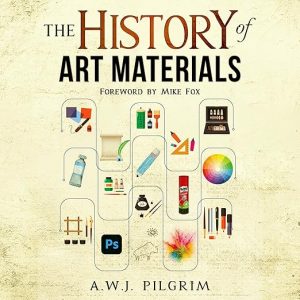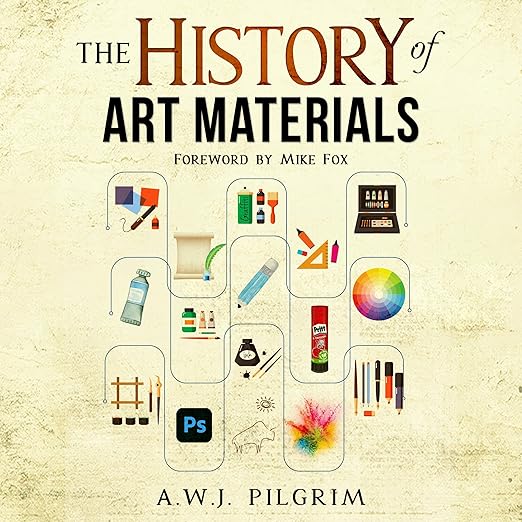
Egg tempera and ground oil paint both come with instructions in this audiobook, which is the first sign that something in the packaging has gone sideways. A.W.J. Pilgrim wrote a chronological history of every art material from Stone Age cave walls to hologram art, illustrated it with paintings and prints made for the purpose, and included recipes you follow with your hands. Then it was recorded solo and released as thirteen hours and twenty-four minutes of talking. A companion PDF is promised, and that PDF is carrying more than it should have to.
From Ochre to Holograms, Compiled by One Person
The scope is genuinely impressive and the organizing idea is simple: work forward through time and give each material a story about how somebody discovered it, made it and improved it. Ochre through to holograms, with conservation and restoration inventions folded in along the way. A five-star response filed from the United Kingdom in February 2020 calls it diligent research into supplies you take for granted, compiled by one person and laid out in a DIY fashion that the same account describes as accessible and fun.
That amateur quality is a feature rather than a defect, and it deserves defending. A commercially edited history of pigments would be smoother and would lose the thing that makes this one worth having, which is a working artist compiling answers to questions that occurred while standing in a supply shop. Curiosity organized by one person has a shape that institutional research does not, and the passages about using the materials personally are where that shows. The foreword comes from the artist Mike Fox, and the page never says who reads it.
Author, reader and publisher are the same name on this listing, which explains both the strengths and the shape of the complaints. Nobody commissioned this and nobody edited it. What you get is unfiltered enthusiasm and a level of detail no house would have permitted. What you do not get is the apparatus a publisher would have insisted on. The catalog entry carries no series, no edition note and nothing at all about how the recording was made.
Chronology Lets a Drifting Listener Rejoin Easily
Chronology is the reason the recording works at all. A book organized as one thing after another survives being heard, because you never have to hold two threads at once, and a listener who drifts for a minute rejoins at the next material without losing anything. A four-star response from January 2022 describes the structure precisely, historical order with each material given a story of how it was discovered, made and developed, and singles out the passages where the author stops narrating history to describe using a pigment in an actual painting.
Half of this book lives in the companion document. Artwork and prints were made to show what each material actually looks like, and the listing promises the file alongside the audio, which is the only route that content has to a listener at all. The honest description of this purchase is a long lecture with a picture book attached, and how well it works depends entirely on whether you will open the file. Anyone listening at the wheel will not.
Then the recipes, which fall into the same trap. Making egg tempera and grinding oil paint are procedures with quantities, sequences and things that go wrong, and a procedure heard once while your hands are busy elsewhere is a procedure you will need to hear again. Nothing about the instructional material is wrong. It is simply in a format that cannot be scrubbed back to, which is why the document matters more here than on almost any other title in this category.
No Bibliography, and Every Review Predates the Recording
One star is the lowest grade here, filed from Canada in September 2025, and the whole complaint is the absence of a bibliography. That account went looking for a list of works cited on the reasonable ground that the book advertises itself for people studying at university, and argues that references to sources, whether books, lectures, broadcasts or websites, are a bare minimum for a reference work. On a self-published history assembled from one person's research, that objection is correct and unanswerable.
Four votes carry it a long way. The displayed average is 3.4, which four whole-star ratings cannot produce: a total of thirteen shows 3.3 and fourteen shows 3.5. The four written grades add up to fifteen, which would show 3.8. So the figure on the page is unreachable from its own pool in either direction, and on a listing this small a single one-star response shifts the average by a full star by itself. Read the four responses rather than the number above them.
Every one of the four written responses predates this recording, the oldest by more than six years, so not one of those grades could have taken the reading into account. Three were filed in the United Kingdom and the fourth in Canada. That matches the sales copy, which recommends the book for College, GCSE, A Level, Foundation Degree and degrees at university, a list of qualifications meaning nothing to most buyers browsing an art shelf in the United States. The book travels. The pitch does not.
Half of This Book Is a Picture
Art students and working painters are the obvious audience, particularly anyone who has stood in a supplier's shop wondering why cadmium costs what it costs. A five-star response from the United Kingdom in January 2020 supplies the shortest recommendation on the page, calling it very informative, full of surprises and great for research, which is a fair account of the transaction. Teachers assembling a materials-and-techniques module will find more here than in any single textbook, provided they open the document.
Walk away from it when citations are the point, because the book supplies none and no amount of enthusiasm substitutes for a source list. Anyone hoping for a critical history rather than an inventory should also look past it, since the material is organized by object and by date rather than by argument, and nothing here asks why one pigment displaced another beyond the fact that it did. And anyone who listens exclusively at the wheel should buy the printed edition instead, because half of what was made for this book is a picture.
Before You Listen
Is this audiobook a reference work or a listen-through history?
A listen-through history that buyers keep trying to use as a reference. The chronological build rewards going start to finish, and the material is absorbing in sequence. Going back later to find what was said about ultramarine is another matter entirely, since the format offers no index, no search and no page numbers.
Does thirteen hours of material history hold up as a listen?
Better than the length suggests, because the structure is a chain of short discoveries rather than one sustained argument. Each material arrives with its own beginning and end. The real risk is sameness across a long stretch, and the personal anecdotes about actually handling the pigments are what break it up.
Is the audiobook worth it if you already own a materials textbook?
Probably, because this is not a textbook. A textbook tells you what a pigment is; this tells you who found it, what went wrong the first time, and what it felt like to grind it. The overlap is factual and the difference is narrative, which makes it a companion rather than a replacement.