Quick Take
- Narration: Sarah Zimmerman reads with quiet warmth that honors the book’s meditative quality without becoming saccharine, a genuine match for Schaeffer’s tone.
- Themes: Creativity as spiritual practice, beauty in the domestic, hospitality as art
- Mood: Contemplative and gently countercultural, like being given permission to slow down
- Verdict: A decades-old book that argues for something contemporary culture genuinely needs to hear, and the audio format makes it easier to absorb slowly.
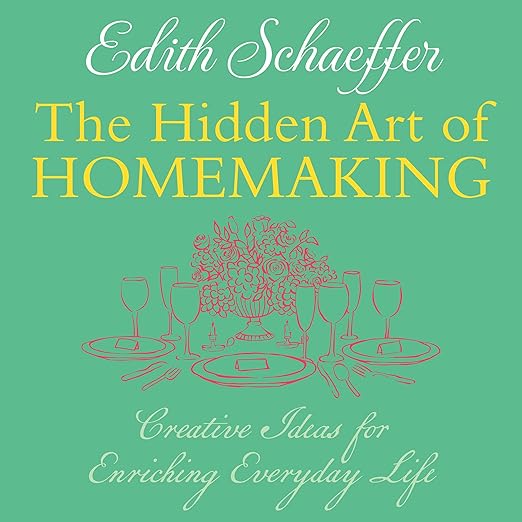
I was not expecting to be moved by a book about homemaking. I want to say that upfront, because the title had always made me assume it was adjacent to the kind of organizational content that circulates on Pinterest with aggressive cheerfulness. A friend who has very different reading habits from mine pressed Edith Schaeffer’s name into conversation twice in a month, so I finally queued The Hidden Art of Homemaking on a quiet Saturday morning with low expectations and an open afternoon. I finished it before lunch.
What Schaeffer is actually writing about is creativity, and what she is arguing is that creativity is not something confined to studios and concert halls and literary fiction. It happens in the way you arrange a room, in the meal you choose to make versus the one that requires least effort, in whether you light a candle before dinner. These are not small things dressed up in large language. Schaeffer genuinely believes, and makes a coherent case, that the artistic impulse belongs to daily life as much as to any dedicated practice.
The Argument Schaeffer Is Actually Making
The book was first published in 1971, and some of its cultural assumptions belong to that moment. But the core argument has a timelessness that comes from its refusal to be fashionable. Schaeffer is not arguing that homemaking is women’s work or that it is the highest calling. She is arguing that wherever you live and however you live there, you can either treat the space with thoughtfulness and creativity or you can treat it as a backdrop. The choice matters, and it matters because it reflects something about how you understand beauty and what you believe it is for.
One reader’s note that the book would be more accurately titled The Hidden Art IN Homemaking gets at something real. Schaeffer is not writing a celebration of housework. She is writing about what the domestic space can be made to carry if you choose to see it as an opportunity rather than an obligation. The chapter on music as a dimension of home life is particularly striking, as is the section on hospitality as a practice that has nothing to do with impressing people and everything to do with making them feel received.
Sarah Zimmerman’s Narration and the Audio Experience
Echo Point Books chose Sarah Zimmerman to read this, and the pairing works. Zimmerman has a voice that is warm without being cloying, and she understands that Schaeffer’s prose operates by accumulation rather than by dramatic peaks. She reads it at the pace the book deserves. There is no hurry in the delivery, which is exactly right for material that is asking you to think about slowing down and attending to things. At five hours and fifty-six minutes, the audiobook feels neither rushed nor padded. Each chapter arrives as a complete thought.
The production from Echo Point Books and Media, an independent bookseller in Brattleboro, Vermont, with audio engineering by Stuart Wise, is clean and careful. This is a book that was produced with attention, which is something you notice in the audio format more than you might in print. There is a difference between a book that was recorded and a book that was produced, and this one was produced.
Where the Book Asks Something of You
Schaeffer writes from an explicitly Christian worldview, and the theological grounding of her argument is not subtle. Beauty and creativity, in her understanding, are reflections of a creative God, and homemaking as art is ultimately a form of worship. Readers for whom this framework is congenial will find the book deepened by its theological roots. Readers who do not share those commitments but are willing to translate the argument into secular terms, creativity as a form of care, beauty as an act of generosity toward the people in your life, will still find most of the book accessible and valuable. Several reviewers have noted that the book works even in translation from its original assumptions.
A new wife who found it helpful for figuring out how to bring life and beauty into a first home is exactly the kind of reader Schaeffer seems to have had in mind. But the book also rewards the reader who is not a new wife, who is perhaps exhausted by whatever version of the harried, efficient life they have built, and who suspects there might be something they have been treating as too small to matter that is actually rather large.
The Listeners Who Will Find It Essential
This audiobook suits people who find themselves thinking about beauty in daily life and wanting a philosophical framework for why it matters. It suits those who feel a gap between how they live and how they want to live, and who have always suspected that gap is not about money or time but about attention. It is not for listeners looking for practical decorating advice or organizational systems. Schaeffer has no interest in that. She is interested in the animating intention behind whatever you do, and that is a harder and more interesting conversation than where to put the throw pillows. The rating of 4.5 from 313 listeners reflects consistent appreciation across very different types of readers, which is the mark of an argument that lands independently of its particular cultural packaging.
Frequently Asked Questions
Do you need to share Edith Schaeffer’s Christian beliefs to get value from this audiobook?
No, though the theological framework is present throughout. Many readers outside the Christian tradition have found the core argument about creativity and beauty in daily life translates readily into secular terms. The book rewards a willingness to engage with the underlying ideas even if you set aside their specific theological grounding.
Is The Hidden Art of Homemaking specifically addressed to women or does it speak to a broader audience?
Schaeffer’s framing draws on assumptions of her 1971 context, but the argument she makes about creative attention in domestic space applies to anyone who keeps a home. Several contemporary readers, including those who came to it skeptically, have found it applicable regardless of gender or household role.
How does Sarah Zimmerman’s narration handle the book’s more philosophical and theological passages?
Zimmerman’s pacing is a particular strength in those sections. She gives the more meditative passages room to settle rather than rushing through them, which is crucial for a book that asks readers to sit with ideas rather than extract actionable advice.
Is this audiobook connected to the L’Abri Fellowship or Francis Schaeffer’s work?
Edith Schaeffer was married to theologian Francis Schaeffer and was co-founder of L’Abri Fellowship. The community’s ideas about art and culture surface in the book’s argument, but The Hidden Art of Homemaking is accessible as a standalone read without any familiarity with L’Abri or Francis Schaeffer’s theological writing.