
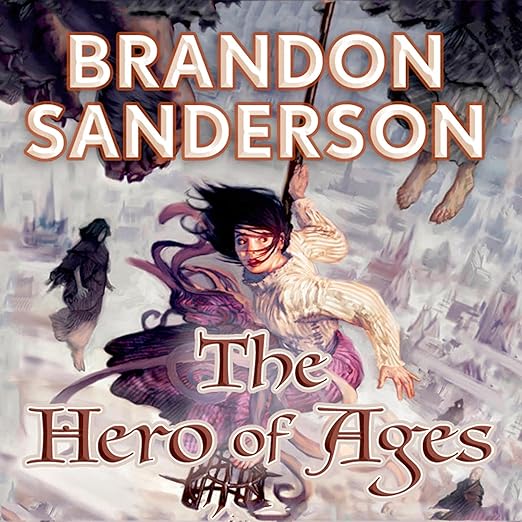
The final volume of a beloved fantasy trilogy is a specific kind of pressure. Sanderson knew going in that The Hero of Ages had to close a system, not just a plot, and after the structural wobble of The Well of Ascension that middle-chapter problem so many trilogies share, the question was whether he could pull the architecture back together without it feeling forced. He does. This audiobook, delivered by Michael Kramer in the same register he has held across all three Mistborn volumes, lands as one of the more satisfying fantasy conclusions I have encountered in a very long time of reading and listening in this genre.
The setup at the start of Book Three is genuinely difficult. Vin has released Ruin from the Well of Ascension, the mists are killing people, ash is falling without stopping, and every system of magic that Sanderson built so carefully in The Final Empire is now operating under catastrophic pressure. What makes this particularly interesting as a narrative challenge is that the enemy, Ruin, is near-omniscient. It can read minds, warp written text, and manipulate individuals without their awareness. Sanderson uses this constraint brilliantly: Vin and Elend literally cannot discuss certain plans without being overheard, which forces the plot into a set of communication puzzles that are as interesting to track as the combat sequences.
Reviewers have consistently praised how this book rewards patience with the earlier volumes. One noted that 'revelations abound, connections rooted in early chapters click into place.' This is accurate but undersells the mechanism: the connections are not just thematic callbacks but structural reveals that change the meaning of events you witnessed in Book One. The atium mystery, the nature of the koloss and kandra, the purpose of the Lord Ruler's decisions, all of these are reframed with information that makes the entire trilogy feel retrospectively more coherent. Sanderson planted the answers early, which is not the same as planting clues that point toward them. The distinction matters because it produces genuine surprise rather than detective-fiction satisfying inevitability.
Kramer Sustains Four Threads Across Twenty-Seven Hours
Michael Kramer has been with this series from the beginning, and by Book Three his familiarity with the cast is audible in small ways that accumulate into something significant. He knows where Vin's hesitation lives, where Elend's rhetorical confidence sits relative to his self-doubt, where Sazed's measured delivery should soften and where it should hold. For a 27-hour production, that consistency is not a minor asset. Fantasy audiobooks of this length live or die on whether the narrator can sustain differentiated characterization across dozens of hours and Kramer demonstrates across the Mistborn trilogy why he is one of the genre's most trusted voices.
The plotting at this scale is dense. Sanderson runs multiple threads: Vin in Fadrex City, Elend's political and military maneuvering, Sazed's crisis of faith as he works through the world's religions one by one, and the kandra subplot that intersects with all of them. The interweaving is handled competently, though some listeners who prioritized the Vin-Elend relationship may find the Sazed sections, which carry much of the book's philosophical weight, to be slower going. My own read is that the Sazed arc is the emotional spine of the volume and the most formally ambitious part of the trilogy, but I understand why some listeners resist it.
Audacious Choices Reward the Reader's Accumulated Trust
The magic system, one of the great pleasures of the original Mistborn, operates differently here. The restrictions have changed, new abilities have appeared, and Sanderson leans into the expansion in ways that feel earned by the story's logic rather than added for spectacle. If you found the allomancy system in Book One to be one of the primary pleasures of the listen, this volume delivers substantially more of it, including revelations about the system's origins that reframe everything you thought you understood about how metals and power interact in this world.
The final act has been called audacious by multiple readers, and the word is appropriate. Sanderson makes structural choices in the last quarter that require trust in the reader's accumulated investment in the world's logic. One reviewer described feeling like they were 'awaking from an amazing dream,' and I found this accurately describes a specific quality of the ending: it is emotionally coherent even before it becomes rationally coherent, which is the rarer achievement. For listeners who prefer clean resolutions over lingering ambiguity, the ending delivers satisfaction. For listeners who prefer their finales weighted toward implication, it may feel slightly tidier than the complexity earned.
The magic system expansion in Book Three is worth discussing separately from the plot mechanics it enables. Sanderson built allomancy in The Final Empire as a tightly bounded system with clear rules, and part of what made the first volume so satisfying was the sense that the rules were fixed and the creativity lay in discovering their implications. Book Three interrogates the system's assumptions in ways that feel organic to the story's cosmic scale. The question the book is partly asking is whether the rules were ever actually fixed, and the answer it provides is more interesting than simple revelation would be.
Exclusively for Readers Who Finished the First Two
Exclusively for listeners who have completed The Final Empire and The Well of Ascension. This is not a series where entry at Book Three is possible in any meaningful sense. Listeners already invested in the Mistborn world will find this audiobook delivers a conclusion that honors the earlier volumes. Those new to Sanderson should begin at The Final Empire, where Michael Kramer starts fresh and the magic system is introduced at the pace it requires. Long-form epic fantasy listeners who prioritize internal coherence and systems-level payoff over pure emotional intensity will find this the most rewarding of the three.
Key Details
- Narrator: Michael Kramer's deep familiarity with the Mistborn cast across all three volumes pays dividends in Book Three. His differentiation of Vin, Elend, and Sazed is precise and consistent across 27 hours.
- Subjects: The cost of power and prophecy, faith under catastrophic pressure, self-sacrifice and identity
- Tone: Dense, revelatory, and building toward an ending that earns its scale
- Bottom line: A rare fantasy trilogy conclusion that retroactively improves the earlier books by revealing what they were actually about, delivered in a production that matches the material's ambition.
Can The Hero of Ages audiobook be listened to without having heard the first two Mistborn books?
No. This is the conclusion of a tightly plotted trilogy with extensive callbacks to events and revelations from Books One and Two. Jumping in here would leave significant portions of the plot incomprehensible. Start with Mistborn: The Final Empire.
How does Michael Kramer's narration handle the multiple POV threads in this audiobook?
Kramer maintains distinct vocal registers for each POV character and differentiates them consistently across 27 hours. The Sazed chapters, which are philosophically dense, benefit from his measured delivery. His Vin and Elend performances carry emotional continuity from the earlier books.
Does The Hero of Ages resolve all the major mysteries set up in the first two books?
Yes, with considerable ambition. The atium mystery, the nature of the kandra and koloss, the Lord Ruler's true purpose, and the origin of the magic system are all addressed. Sanderson planted the foundations of these answers in Book One, so the reveals feel earned rather than invented.
Is Sazed's faith arc in this audiobook worth the pacing shift it requires?
This divides listeners, but I find it the most formally ambitious part of the trilogy. Sazed works through the world's collected religions one by one while his own belief fails him, and the resolution of this arc is what gives the ending its emotional weight. Listeners who find it slow in the middle should continue.







