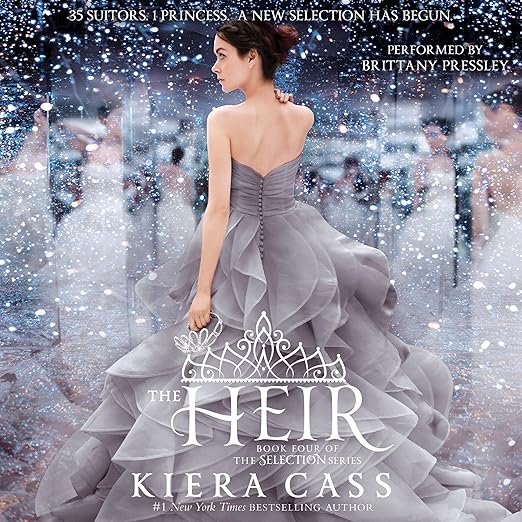
Before You Press Play
- Read by: One credited voice for a first-person princess written to resist you, which is the casting question this record leaves open.
- At its heart: Royal succession, an arranged competition, a protagonist who refuses to be charming.
- Vibe: Glossy, brittle, quietly political.
- Short version: Book four justifies itself if you accept a new lead instead of the old one.
Twenty years pass between the romance that made this series famous and the Selection that opens this audiobook, and that gap is the entire design. America Singer entered the first competition and won Prince Maxon; her daughter Eadlyn now has to hold one of her own, with no intention of repeating her parents' fairy tale. Kiera Cass wrote a sequel that declines to be a rerun, and eight hours and forty-eight minutes later almost every argument about this book still lands on one character.
Where This One Lands
Eadlyn divides the room, and she is built to. A princess raised inside a castle as heir to a throne, with limited contact with anyone her own age, was never going to arrive charming; the real question is whether a reader will extend her the patience they extended her mother. A June 2015 five-star came to the book already braced for disappointment by what other people had written, found the complaints about a selfish, spoiled protagonist unearned, and argued that Eadlyn reads as realistically written for the life she was handed rather than written to be liked.
Sympathy, then, is a design decision here rather than an oversight, and it is riskier than it looks. The Selection worked because America was an outsider with everything to gain. Eadlyn begins with everything and wants none of it, which reverses the engine of the original and asks a listener to enjoy watching somebody be difficult before she becomes interesting. When that lands, it is the most grown-up move the series has made. When it does not, you are several hours into disliking the person whose head you are stuck inside.
Everything else repeats the first book's shape faithfully: a field of suitors, a palace, a schedule of eliminations, a country watching it happen. The description sells the competition as the frame and the personal reckoning as the payoff, which is accurate enough. It also promises a new generation of swoon-worthy characters, and swoon is doing heavy lifting in that phrase, because the format introduces a crowd of young men before it can make any of them distinct. The elimination structure does suit a listening schedule, though: rounds arrive at regular intervals, each one trims the field, and a session that ends on a departure feels finished in a way that chapter breaks in most romance novels never manage.
The Best Parts of The Heir
Ranking is what the written column does best here, and the rankings disagree usefully. November 2025 brought the strongest endorsement on the page, a full decade after release: better, much better, and as good as The Selection itself, from a reader who then signs off hoping for the volume after this one. That is a direct comparison against the original rather than general enthusiasm, which makes it worth considerably more than a stack of adjectives.
Palace politics are the second reason. Eadlyn is the heir, not a candidate, and the book understands the difference: a Selection run by the woman who will eventually rule is a political event with a romance inside it, not a romance with politics for decor. That inversion gives Cass a legitimate reason to keep the country in the room, and it gives the competition consequences beyond who gets a rose. Readers who found the earlier books too enclosed will notice the walls move outward a little. A third pleasure waits for anyone who came through the original trilogy: watching the couple from the first book now running a household and a country, seen from the outside by a daughter who does not find either of them romantic. Cass gets a good deal of comedy and some real ache out of that angle, and it is the part of the book that could not have existed without the twenty-year jump.
What Gives Us Pause
Brittany Pressley is credited with eight hours and forty-eight minutes of a first-person teenage monarch, and not one of the five written responses reaches the recording at all; they are grading a novel, and mostly a printed copy of it. That leaves this page's largest blank sitting exactly where the decision gets made, with the sample as your only evidence about a voice asked to hold a register that is imperious by design, which is among the harder tones to sustain across a full book without wearing on the ear.
Comparison titles are the second thing to weigh. The description sells the book to fans of Divergent, Delirium and The Wrath and the Dawn, three titles built on rebellion, dystopian machinery and mortal danger. This is a palace romance with a competition inside it and a succession question underneath. Expectations set by that comp list are hard to walk back once the first hour makes the actual stakes clear.
Cross-selling closes the description, and it points away from this series entirely: a final line urging you not to miss The Betrothed, a separate royal romance by the same author. On a record whose only series data is a fourth-book placement, ending the copy with a different book's advertisement is exactly how a browsing listener ends up on the wrong page. This is book four of a sequence, and the three that precede it are prerequisites rather than optional background.
The Right Listener for The Heir
Grown-ups are welcome here, and the column proves it. A July 2023 entry from Australia comes from a 41-year-old parent of two who was unsure the series would land and devoured the whole run, praising the characters and the plotting rather than any nostalgia. Teen and young adult is the shelf, and no tag narrows it further, but the appetite this satisfies is the same one that keeps competition television on the air. It does not check identification at the door.
Start elsewhere if you have not read the first three. A 2020 entry from the Netherlands liked this less than the original run yet found the ending satisfying, which is roughly the shape of the consensus: people who loved America's story can enjoy Eadlyn's, provided they let the new voice be new. Anyone who wants the same fairy tale told again will spend the whole file waiting for it. And anyone who cannot tolerate an unlikeable lead for the first stretch should know the book asks for that patience early and never apologizes for asking.
Frequently Asked Questions
Can I start the series with this audiobook?
Better not. The series field places it fourth, and the description opens on a twenty-year jump that assumes you already know who America and Maxon are and how a Selection works. Starting here means meeting the payoff of three books as background detail.
Does the audiobook finish the story or continue into another book?
Nothing here marks this as a finale. It is the fourth entry, and the description frames it as a new era beginning rather than a sequence closing. Treat the ending as a stage in a longer arc rather than a resolution.