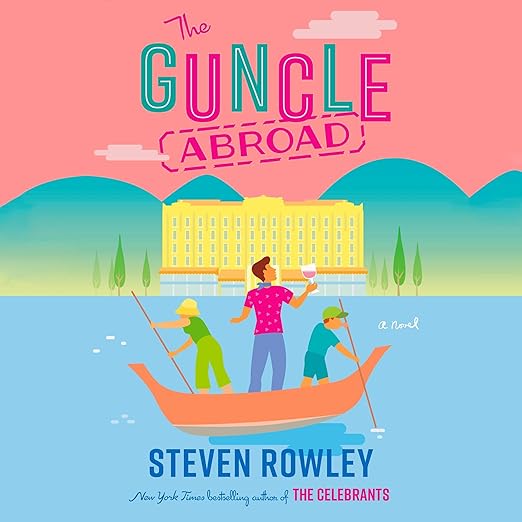
Patrick O'Hara lands in this second Guncle novel at exactly the moment you might expect him to: professionally on top, personally unmoored. The Guncle Abroad audiobook, written and narrated by Steven Rowley, picks up five years after Patrick spent a transformative summer caring for his niece Maisie and nephew Grant following the death of their mother. The children are older now, complicated in the way teenagers are complicated, and Patrick is single again at nearly fifty, his relationship with Emory behind him. What pulls him back into the thick of family life is a wedding, specifically his brother Greg's remarriage in Italy, which neither Maisie nor Grant is thrilled about. Patrick, characteristically, decides to take the kids under his wing and make the journey through Europe something larger than a family obligation.
Rowley's instinct for blending humor and emotional honesty is what distinguishes his fiction, and this audiobook demonstrates that blend working at a high level. The Italy setting is not merely picturesque backdrop. It functions as a pressure cooker, bringing Patrick into contact with a chaotic wedding party that includes a groom with cold feet, his sister Clara running flirtatiously loose among the guests, and a charming soon-to-be launt, the lesbian aunt, who becomes an unexpected rival for the children's affection and attention. The rehearsal dinner disaster is the kind of ensemble comedy sequence that is very difficult to pull off without it feeling manufactured, and Rowley pulls it off because his characters have earned their chaos.
What makes this book more than a pleasant sequel is the way Rowley refuses to let Patrick coast. Five years on, Patrick has resolved nothing about his own life. He has remained close to the children, yes, and he has restarted his acting career, but the things he set aside while holding his family together have stayed set aside. Teaching Maisie and Grant about love while his own romantic life sits empty is the central irony the novel turns over repeatedly and without self-pity. Rowley gives Patrick enough self-awareness to see his situation clearly and enough stubbornness not to fix it, which makes him feel like a real person rather than a comedy archetype.
The laugh-out-loud moments are real and frequent. Reviewers note both the humor and the eye-watering sentiment, and both are present without undermining each other, which is harder to achieve than it sounds. The book was a semifinalist for the Thurber Prize for American Humor, a distinction that recognizes literary comedy of genuine quality, and that recognition is earned. The jokes are built from character rather than situation, which gives them a different texture than the set-piece humor of genre comedy fiction.
Highlights
Rowley narrating himself matters more than it might for some authors. His comic timing in the audio format is excellent. He knows where the pauses belong. He knows when to let a joke land in silence rather than pushing toward the next line. The Patrick O'Hara voice he has developed across two novels is consistent and lived-in, and having the author deliver it brings a certainty about intention that even a skilled professional narrator can only approximate. The emotional scenes, particularly moments with Maisie and Grant as they process their mother's absence against the backdrop of their father's new life, are handled with the same precision as the comic passages. Rowley does not soften them, which is the right call.
At nearly ten hours, the runtime gives the novel room to breathe through its European journey before arriving in Italy. Listeners who want to spend time in the company of people they are genuinely fond of will find the pace comfortable. The book rewards that kind of patient listening, where what matters is not the acceleration toward resolution but the quality of time spent en route.
Before You Commit to The Guncle Abroad
This is a second entry in a series, and while Rowley provides sufficient context that a new listener can follow the story, the emotional resonance of certain character moments depends significantly on having spent time with Patrick, Maisie, and Grant in the first novel. The grief at the center of both books is not explained or re-established in full. It is assumed as shared background, and readers who do not have that background may find some of the more tender sequences less affecting than those who do. The first Guncle book would be worth listening to before this one for the full experience.
The ensemble of wedding characters is enjoyably chaotic but occasionally presses the narrative into sitcom territory, which is not always a problem in a novel that holds humor and pathos together, but listeners expecting a tightly plotted story will notice that the middle section prioritizes atmosphere and character incident over narrative momentum.
Is This One for You?
This audiobook suits listeners who love character-driven literary fiction with a warm comedic sensibility, particularly anyone drawn to writers like Matthew Norman or Tom Perrotta who work in the space where family dysfunction and genuine love coexist without easy resolution. Fans of LGBTQ fiction who want gay characters written with full interiority rather than as representatives of a type will find Patrick exactly that. Listeners new to Rowley should consider beginning with the first Guncle novel to get the most out of this one, but those willing to enter the story here will still find plenty to enjoy in the Italian wedding chaos and Patrick's perpetually complicated self-reckoning.
Frequently Asked Questions
Do I need to listen to the first Guncle audiobook before starting The Guncle Abroad?
The Guncle Abroad can be followed independently, but emotional payoffs tied to Patrick's relationship with Maisie and Grant will carry more weight if you have listened to the first book. The backstory of their mother's death and Patrick's original summer with the children is assumed rather than fully recapped.
Does Steven Rowley narrating his own audiobook work well for listeners who value strong performance?
Yes. Rowley's comic timing is a genuine asset in this format. He delivers both the funny and the tender scenes with confidence, and his familiarity with the character gives the Patrick O'Hara voice a consistency that is difficult to manufacture.
How central is the Italy setting to the audiobook, and does it feel like travel writing as well as fiction?
The Italian setting is vivid and integral to the plot, but the book is not travelogue-focused. The wedding party's European journey serves the character dynamics rather than functioning as a sightseeing itinerary. The setting adds color and pressure to a story that is fundamentally about people.