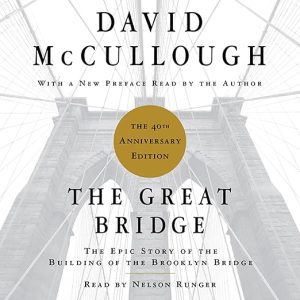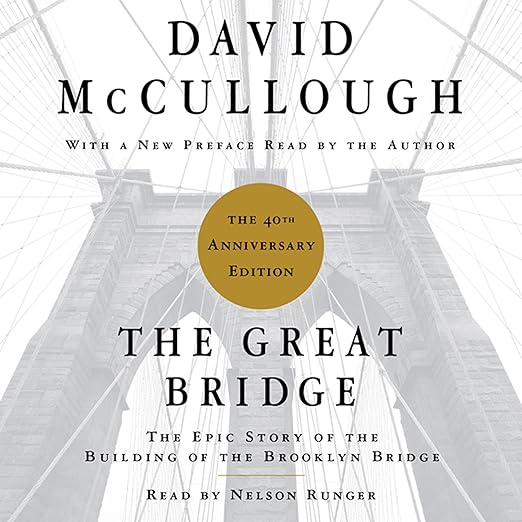
- Narrator: Nelson Runger brings steady, distinguished delivery to McCullough's prose, matching the grand scale of the subject without becoming ceremonial; a good match for 27 hours of historical narrative.
- Subjects: American ambition and perseverance, gender and institutional power, engineering as biography
- Tone: Grand and immersive, occasionally pausing to absorb the scale
- Bottom line: McCullough's command of how to make structural engineering emotionally urgent has rarely been matched, and Runger's narration honors the 27-hour scope without flagging.
David McCullough understood that the Brooklyn Bridge was not primarily a story about steel. The Great Bridge, now available as an audiobook narrated by Nelson Runger, is a 27-hour account of the bridge's construction that is actually a study in what ambition costs the people who carry it. McCullough won the Pulitzer Prize for biographies of John Adams and Truman, and his method is consistent here: he finds the human beings behind the monument and follows them close enough that the engineering specifications become a vehicle for character. The Roebling family, specifically Washington Roebling, who took over from his father John after John's death from an injury sustained during the project's earliest surveys, and Emily Roebling, who became the bridge's indispensable administrator after Washington was incapacitated by caisson disease, are the book's beating heart, and McCullough renders them with the specificity of a biographer rather than the sweep of a historian.
First, the Big Picture
The caisson disease that incapacitated Washington Roebling is the pivot on which the book turns. Compressed air sickness, largely ununderstood in the 1870s, left him mostly bedridden for the remainder of the project's fourteen-year span. From his window overlooking the bridge's progress, he directed construction via written instructions, which his wife Emily then carried, interpreted, and implemented on the bridge and in negotiations with politicians and contractors. McCullough is careful about how he frames Emily's role: she is not presented as a secret engineer, but as someone whose intelligence, social skill, and determination became structurally necessary when her husband could no longer function publicly. Reviewer Barbara, discovering McCullough through The Wright Brothers before returning to this book, calls the story 'powerful,' which is right. Emily's ascent within a project that was not designed to accommodate her is one of the great underappreciated American administrative stories.
The corruption and political machinery of 1870s New York is the book's other major thread. The Tweed Ring, in its terminal years, intersects with the bridge project's financing and contracting in ways that required the Roeblings to navigate a municipal environment where incompetence and fraud were structural rather than exceptional. McCullough documents this without turning it into a thriller; he maintains his characteristic register of steady, admiring historical narrative. But the details accumulate into a portrait of how large American public works actually got built during the Gilded Age, and the accumulation is the argument.
What Makes The Great Bridge Worth Hearing
At 27 hours, this audiobook is a substantial undertaking, and Nelson Runger's narration is what makes it a pleasure rather than an endurance test. He reads McCullough's long, architecturally complex sentences with the right sense of where each one is going, never rushing toward the period, never losing the main clause in the subordinate structure. The effect is of someone who has read the whole book before narrating it and knows which details deserve the emphasis. Reviewer AGravitt identifies that McCullough 'writes with a literary style that is enjoyable but also educational,' which is a fair description of a method that Runger's narration complements well.
The engineering sections are not technically demanding for the lay listener. McCullough translates caisson construction, cable spinning, and anchorage design into terms that serve the narrative without becoming a technical primer. The understanding you gain is sufficient to appreciate what was being attempted, which is the correct level of granularity for this kind of biography-of-a-structure. The book covers an extraordinary range: suspension bridge engineering, New York municipal history, the social world of the 1870s, and the interior lives of the Roebling family. Runger keeps all of it on the same tonal plane, which is the only way to manage such range across such length.
A Few Reservations
The book's treatment of John Roebling's death, killed by tetanus after his foot was crushed by a ferry at the site of the future bridge, is handled with characteristic McCullough restraint. It functions less as a tragedy and more as a structural fact: John designed the bridge; Washington built it; Emily completed it in the public sphere. The three-generation relay structure gives the book an unusual completeness for a work of historical narrative. Watch also for the recurring theme of public skepticism: the bridge was widely doubted before it was completed, and the political attacks on Washington Roebling's fitness to continue directing the project, launched largely because he could not appear in public, required Emily's presence and credibility to deflect. The relationship between public confidence and physical presence is one of the book's quieter arguments.
Who Should Listen to The Great Bridge
Listeners who respond to McCullough's larger body of work, including John Adams, 1776, and Truman, will find The Great Bridge consistent with the qualities that make his books compelling: deep archival research rendered as intimate human narrative, technical material made comprehensible through biography, and a tone that never mistakes reverence for hagiography. The 27-hour runtime is honestly suited to the subject's scale; this is not a book that feels padded at any point in the narrative.
Readers who prefer their history fast-paced or who find methodical archival narrative frustrating will need to approach this book with patience. McCullough does not manufacture urgency; he trusts the material to carry it. For engineering readers hoping for detailed technical analysis, the book provides enough context to appreciate the achievement but not enough to fully understand the structural mechanics as a practiced engineer would. Those interested in the history of nineteenth-century New York more broadly will find The Great Bridge rewards that interest too: the Gilded Age political machinery, the scale of urban growth pressing on the East River crossing, and the social world the Roeblings navigated are all given full treatment across the audiobook's considerable runtime.