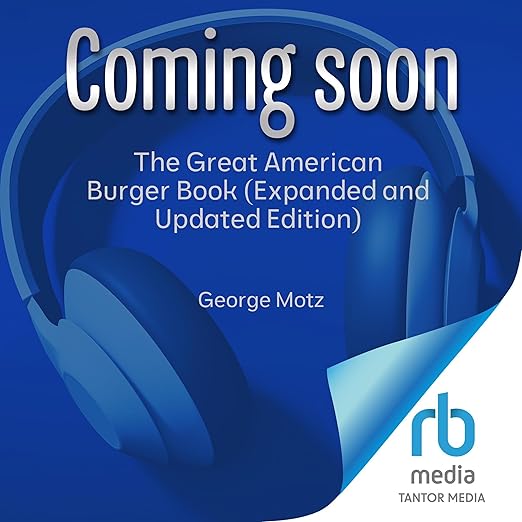
George Motz, the filmmaker and food writer who made his reputation documenting American regional burger culture, brings The Great American Burger Book (Expanded and Updated Edition) to audio and narrates it himself. The craft of this audiobook is inseparable from the voice delivering it: Motz has spent years driving to out-of-the-way diners, befriending short-order cooks, and eating his way through the regional variations that most food media treats as a single undifferentiated category. The authority he brings to the subject is experiential rather than academic, and across 6 hours and 30 minutes of audio, that lived knowledge is consistently evident in how he describes not just what a technique produces but why a specific place or moment generated it.
Connecticut's Steamed Cheeseburger Gets Its Own Geography
What Motz does in this expanded edition that similar cookbooks rarely attempt is insist on the specificity of place. The Connecticut Steamed Cheeseburger is not a curiosity - it is a technique with a particular geography, a set of equipment requirements, and a history that connects it to specific diners and specific communities in ways that no other region replicates. The same holds for the Loosemeat Sandwich from Iowa, which Motz is careful to distinguish from a Sloppy Joe in ways that matter to the people who grew up eating it. The Smashed Burger's origins connect to specific structural arguments about crust formation and fat rendering that Motz traces with genuine enthusiasm. The expanded edition adds international locations - Australia, Brazil, Denmark, Malaysia, Turkey - which broadens the argument that the burger as a form has been genuinely absorbed and transformed by different culinary cultures rather than simply exported as American product. One reviewer describes the book as doubling as a coffee table read alongside a functional cookbook, and that dual character translates imperfectly to audio: the visual component that accompanies the print edition - photographs of the burgers, the diners, the people who make them - is absent in the listening experience. Motz compensates with evocative description, and largely succeeds, but listeners who want to cook from this book directly will want the print or ebook edition alongside the audio for reference in the kitchen. Iowa's Loosemeat Sandwich, Pennsylvania's Fluff Screamer, Houston's Smoked Burger - these come to life in Motz's telling in ways that a recipe card alone could not accomplish.
Maillard Chemistry Lands Better Than Recipe Steps
Motz on audio is most valuable in the historical and cultural chapters that precede each recipe cluster. His explanation of why smoke penetrates a burger differently than it does a larger cut of meat, why a smash patty develops a different Maillard reaction than a loosely formed one, and why the steam table in a Connecticut burger joint produces a specific texture that cannot be replicated by any other method - these are the audiobook's most absorbing passages. The technique explanation translates well to listening because it is essentially demonstration narrated by someone who understands the chemistry behind what they are doing and can locate that chemistry in a specific diner history. The recipe steps themselves are somewhat harder to retain aurally, which is a format limitation rather than a writing problem. Motz's voice does the work it needs to do: he sounds like the expert he is, the pacing in conversational passages is natural, and the genuine enthusiasm never tips into performance. Listeners who have seen any of Motz's documentary work will recognize the same curiosity and generosity toward the people who make these burgers - the attention to the human side of regional food culture is as consistent here as it is in his films.
Brat Burgers Challenge What Counts as a Burger
The Pennsylvania Fluff Screamer and the Sheboygan Brat Burger are two of the more unexpected entries in the American regional chapter, and they illustrate what makes Motz's approach distinctive: he is not ranking burgers, he is documenting them as ethnographic artifacts with the respect that term implies. The Brat Burger, which replaces beef with bratwurst, challenges the definition of "burger" in ways Motz engages with directly rather than dismissing as category error. Similarly, the international chapters raise the question of what constitutes authenticity when a form travels - the Australian burger with beetroot and a fried egg is not an American burger with additions, Motz argues, but a genuinely distinct form that happened to use the same structural vocabulary. These are the moments where the audiobook transcends its cookbook category and becomes something more like a short work of cultural criticism about what regional food traditions reveal about the communities that produced them. The New Mexico Tortilla Burger belongs in the same conversation.
Read the Recipes, Listen for the Culture
Food enthusiasts who cook regularly and want the cultural and historical context behind regional American techniques, not just instructions. Listeners who are content to let recipe steps wash over them aurally and consult the print edition when actually cooking. Home cooks who are ready to move beyond standard grilling and into steam cooking, smashing, smoking, and deep-frying as distinct methods with distinct results and distinct origins. Skip this audiobook if your primary need is step-by-step cooking instruction you can follow in real time - the audio format is a genuine limitation for that use case, and the print edition will serve you better in the kitchen. If you want to understand why American regional food culture is as varied as it is, this is one of the better six hours of listening available in the genre.