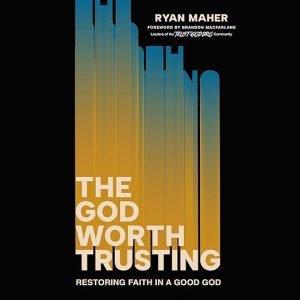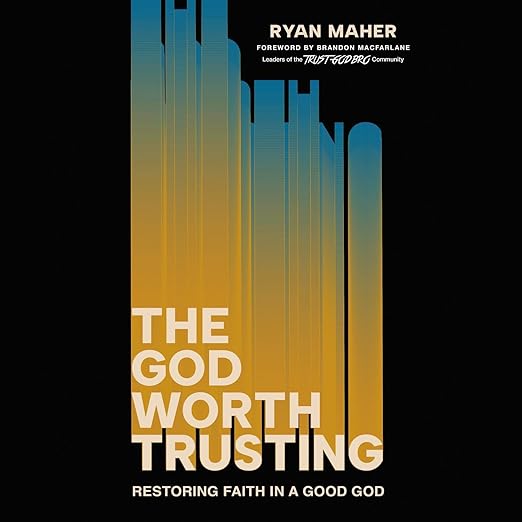
The question The God Worth Trusting addresses is one of the oldest in religious philosophy: how do you trust a God who allows suffering? Ryan Maher does not come to this book as a detached theologian. He is a pastor, a digital ministry leader whose platforms including Trust God Bro and Her True Worth reach an enormous online audience, and someone who describes having encountered gut-wrenching, life-changing pain that made him question everything he believed. That combination of intellectual engagement and personal stake gives the book a quality that straightforwardly doctrinal treatments of theodicy tend to lack.
The audiobook, running six hours and thirty minutes, is narrated by Maher himself. That choice matters. When he moves from the book's philosophical register into personal testimony, the transition is not a gear change; it is continuous. The same voice that establishes the question, how could a good God allow this, is the voice that describes the losses that made the question personally urgent. In pastoral nonfiction, the difference between an author narrating their own work and a professional narrator is often the difference between testimony and performance.
An Honest Path That Still Makes Room for Doubt
Maher is explicit in the synopsis that this is not a book of easy answers. That is not just modesty about the scope of the problem; it is a structural commitment. He does not move through the questions about divine goodness and human suffering toward a resolution that leaves the reader comfortable. He moves toward something he describes as an honest path back: not the absence of doubt, but the willingness to bring doubt into a relationship with God rather than using it to exit the relationship altogether.
The biblical engagement is clear and accessible without being reductive. Maher draws from his own story and from the stories of others he has counseled and encountered through his ministry, which means the abstract questions about theodicy are consistently grounded in specific human situations. For listeners who approach the problem of evil in terms of lived experience rather than philosophical argument, this framing is exactly right. The book is not trying to win a debate about God's existence. It is trying to offer a framework for staying in relationship with God when staying feels impossible.
Maher's Pastoral Address Sustains Six Long Hours
Maher's digital ministry context is relevant to understanding who this book serves best. He writes for an audience that has already moved through the first stage of faith, the inherited belief of childhood or conversion, and is now navigating something more difficult: the confrontation between what they were told God is like and what their own experience of the world has shown them. This is the faith of people who are not losing faith so much as losing their old understanding of it.
The audio format amplifies this dynamic. Maher's pastoral voice, warm and direct without being soft, addresses the listener the way a trusted counselor would in a private conversation. The six-and-a-half-hour length is sustained by this quality of address. This is not a lecture in audio format; it is closer to a series of extended pastoral conversations about the hardest questions the faith encounters.
This Book Assumes You Already Believe
The book works within a specifically Christian theological framework. Listeners who are exploring theodicy from outside Christianity, or who are agnostic about God's existence and approaching the question philosophically, will find the starting assumptions of the book limiting. Maher is not writing for people who are undecided about whether God exists; he is writing for people who believe, or want to believe, and are struggling to reconcile that belief with their experience of suffering.
Because this title had no public reviews at the time of writing, with a May 2026 release date, the response from readers and listeners is not yet available to draw on. The book's quality must be assessed through its argument and its narration rather than its reception. What can be said is that Maher's platform gives the book a natural audience of millions who follow his ministry, and the theodicy question he addresses is genuinely urgent for that audience.
Pastoral Comfort for Grief-Driven Crises of Faith
This audiobook is most directly relevant to Christian listeners who are experiencing a crisis of faith connected to personal suffering, or who are accompanying someone through such a crisis and looking for resources that do not offer cheap consolation. It is also valuable for pastors and ministry leaders who work with grieving or doubting congregations and want a model for how to hold the questions seriously without abandoning the faith.
Listeners approaching theodicy from a philosophical rather than devotional perspective will find the book less satisfying, since it does not engage with the formal philosophical arguments around the problem of evil in the way that, say, Alvin Plantinga or John Hick do. But as a pastoral treatment of the question, written by someone who has sat with the suffering that makes the question urgent, it offers something the philosophical treatments cannot: the credibility of someone who has been there.
A Few Questions About The God Worth Trusting
Does The God Worth Trusting address the problem of evil philosophically, or is it primarily a pastoral book?
Primarily pastoral. Maher engages with the theological questions seriously but grounds them consistently in personal stories and biblical narrative rather than philosophical argument. Listeners expecting engagement with Plantinga-style free will theodicy or formal philosophical treatments will find a different kind of response here.
Is this book appropriate for someone who is not a Christian but is questioning belief in God?
It is written within a Christian framework and assumes the reader is oriented toward Christian faith rather than evaluating it from outside. Listeners who are agnostic or exploring multiple traditions will find the book assumes commitments they may not yet hold.
How does Ryan Maher's digital ministry background shape the tone of the audiobook?
Significantly. Maher runs platforms including Trust God Bro and Her True Worth that reach hundreds of millions monthly, which means he writes for people in active, unresolved faith struggles rather than for an academic audience. The book's tone is conversational, direct, and emotionally intelligent in ways that reflect pastoral rather than scholarly training.
Is the narration effective given that Maher is not a professional audiobook narrator?
Self-narration by pastors and ministry leaders can go either way, but Maher's extensive experience speaking publicly for his digital platforms means his vocal delivery is practiced rather than amateur. The warmth and conviction that make his ministry effective come through in the audio recording.