Percentages belong to e-readers, not to audio, so a written response reporting that the book ends at 85 percent with the rest given over to sample chapters is describing a file with a progress bar, not this recording. It is still the single most practical warning on the page. If those appended excerpts came across into the audiobook, an eight hour twenty-eight minute runtime would contain rather less story than the number implies. Nothing on this listing confirms either way, and the gap between the two possibilities is worth about an hour of your evening.
What K.L. Slater Delivers
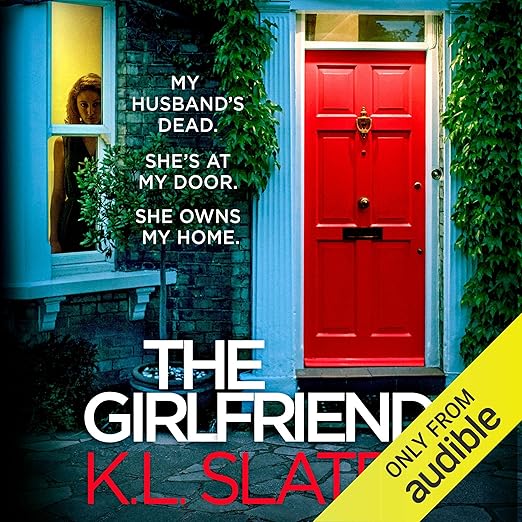
A doorbell rings days after a sudden death, and the woman on the step has a diamond bracelet matching the widow's own and a baby on her hip. She is the husband's girlfriend, the baby is his son, and she owns the house. K.L. Slater sets that up in the first two minutes and then spends eight hours making you live inside it. As openings for domestic thrillers go, it is close to unimprovable: no mystery to solve, just an intolerable situation you cannot look away from.
Two of the written responses supply names the blurb withholds. The description is told entirely in first person, so the dead husband and the surviving wife go unnamed throughout, while readers refer to them as Cole and Jennifer without hesitation. That gap between the marketing voice and the reading experience is a small thing, but it tells you the book itself is not coy. Whatever the copy is doing with its anonymous I, the novel names its people and gets on with it.
Eight hours and twenty-eight minutes is a well-judged length for this kind of story. Domestic thrillers live on escalation, and past ten hours the escalation starts repeating itself. Several responses use the phrase fast paced, and one calls it a perfect sink your teeth in domestic thriller, which matches the runtime. Two sessions, three at most, and the situation on that doorstep has resolved itself one way or another.
Objects do the heavy lifting in that opening scene, and Slater knows it. A diamond bracelet identical to the one the widow already wears. Silver-framed family photographs on a wall the stranger is quietly appraising. A small daughter hiding in her mother's skirts while a baby boy sits on the visitor's hip. None of it is stated as a threat and all of it is a threat, which is the exact register a psychological thriller wants in its first five minutes. Read aloud, the effect sharpens, because the inventory arrives at the speed a voice delivers it rather than the speed an eye skips it.
What K.L. Slater Gets Right
Clare Corbett holds the entire credit alone, which for this particular book is a structural choice worth thinking about. Nearly every scene puts two women in one house, circling each other with maximum politeness and minimum trust, and a single reader has to keep them apart with nothing but pitch and pacing. Full-cast productions make that easier and lose the claustrophobia. One voice doing both sides of a standoff is arguably the truer fit for a story about a house that has become too small.
Domestic thrillers have a specific pleasure, which is watching an ordinary living room turn into a battlefield without anyone raising their voice, and this premise supplies that immediately. The copy positions it beside Gone Girl, The Girl on the Train, and the work of Lisa Jewell, and names Slater as the author of The Marriage. Comparisons in publisher copy are aspirational by nature, but the shape here really does belong to that shelf: unreliable domestic space, a woman nobody quite believes, property as the weapon.
Nine votes must total exactly thirty-eight of a possible forty-five, and the five visible grades run five, four, five, three, and four, which comes to twenty-one. That leaves seventeen points spread across four people who did not write anything, and those four are grading it almost exactly as the visible five did. The unseen half of this rating is not hiding a wave of disappointment. The score you can see is the score that exists.
Where K.L. Slater Loses Some Ground
That three-star response is also the earliest on the page, dated about three weeks before this recording was published, which tells you it was written about the text, with the performance nowhere in it. Its two complaints are specific. The author, it says, took the easy way out with the main antagonist, and the story could have been five stars but fell short in more ways than one. Coming from the only dissenting grade, that is the review to read twice before buying.
The most common reservation across the column is not the premise but the resolution. Two of the five flag something: an antagonist handled too easily, a main character described as frustratingly slow on the uptake, and a middle stretch that dragged. None of that stops any of them recommending it, and every complaint arrives attached to four or five stars. Adjust your expectations for the final act; the setup is what nobody disputes.
Filed under literary fiction and under thriller at the same time, this record sends a slightly mixed signal about what it is. The tags say genre fiction and thriller and suspense, the blurb says psychological thriller, and the double-listing may put it in front of readers expecting prose-first literary work. It is not that. It is a fast, plot-driven commercial thriller and perfectly happy to be one, so calibrate before you press play.
Who Should Pick Up The Girlfriend
Anyone who reads domestic suspense for the situation rather than the puzzle will find this an efficient eight hours, especially listeners who want a self-contained story with no series homework attached. It suits a couple of long sessions where the discomfort has room to build. Readers who want a tidy, well-earned villain will leave annoyed, since that is precisely where the dissenting response lands, and anyone who needs the ending to be as strong as the opening should treat that warning seriously.
However you land on the resolution, the first hour is genuinely hard to switch off. The last quarter is where this one either holds you or loses you, and the page is unusually honest about which way that went for at least one reader.
A Few Questions About The Girlfriend
Did the sample chapters readers complained about make it into the audiobook?
Unknown from this listing. One response describes a digital edition that finishes early, with excerpts from other titles filling out the remainder. Whether those extras were carried across into this recording is stated nowhere in the listing, so the eight and a half hour figure may cover somewhat less story than it suggests.
What does the narration credit tell me about this audiobook?
Clare Corbett is listed as the sole performer, so one voice covers both women in a story where they share nearly every scene. No second reader and no full-cast production is indicated. None of the five written responses discusses the reading, so the credit itself is the only information available.
Are the twists in The Girlfriend genuinely surprising?
Most readers who posted say yes, using phrases like awesome twists and constantly kept guessing. The dissent concerns the resolution more than the surprises: one three-star response argues the author took the easy way out with the main antagonist, which soured an otherwise strong domestic thriller for that reader.