
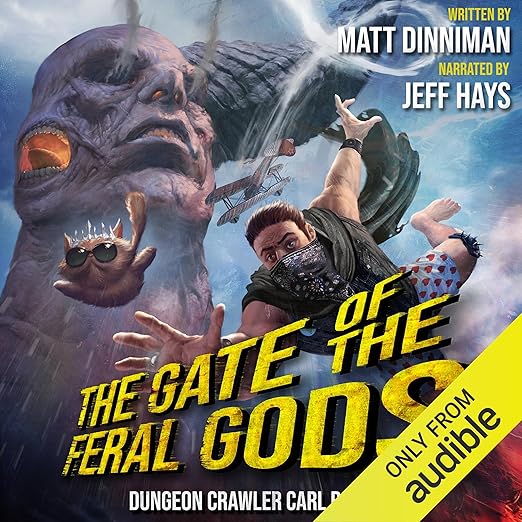
Failing a quest inside five minutes earns you an achievement in this world, and that single detail tells you the tone before the audiobook has cleared its first chapter. 'New achievement! Total, utter failure,' the description announces, in the flat congratulatory register of a system that enjoys watching people suffer. Matt Dinniman's fourth Dungeon Crawler Carl book runs eighteen hours and three minutes on that joke and everything it costs, and the joke holds up because the dying underneath it is not a joke at all. A floating fortress held by warrior gnomes. A castle made of sand. A derelict submarine guarded by malfunctioning machines. Four of those, one bubble, fifteen days.
Casual Reminders That Rescue a Complex Plot
Book four is where the series stops being a stunt. One crawler on this page admits to having 'struggled with book 3, but wow did this turn it around,' calling this one 'engaging, funny, creative and with strong character development' and singling out a craft habit worth naming: the author 'cleverly reminds of you key points casually through the book.' That last observation, typo and all, identifies the exact problem a fourth volume of a mechanics-heavy series has to solve, and the problem bites harder in audio than in any other format.
Consider what a listener is carrying by this point. Floor rules, class abilities, a cast of crawlers, a corporate entertainment apparatus broadcasting the whole thing, and an accumulated pile of coined vocabulary that the books treat as ordinary language. A reader can flip back to check what a term meant. A listener cannot, practically speaking, and a series that requires lookups would collapse in this format. Dinniman writes as though fully aware of that, folding reminders into dialogue and announcement text rather than parking them in exposition, and it is the single biggest reason these books work as well as they do out loud.
Structure here is unusually clean for the series. Carl and his team land on the fifth floor inside a sealed bubble containing four castles, each of which must be taken before the stairwell opens, and they cannot do it with their own crew. They need the low-level survivors trapped in there with them, described in the book's own phrasing as the I-can't-believe-these-idiots-are-still-alive crawlers. Whether those people can be trusted is the engine of the whole volume.
Four Castles Keep Eighteen Hours From Sagging
Dinniman's real trick is that the mechanics are not decoration. One response frames it as 'escalating stakes and clever game mechanics,' crediting the book with keeping the humor and character moments intact while the action intensifies and with 'expanding the world while deepening the emotional payoff.' That balance is the series' whole proposition. Strip out the stat inflation and you have a story about people being murdered for ratings; strip out the grief and you have a spreadsheet with jokes. Book four holds both, and the four-castle format gives it a natural rhythm of setup, assault, and cost.
Eighteen hours is also a lot of runway for a comedy to run on, and it does not thin out. The quadrant structure means the book resets its problem four times with different terrain and different allies, which keeps the middle from sagging the way middle volumes usually do. Each castle is a fresh puzzle with a fresh failure state, and the fifteen-day clock supplies a deadline the earlier floors did not have. That combination of hard limit and repeated setup is what a long serial needs to stay propulsive, and it is why this volume gets recommended as the one that fixes whatever the previous one broke.
Book Four's Steep Entry Cost and Its Whiplash
Start with the obvious warning: this is volume four and it behaves like one. The most thorough response on the page opens by stating flatly that it is the fourth book in the series and that they bought it on audiobook, then proceeds to describe Carl and Donut on Level 5, the bubbles, and the four castles that must be won before a team can leave the quadrant. Every one of those nouns is meaningless cold. Nothing about this entry is designed as an entry point, and starting here would waste both the jokes and the deaths.
Tonally, the other thing worth weighing before you commit is whiplash. The series runs on gallows comedy, and responses reach for 'crazy storyline that keeps you laughing' in the same breath as strong character development, which is accurate but incomplete. Dinniman is willing to kill people you like, and to make the killing funny first and devastating about ninety seconds later. Anyone who bounces off that kind of gear change should treat it as the real content warning here, more than the violence itself. The description sets the register in its own opening breath, congratulating you on failing a quest as though total, utter failure were an accomplishment worth logging. That is funny until you notice it is also the tone in which people are being counted as they die.
Series Veterans and Fans of Heist Plots
Existing crawlers are the obvious audience, and the ones who wobbled on the third volume are the specific one. Beyond them, it suits listeners who enjoy heist structure, since taking four fortified positions with unreliable help is heist logic wearing a fantasy costume. A four-star response reports that the story 'continues, and it does not disappoint,' crediting 'good action and humor' and a storyline that is 'developed,' which reads as a fair temperature check on the column as a whole.
Give this a miss if game systems in fiction irritate you, because the numbers are not background decoration here, they are plot machinery. Likewise for anyone who wants their fantasy dignified, since the book is profane, frequently silly, and entirely unembarrassed on both counts. Should you not have done the first three, buy those instead. Nothing across eighteen hours will land properly without them, and the series is good enough to be worth taking in order rather than sampled at whichever volume somebody happened to recommend.
Can you start the Dungeon Crawler Carl series with this audiobook?
Really not advisable. This is volume four, and reviewers describe it using floor rules, character histories, and a running scoring system established across the first three books. The emotional payoffs depend entirely on time already spent with Carl and Donut, so beginning here throws away most of what makes it land.
Why is this audiobook filed under horror and literary fiction?
The category tags on this listing sit oddly. Dungeon Crawler Carl is LitRPG, a genre built on visible game mechanics inside a narrative, and the listing carries no tag saying so. Horror captures the body count and the dread, but literary fiction and mystery are poor descriptions of what a listener actually gets.







