Quick Take
- Narration: Scott Merriman delivers a confident, engaged reading that suits the book’s essayistic and conversational tone. He handles the business case studies fluently without overworking the more provocative arguments.
- Themes: Liberal arts in the tech economy, interdisciplinary innovation, the myth of STEM supremacy
- Mood: Contrarian and optimistic, with the energy of a well-argued TED talk
- Verdict: A persuasive and well-researched counterargument to the coding-is-everything narrative, though listeners should note this was published in 2017 and some of the company examples have aged differently than Hartley anticipated.
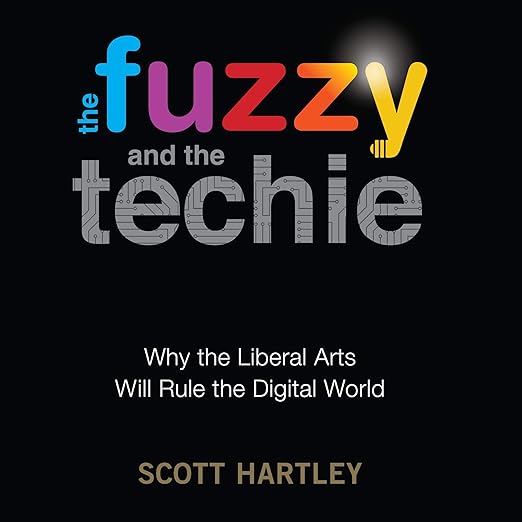
I remember exactly when I first heard the fuzzy/techie distinction that Scott Hartley takes as his starting point. I was at a conference in 2014, and a venture capitalist on a panel was explaining, with complete confidence, that hiring humanities graduates was a waste of resources. The room largely agreed. The Fuzzy and the Techie is the extended, evidence-based argument I wish I’d had in my pocket at that moment.
Hartley is a venture capitalist himself, which gives his contrarian position unusual credibility. He’s not defending the liberal arts from the outside. He’s arguing from inside the machine that the machine needs what the fuzzies bring. His Stanford background adds texture: he experienced the techie/fuzzy divide firsthand, saw how the informal categorization shaped career expectations and self-selection, and went looking for evidence that the assumptions behind it were wrong.
The Counterintuitive Case at the Heart of the Book
The book’s central argument unfolds across case studies of companies and individuals where liberal arts education or humanities thinking drove significant technological or business innovation. Hartley is careful not to argue that technical skills don’t matter. The argument is more specific: that the framing of innovation as primarily a technical challenge misidentifies where the hard problems actually are. Identifying which problems are worth solving, understanding the human contexts in which technology will actually operate, communicating across disciplines, managing the ethical dimensions of powerful systems, these are the domains where fuzzies contribute most, and they are systematically undervalued.
The collaboration argument is where the book is strongest. Hartley documents specific partnerships between technical developers and people with social science, philosophy, and design backgrounds that produced innovations neither could have reached alone. These are not soft-skills parables. They are accounts of products that would not exist without the fuzzy contribution, and the evidence for this is traced with enough specificity to be persuasive rather than anecdotal.
The Financial Times Prize Context
The book was a finalist for the 2016 Financial Times and McKinsey Bracken Bower Prize, which recognizes the best business book proposal by a young author. That framing is worth keeping in mind: the book reads like a well-executed argument developed with institutional backing and editorial attention. The research is genuine, the case studies are researched rather than invented, and the writing is considerably more disciplined than most management books in the innovation genre.
Scott Merriman’s narration suits this register. He reads the material as advocacy with evidence rather than polemic, which is the right tone for a book that is genuinely trying to persuade skeptics. He gives the case studies clarity without over-dramatizing them.
A Note on the Book’s Age
This was published in 2017, and some of the company examples Hartley uses as evidence for his argument have had complicated subsequent histories. Companies cited as models of fuzzy-techie collaboration have since been acquired, pivoted, or run into exactly the ethical and human-factors problems Hartley worried about. This is not an argument against the book’s thesis; if anything, the cases where the human dimension was neglected after the founding period support Hartley’s broader point. But listeners should engage with the specific examples as illustrations of a principle rather than as current models to emulate.
The forward-looking sections on education and the case for liberal arts in university curricula have aged better. The arguments about what students need from higher education to participate in the tech economy remain current, and the debate about whether coding should be a universal requirement has continued to evolve in the directions Hartley anticipated.
Frequently Asked Questions
Is this book arguing against learning technical skills, or for something more nuanced?
It’s a nuanced argument, not an anti-STEM position. Hartley does not argue that technical skills are unimportant. He argues that the assumption that technical skills alone are sufficient for innovation is incorrect, and that liberal arts graduates bring capabilities in problem framing, ethics, communication, and user empathy that are systematically undervalued in hiring and institutional culture. The book advocates for collaboration and interdisciplinarity, not for choosing one track over the other.
How does the book hold up given it was published in 2017 and the tech landscape has shifted significantly?
The core thesis holds well, and some subsequent developments have reinforced it: the rise of AI ethics as a field, the growing recognition that autonomous systems require humanistic input to deploy responsibly, and the documented failures of technology built without adequate user research all support Hartley’s argument. Some of the specific company examples have complicated histories, so they’re better read as period illustrations than current models.
Is this book relevant for students trying to decide between a technical and a humanities degree?
Yes, and this may be its most useful audience. The book provides both the theoretical framework and the concrete examples to counter the conventional wisdom that only STEM education leads to tech careers. It argues that the combination of technical literacy with humanistic reasoning is more valuable than pure technical depth, and that liberal arts students who engage with technology are well-positioned rather than disadvantaged.
What is Scott Hartley’s own background, and does his venture capital career affect the credibility of his argument?
Hartley studied political science at Stanford before working at Google, Facebook, and in venture capital. His background as an admitted fuzzy who succeeded in highly technical environments gives the book credibility it wouldn’t have from an academic author. His VC experience means he’s evaluating companies for a living, and his argument that the best companies tend to involve both technical and humanistic thinking is grounded in professional observation rather than academic theory.