- Narration: Ray Porter handles the vigilante thriller register with his characteristic combination of controlled menace and occasional weariness, making Chris Walker's disillusionment land with physical weight.
- Themes: institutional betrayal, outlaw justice, the opioid crisis as personal catastrophe
- Mood: Propulsive and morally unsettled, with the cadence of a Western filtered through contemporary thriller pacing
- Verdict: Jack Carr and M.P. Woodward launch a new vigilante series with a compelling lead and a premise built around the institutions that fail ordinary people in specific, documented ways.
Chris Walker is standing at the edge of ending his life when the phone rings. That call is the event that sets the entirety of The Fourth Option audiobook in motion, and Carr and Woodward engineer it with deliberate economy: former Navy SEAL, former CIA ground branch operative, disillusioned by everything he served, reduced to a VW pop-up camper and a Belgian Malinois and a cache of weapons he no longer has a purpose for. Then a dead teammate's widow calls. Her son is dead from opioids. She needs help. Walker has a fourth option after all.
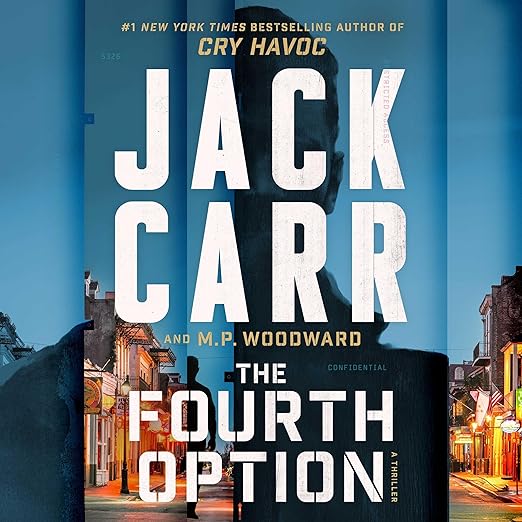
The Fourth Option is Book 1 of a new series co-written by number-one New York Times bestselling author Jack Carr and M.P. Woodward, narrated by Ray Porter, and running to eleven hours. Porter is the kind of narrator who makes this specific genre, the disenchanted special forces operator turned reluctant vigilante, feel inevitable rather than calculated. His voice for Walker is measured and tired in exactly the right way: a man who knows how to do terrible things efficiently and has spent some time trying to decide whether that knowledge is a curse. Porter has spent enough time in the adjacent territory of military and thriller fiction that the rhythms of the prose feel native to him here.
The Western Frame Behind Walker's Camper
Carr and Woodward are clearly reaching for something specific with this series launch. The Western framing, explicitly invoked in the synopsis's reference to the "stranger comes to town" tradition, is not decorative. Walker's off-the-grid camper setup, his Belgian Malinois companion, his entry into a community from outside its established power structures to deliver justice the system has refused, all of these position the book in a lineage that runs through Shane and High Plains Drifter before arriving at the contemporary thriller. The opioid crisis gives that Western template immediate, documentable stakes. This is not a fictional drug lord. The machinery of prescription medicine, distribution networks, and institutional failures that killed Walker's teammate's son operates on real infrastructure that Carr and Woodward research with the same precision they bring to military accuracy.
FBI agent Jarrett Stanton, pursuing Walker from the institutional side, is a structural necessity that the book handles with more nuance than the genre sometimes allows. Stanton is not simply an obstacle. She is, from her own perspective, correctly enforcing the rule of law against a man who is extrajudicially deciding who deserves to die. The tension between Walker's moral logic and Stanton's institutional one is where the book's intelligence lives, and it prevents the vigilante framework from collapsing into simple power fantasy.
Porter Finds Walker More Broken than Reece
Ray Porter is a significant part of why the audiobook version of this title is the format of choice. Carr's previous James Reece series benefited enormously from Porter's narration, and this new series continues that collaboration with material that suits Porter's strengths even more directly. Walker is a more internally complex figure than Reece in some respects, more broken at the series' opening, more genuinely uncertain about what he is becoming, and Porter handles that interiority with subtlety rather than simply playing the character as competent danger.
The eleven-hour runtime is well-paced for a series opener. Carr and Woodward do not linger on the setup longer than necessary to establish Walker's specific psychological situation and the specific chain of institutional failures that created the fourth option premise. The conspiracy that Walker uncovers expands convincingly from its personal origin without losing the intimate scale that makes the story feel like more than a procedural. Walker's relationship with his K-9 companion is a grounding element that several similar series have tried and fewer have pulled off, and here it works as character texture rather than sentimental accessory.
Legitimate Systems That Failed Walker's Teammate
The book's title is its thesis. Law enforcement, the courts, and the prison system are presented not as corrupt institutions to be overthrown but as legitimate systems that have genuinely failed in specific cases and left a gap that Walker chooses to fill. Tracking how carefully Carr and Woodward document those specific institutional failures, the way Walker's teammate's son moved through a system that had technical opportunities to intervene and took none of them, gives the vigilante premise the weight it needs to function as more than wish fulfillment.
The Western genre echo is also worth tracking actively. Carr and Woodward place explicit markers throughout the text that signal their engagement with that tradition, and reading Walker against that template, the outsider with a specific skill set arriving after the community has exhausted its institutional options, illuminates choices the authors make that might otherwise seem like genre convenience. This is a book that knows its literary ancestors and is in deliberate conversation with them.
Reece Fans Will Recognize Familiar Pleasures
This audiobook rewards listeners who enjoy military thriller fiction with moral weight, series starters that invest in character psychology alongside action, and Ray Porter's specific interpretive gifts in this genre. Fans of Carr's James Reece series will find familiar pleasures here while also encountering a protagonist whose emotional situation at series launch is more explicitly fragile and more interestingly complicated than Reece's.
Skip it if you want a fully self-contained thriller with no series obligations. The Fourth Option is explicitly a series opener, and while it resolves its immediate plot, Walker's story is clearly designed for extended development. Skip also if you need a morally simple vigilante narrative. Stanton's institutional perspective is given genuine credibility, and the book does not make it easy to simply cheer Walker's extralegal choices without thinking about what they cost.
Common Questions
Does the audiobook portray the opioid crisis as a backdrop or as a central plot element?
The opioid crisis is the specific engine of the story: the death of Walker's teammate's son to opioids is the call that pulls Walker back from the edge and sets the entire plot in motion. Carr and Woodward research the institutional machinery of prescription drug distribution with the same precision they bring to military accuracy, and the specificity of those failures gives the vigilante premise its moral weight.
Is this audiobook suitable for listeners who do not typically read military thrillers?
The Fourth Option is accessible to readers outside the core military thriller audience because Walker's initial crisis is civilian in character and the Western genre framework gives the story a familiar dramatic shape. The military background informs Walker's capabilities but is not the primary lens through which the story operates.