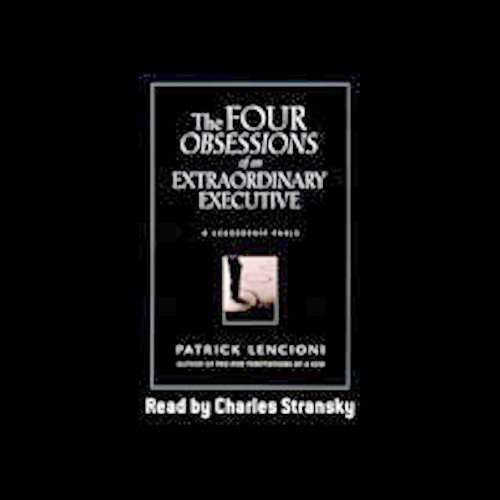
Four disciplines and a fable is the entire design, and at three hours and one minute this is the shortest business audiobook likely to land in your library this year. Patrick Lencioni wrote it as a follow-up to The Five Temptations of a CEO, and it runs on the same engine: a story about a fictional executive in trouble, then a compact model extracted from the story. The trouble here belongs to the frustrated head of a consulting firm facing a challenge large enough to threaten the company, the career and everything held true about leadership. The subject underneath is organizational health, which Lencioni treats as the neglected half of business life and the thing that quietly decides whether strategy survives contact with people.
This Recording Dates From October 2002
Repetition is the method, and one reader named it precisely. A four-star from December 2011 describes the book as an exploration of the foundations of leadership seen from the leader's chair, and notes that each of the four disciplines gets restated through the text in different forms, which that reader thought would suit people who learn through narrative. That is a fair description of what Lencioni does and of why some readers bounce off him. The ideas would fit on an index card. The fable exists to make them stick, and the restatement exists because a principle heard once inside a story tends to evaporate the moment you close the book and open your calendar.
Age is worth registering before anything else. This recording dates from October 2002, which makes the consulting firm at its center a workplace with different assumptions about meetings, hours and where anyone physically sits. None of that damages the argument, because the argument is about clarity and reinforcement rather than about tools. It does mean the texture is period. Charles Stransky is the reader across all three hours, which is the right length for the form: a fable needs momentum more than it needs nuance, and a short recording keeps the parable from sagging into a management seminar with characters attached.
Three Hours Is Exactly Two Sittings
Brevity is the strongest argument for buying it in this format. A five-star posted in January 2025 recommends keeping a notebook within reach and expects to return to it as often as that reader returns to The Five Dysfunctions of a Team, which is a telling comparison, since both books are built to be re-entered rather than finished. Three hours is two sittings. You can finish the whole thing before your next leadership meeting and still have time to write down the three questions it raises about your own organization, and that ratio of effort to output is rare enough in the category to matter.
Reinforcement is the second argument here, and a March 2026 five-star puts it in the plainest possible terms: the storytelling supplies context for the principles, and the result reinforces where that reader's time should be going. Most leadership writing tries to give you something new. This one is closer to a corrective, aimed at executives who already know what matters and have let the urgent crowd it out. Anyone who has watched a strategy fail for reasons nobody would put on a slide, because two departments understood the same sentence differently, will recognize the disease Lencioni describes long before the fable reaches its diagnosis.
A Lone Grade Cannot Explain a 4.6
Even the admirers push back on the packaging. A September 2012 five-star, from a reader who owns many of the author's books and recommended this one upward to a boss, opens by calling the title misleading, as that reader finds all of this author's titles to be, and files the whole thing under a headline that is just a user handle. The complaint is fair. Nothing about the phrase extraordinary executive prepares you for a short novel about a consulting firm, and the description declines to name the four disciplines, so nobody can tell before buying whether the model is one they already use. The listing also drops the subtitle that identifies the book as a fable, which is the single most useful word available.
Arithmetic on the badge does not work either. The average shown is 4.6 and the grade counter alongside it reads one. A lone grade can only be a whole number of stars, so a 4.6 cannot have come from it, and five dated responses are visible on the same page, running from December 2011 to March 2026. None of this reflects on Lencioni, and all of it should make you treat the score as decoration rather than as evidence when comparing this against the other titles in the sequence.
The Dialogue Exists to Carry Ideas
New managers get the most from it, particularly anyone promoted into a role where the technical work is no longer the work. The four disciplines are the sort of thing experienced executives claim to know and routinely fail to practice, and the fable form is unusually good at delivering that news without lecturing. Readers already inside the Lencioni sequence will find the familiar architecture, and several responses here come from people who own other books by the same author rather than from first-timers. The material also travels well outside a commercial setting, since none of the four disciplines depends on having shareholders or a quarterly number to hit.
Skip it if fables irritate you. The characters exist to carry ideas, the dialogue does structural work rather than dramatic work, and readers who prefer research, case studies and citations will find three hours of invented company politics an odd way to receive four bullet points. Pass as well if you want depth on any single discipline, since the whole method is breadth delivered fast. Everyone else is looking at a genuinely efficient piece of leadership writing that has outlived its decade, sold under a title that undersells it and a score that means nothing at all.
Frequently Asked Questions
Can the audiobook help leaders outside the business world?
A January 2012 five-star from someone running a church says it does, with a caveat worth keeping: not every lesson from the corporate world transfers cleanly, but understanding how business leaders think about organizations proved useful anyway. The disciplines concern clarity and reinforcement, which apply anywhere people have to act on shared assumptions.
Do I need to read The Five Temptations of a CEO first?
No. The description presents this as a follow-up rather than a sequel, and the fable stands on its own with a new company and a new problem. Readers who have taken the earlier books tend to arrive here for the format rather than for continuity, and nothing in the story depends on what came before.
How much of the audiobook is story and how much is model?
The bulk is narrative, with the four disciplines drawn out of it toward the end and restated along the way. That balance is deliberate: the fable carries the argument, the model summarizes it, and the repetition through the middle exists so the framework survives past the last chapter.
Is three hours enough to cover the subject properly?
For an introduction, yes. Depth on any one discipline is not on offer here, and readers wanting evidence, research or case studies will feel the absence. What the length buys is a complete argument you can finish in a single afternoon and act on the following week, which for a busy manager is the point.