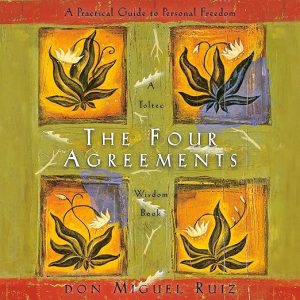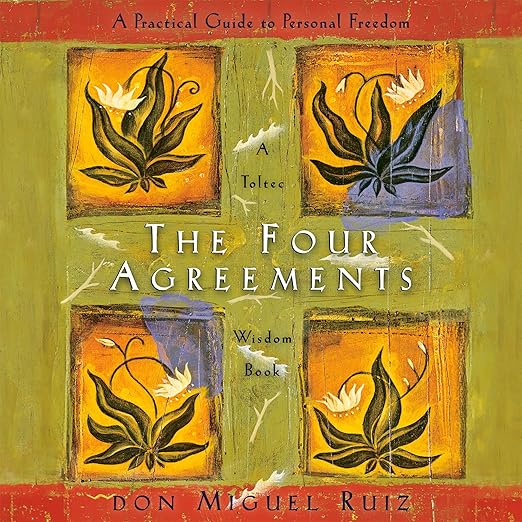
Peter Coyote narrates The Four Agreements, Don Miguel Ruiz's distillation of Toltec wisdom into four behavioral principles, in this 2-hour-31-minute audiobook that has been in continuous circulation since 1997 and has sold over twelve million copies worldwide. Part of the A Toltec Wisdom Book series, it is one of the more consistently cited life-changing books across multiple decades of bestseller culture - endorsed by Oprah Winfrey, Deepak Chopra, and Wayne Dyer. What the audiobook actually contains is something more stripped-down than the endorsements suggest: a clear argument about how self-limiting beliefs are formed, and four specific agreements you can make with yourself to dismantle them.
Domestication Is Why Each Agreement Reinforces Others
Ruiz draws on ancient Toltec philosophy - specifically on what he describes as a process of "domestication" through which humans are taught to judge themselves against standards they didn't choose and can't meet. The four agreements are: be impeccable with your word; don't take anything personally; don't make assumptions; always do your best. These statements are simple enough to print on a bookmark, and Ruiz spends his 2.5-hour runtime unpacking why each one is harder to practice than it sounds and what consistently practicing each one does to the quality of a life. The craft is in the unpacking. He doesn't treat the four agreements as affirmations or mantras; he treats them as a coherent philosophical system in which each agreement reinforces the others. Not taking things personally, for instance, requires first being impeccable with your word, because the voice in your head that tells you everything is about you is also the voice that speaks imprecisely to itself. The philosophical coherence beneath the simplicity is what has given this book its durability over nearly thirty years. Reviewer Nick describes the book as having "completely transformed my life, more than anything I've ever read or meditated on" - which is exactly the kind of testimonial that skeptics discount and that adherents recognize as matching their own experience. Another reviewer, Patrice, notes it gives "a whole new clear perspective on life" and shows "just how trapped you can become in beliefs that don't serve you" - which is a precise description of what Ruiz is doing with the domestication concept. Dan Millman's description of Ruiz as distilling essential Toltec wisdom for people living as "peaceful warriors in the modern world" captures the book's register precisely: it is practical without being tactical, philosophical without being inaccessible.
Coyote's Casting Fits an Underrated Short Runtime
Coyote's casting as narrator is significant. He brings a voice that has genuine depth and authority without the performative warmth of a narrator working too hard to sell the material. Ruiz's prose is direct and relatively plain - the language is clear by design, because the philosophy depends on clarity rather than mystical complexity. A narrator who added too much atmosphere to that plainness would distort it. Coyote reads as if he believes what he's saying, which suits material that asks listeners to take it seriously enough to act on it. The 2-hour-31-minute runtime is the audiobook's most underrated asset. Ruiz says what he has to say and stops. The book's argument is complete at that length, and the compression means every section is load-bearing. Returning to the audiobook is easy because the runtime invites complete re-listens rather than targeted section reviews. Multiple reviewers describe coming back to it repeatedly at different points in their lives, which is the practical test of whether a short personal development book has genuine staying power. Deepak Chopra calls it "a roadmap to enlightenment and freedom," which is hyperbolic, but the core claim - that these four principles, genuinely practiced, alter the quality of daily experience - is supported by consistent reader testimony across twenty-five years of the book's circulation. Oprah Winfrey's endorsement about how the book changed "how I think and act in every encounter" is specific enough to function as actual description rather than marketing praise.
Do Your Best Is the Most Complex Agreement
The book's Toltec framing - references to ancient wisdom, to Toltec teachers, to the ancestral lineage of these ideas - may feel culturally distant to some listeners. Ruiz is not asking you to adopt a specific religious practice, but the framing is mythological in a way that can either enrich the material or create distance, depending on your relationship to that kind of language. The four principles themselves are entirely secular in practice, and listeners who prefer to engage with the ideas without the cosmological container can do so without missing anything essential. The book also does not address structural or systemic factors that create the conditions for self-limiting beliefs - it is a personal practice guide, not a sociological analysis, and it operates at the level of individual behavior rather than social change. That is the right scope for what it is, but it's worth noting for listeners who want a fuller account of why people develop limiting beliefs in the first place. The "always do your best" agreement is the most complex of the four and the one Ruiz spends the most time unpacking, particularly his argument that your best varies from day to day and that demanding consistent peak performance from yourself is itself a form of the self-limiting behavior the book is working against.
Endorsement Skeptics Will Find Less Hyperbole Inside
Listeners encountering this material for the first time through the audiobook will find Coyote's narration a strong introduction to what has become foundational in popular personal development. People who have read the book in print and want to revisit it in a format that supports multiple run-throughs will find the short runtime ideal for that purpose. Readers already deeply familiar with the traditions of stoic philosophy, Buddhist practice, or similar systems for interrupting reactive thinking will find Ruiz covering overlapping ground from a different cultural angle - complementary rather than redundant. Listeners who find the endorsement culture around this book off-putting should know the book itself is considerably less hyperbolic than its promotional material suggests.
A Few Questions About The Four Agreements
Does the audiobook version of The Four Agreements include all the content from the print edition?
Yes. The 2-hour-31-minute runtime corresponds to an unabridged production of a book that was short to begin with. All four agreements are covered in full along with Ruiz's framing of Toltec wisdom and the concept of personal domestication.
How does Peter Coyote's narration compare to other performances of self-help audiobooks in this genre?
Coyote avoids the motivational-speaker tone that burdens many self-help audiobooks. He reads with authority and gravity rather than enthusiasm, which suits material that is philosophical rather than tactical. Listeners who find overly warm narration in this genre grating will likely find Coyote's approach a relief.
Is The Four Agreements audiobook suitable for repeated listening, or is it primarily a one-time listen?
Multiple reviewers describe returning to it repeatedly. The short runtime makes complete re-listens easy, and because the four principles are practices rather than information, hearing them again in different life contexts produces different resonances. It's explicitly designed for sustained engagement rather than single-pass consumption.