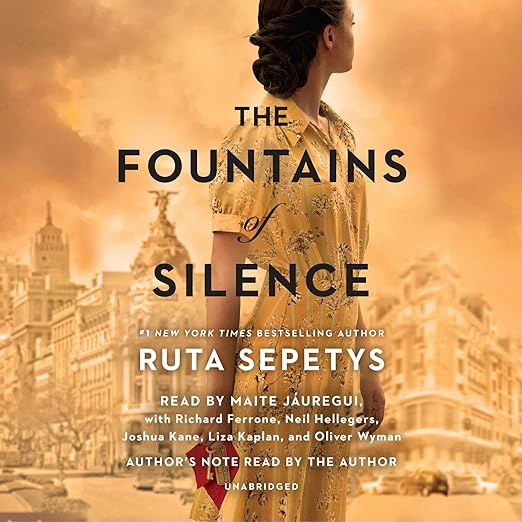
At a Glance
- Narrator: Maite Jauregui leads a full cast including Richard Ferrone, Neil Hellegers, and others, the multi-voice production suits the multi-perspective story and grounds the Spanish setting with appropriate weight.
- Subjects: Complicity and silence under fascism, the violence of historical omission, love across class and ideology
- Tone: Devastating and carefully built, with the quiet intensity of secrets about to surface
- Bottom line: Sepetys illuminates a period most listeners will not know, and the full-cast audiobook amplifies the novel's insistence that silence has a human cost.
I had read Ruta Sepetys's Between Shades of Gray years before I got to The Fountains of Silence, and I came to the audiobook with a sense of what to expect, methodical historical research, multiple perspectives, a story excavated from a corner of the past that mainstream publishing tends to overlook. What I did not anticipate was how much of the novel's weight would come from what her characters cannot say aloud.
Madrid in 1957. Franco's Spain has a surface. Tourists arrive for sunshine and wine. American businessmen arrive for oil. Beneath that surface: a dictatorship holding its grip through silence, through disappearance, through the systematic erasure of evidence. Sepetys makes the audiobook listener feel the pressure of that surface tension across twelve hours and twenty-four minutes.
The Review
The novel follows Daniel Matheson, eighteen years old, son of a Texas oil tycoon, arriving in Madrid with his parents and his camera. Photography is his real vocation, his father wants him to inherit the business; Daniel wants to document the world. Through his lens, and through his growing connection with Ana, a hotel worker whose family is entangled in Franco's crimes, Daniel begins to see the Spain beneath the one he was invited to enjoy.
Sepetys structures the novel around multiple perspectives and intersperses the chapters with fragments of actual period documents: news reports, radio announcements, propaganda. This documentary texture is one of the things that distinguishes her work. She is not just writing historical fiction; she is building an argument about how history is controlled, and who gets to speak it.
What Makes The Fountains of Silence Worth Hearing
The full-cast audiobook production is the right choice for this material. Maite Jauregui's primary narration carries the Spanish perspective with appropriate weight, while the additional cast voices give the American characters their own register. The production does not feel gimmicky; it reflects the way the novel itself insists on multiple lines of sight toward the same events.
Booklist and Kirkus both gave the novel starred reviews, Kirkus called it a stunning novel that exposes modern fascism and elevates human resilience, which captures the dual work Sepetys is doing. She is not writing a monument to suffering; she is writing about people who survived by learning to hold information differently from how they felt it. The fountains of silence of the title are the people who knew and could not say.
The Caveats
The novel covers genuinely difficult content, baby abduction, pregnancy loss, past torture, and the bureaucratic machinery of state violence. One reviewer flagged these specifically, and they are worth knowing about before you sit down with this one. Sepetys does not sensationalize, but she does not look away either. The historical record she draws from required that honesty.
The pace in the first few hours is deliberately patient. Sepetys is building a world, establishing the gulf between what Daniel sees as a privileged American visitor and what Ana and her family experience daily. Listeners who want immediate propulsion will need to give the novel space to earn its momentum. When it arrives, it is considerable.
The Right Listener for The Fountains of Silence
This one is for listeners who want historical fiction that does serious work, who are drawn to lesser-known periods and places, and who can sit with a slow build. Sepetys earns the comparison to her own earlier work, this is the writer of Between Shades of Gray operating at the same level of moral seriousness, applied to a different corner of the twentieth century. Fans of Sepetys's earlier books will be on familiar ground. If you have no patience for multi-perspective narratives or documentary interludes, this will feel more demanding than engaging. But if you want to come away knowing something real about a chapter of history that was deliberately kept quiet, there are few better choices in YA historical fiction.
Do I need background knowledge of the Spanish Civil War or Franco's dictatorship to follow the story?
No. Sepetys builds the historical context into the narrative itself, and the novel is designed to work for listeners who come in knowing very little about this period.
Is this a full-cast production or primarily one narrator?
Maite Jauregui leads the narration, but the production includes Richard Ferrone, Neil Hellegers, Joshua Kane, Liza Kaplan, and Oliver Wyman, plus Sepetys reading her own Author's Note.
How does The Fountains of Silence compare to Between Shades of Gray for someone who loved that book?
The emotional register is similar, meticulous research, multiple perspectives, historical horror given a human scale. Fountains is arguably more structurally complex, with more documentary material woven in.