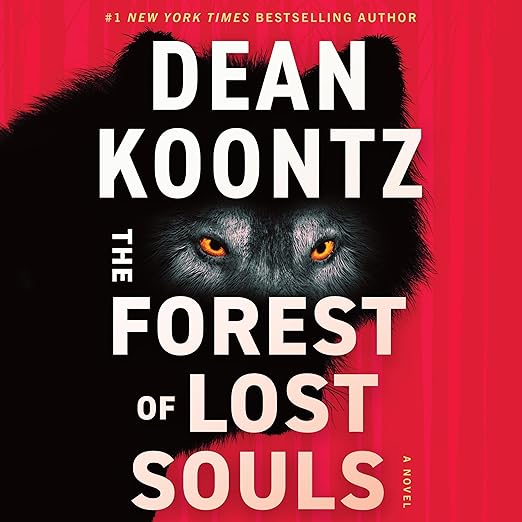
Vida knows the forest the way some people know their own bodies: instinctively, in the dark, without needing to think about it. Dean Koontz's The Forest of Lost Souls, a 2025 Audie Award Finalist for Best Thriller and Suspense Audiobook narrated by January LaVoy, opens with a young woman who has been formed not by civilization but by wilderness, shaped by her late great-uncle, by loss, and by the prophecies of a fortuneteller whose words have settled into her as something between warning and instruction. This audiobook is Koontz working in the space he has made distinctly his own across a long career: the intersection of myth, gothic atmosphere, and moral clarity, where good and evil are real rather than social constructs, and where ordinary people, or in Vida's case an almost preternatural one, stand in the gap.
The verdict-first frame for this review is simply this: The Forest of Lost Souls is among the most fully realized of Koontz's recent novels, and LaVoy's narration makes it something beyond a strong thriller. It is a meditation on what it means to belong to a place, what love costs when it is taken by violence, and what a woman formed by hard experience and genuine wildness can bring to bear against the hungry men of power who want her gone.
Is The Forest of Lost Souls Worth Your Time?
Kettleton County, the shadow that Vida's forested mountains border, is a specific kind of corrupt jurisdiction: not spectacularly villainous but systemically compromised, where the official story serves the powerful and the unofficial truth belongs to those with the courage to hold it. José Nochelobo, the love of Vida's life and a cherished local hero, died in what the record calls a tragic accident. Vida has reasons to doubt that record. The novel's movement is from those reasons toward the truth, and then from the truth toward the confrontation the truth demands.
Koontz has always been interested in evil as something that does not require supernatural machinery to operate at scale, though The Forest of Lost Souls has its own supernatural texture in Vida's preternatural affinity for the wolves that share her mountain and in the fortuneteller's prophecies that arrive at exactly the right moments. But the men of Kettleton County who come for Vida are recognizably human. They are the powerful, the connected, and the ruthless, and what they want is the disappearance of anyone who knows what they did. One by one they come for her. She is waiting.
Reviewer Kate, who describes reading everything she can find by Koontz, identifies what has kept him relevant across decades: every novel is unique, fresh, and new, with wonderful dogs, forces of good and evil, and characters with psychic abilities, but the settings, people, and causes are always different. The Forest of Lost Souls fits that description precisely. The wolves are Koontz's dogs in this novel, rendered with the same loving precision he brings to canine characters throughout his catalog. The good-versus-evil framework is ancient but not simple. And Vida herself is a character who does not exist in any earlier Koontz novel.
The Best Parts of The Forest of Lost Souls
January LaVoy received an Audie Award nomination for this performance, and listening to the audiobook clarifies why. LaVoy voices Vida with a quality that is genuinely difficult to achieve: the sense of a person who is entirely at home in the wilderness and genuinely foreign to the social performances most fiction protagonists navigate effortlessly. Vida is not awkward in civilization because she is naive or unsophisticated. She is foreign to it because she has lived outside its logic, and LaVoy maintains that distinction throughout the novel's shifting environments.
The forest sequences are where the narration reaches its highest pitch. LaVoy's voice for Vida in the mountain sections carries an almost animal alertness, a quality of attention that makes the woods feel inhabited and dangerous and alive in specific ways. When the men of Kettleton County come for Vida in those spaces, the confrontations have a tension that comes from the listener's sense that Vida and the forest are operating as a single system. LaVoy builds that sense across ten hours and forty-six minutes with remarkable consistency.
Before You Commit to The Forest of Lost Souls
Koontz is working with mythological frameworks here, and readers who want pure contemporary thriller mechanics may find the mythic elements intrusive. The fortuneteller's prophecies function as genuine narrative events, not as atmospheric decoration. The wolves are characters with their own moral weight. The good-versus-evil framework is not ironic. For readers who find this kind of earnest moral clarity naive, The Forest of Lost Souls will not convert them. For those who respond to Koontz's particular brand of dark romanticism, where the natural world has genuine agency and love is worth the cost it extracts, this novel is among his most sustained expressions of that vision.
Jennifer VL's review, which identifies a noble heroine, complex story, and rich characters and descriptions, along with a very satisfying and enjoyable story, captures the register accurately. The satisfaction is genuine, and it is the satisfaction of a story that knows what it believes and does not apologize for it. Lisa D. Winburne calls it worth the time to read if only to know more about life, which is a quiet way of saying that Koontz is, at this stage of his career, writing about more than plot.
Should You Listen to The Forest of Lost Souls?
Koontz readers who have followed his late-career evolution toward more overtly mythological, character-centered storytelling will find The Forest of Lost Souls a rewarding ten-hour commitment. The Audie Award nomination confirms that LaVoy's performance belongs in the upper tier of thriller narration, and the combination of Koontz's atmospheric writing and her vocal authority makes this one of the more immersive audio experiences in recent mainstream thriller publishing.
Readers new to Koontz can start here without prior context, as the novel is entirely standalone. Those who appreciate wilderness-set thrillers with strong female protagonists, who responded to works like Paul Tremblay's darker fiction or the more atmospheric end of Thomas Harris, will find Koontz's mythic framing a distinctive alternative to conventional thriller mechanics. The forest is real. The evil is real. And Vida is more than ready for both.
- Read by: January LaVoy voices Vida with a feral quiet authority that makes the forest sequences deeply atmospheric and the confrontation scenes genuinely tense.
- At its heart: good versus evil as ancient and ongoing, the mythology of the wilderness woman, corporate power and its violence against the land and its protectors
- Vibe: Dark and mythic, with an undercurrent of something older than conventional thriller logic
- Short version: Koontz at a late-career peak, working in territory that feels genuinely his own, and January LaVoy delivering a narration that makes the forest feel like a living presence.