
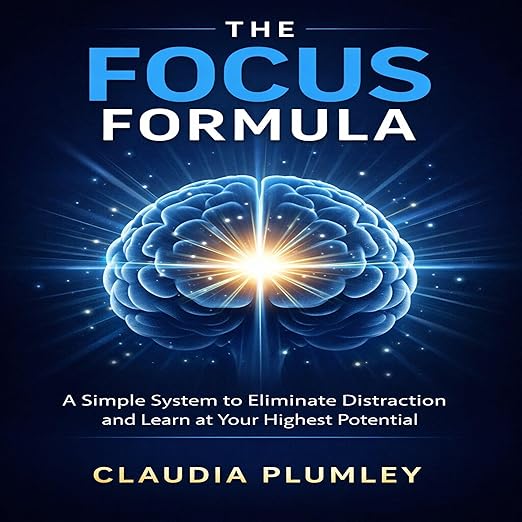
Eighty minutes is the entire runtime Claudia Plumley gets to fix a reader's relationship with their own attention span, and The Focus Formula spends nearly every one of them efficiently. This audiobook opens with a premise most listeners will recognize immediately: a phone buzzes, the mind wanders, tasks pile up, and traditional advice to just try harder keeps failing. Plumley's actual argument is more specific than that setup suggests, framing distraction as a predictable response to how modern technology has reshaped attention rather than a personal failing, and building a step-by-step system from that reframing rather than just another list of willpower tips.
LeCote's Fourth Title in This Exact Register
The core of the book is what Plumley calls the Focus Formula itself, a structured method for training concentration the way you'd train a muscle, paired with what the synopsis describes as digital habits that support focus instead of stealing it. That framing matters because it sidesteps the usual all-or-nothing productivity advice, delete every app, go fully analog, that most people try once and abandon within a week. Instead the book aims at sustainable routines: specific techniques for eliminating procrastination and mental resistance without requiring extreme discipline or giving up technology entirely, which is a more realistic promise for anyone who has already failed at the harder version of this advice before. That same discipline extends to the book's own length: treating restraint as part of the demonstrated method rather than an afterthought, since a shorter book that actually gets finished beats a longer one that gets abandoned on principle alone.
Scott LeCote's narration is worth calling out specifically here, since this is now the fourth title in his catalog built around exactly this kind of measured, unhurried delivery for education-adjacent self-help content, following titles like Learning Without Burnout and Seafood for Health. What makes that pattern relevant to this specific book is almost structural: a book about training sustained attention benefits enormously from a narrator who doesn't fight for the listener's focus with vocal tricks or artificial urgency. LeCote's steady, conversational pace essentially models the calm, non-frantic approach to concentration that Plumley is arguing for, rather than working against it.
The book's own promise to 'train your focus like a muscle and strengthen it daily' is a well-worn metaphor in self-help writing generally, but it earns its keep here specifically because Plumley follows through on the mechanics of the comparison rather than just gesturing at it once and moving on. Muscles need progressive overload, rest, and consistency rather than a single intense session, and the book's daily-habit structure maps onto exactly that logic, small, repeated exercises in noticing and redirecting attention rather than one dramatic productivity overhaul attempted once and abandoned. That consistency between metaphor and method is a small craft choice, but it's the kind of internal coherence that separates a genuinely structured system from a title that borrows fitness language purely for marketing appeal.
A Perfect 5.0 Across 23 Ratings
Anyone currently mid-scroll while meaning to be working will likely recognize themselves within the first few minutes, which is exactly the audience Plumley seems to be writing for directly. The book's stated appeal to students, professionals, and lifelong learners alike suggests a genuinely broad target, and the short runtime plays to that breadth well: this is something a listener could plausibly finish during a single lunch break or a short flight, which lowers the barrier to actually finishing a self-help title that would otherwise sit half-read on a shelf.
A perfect 5.0 average across 23 ratings is a genuinely strong signal for a book this short and specific, especially since brief self-help titles often struggle to justify their price relative to runtime. That the audiobook has earned consistent top marks despite, or perhaps because of, its compressed length suggests Plumley delivers real, usable content rather than padding a thin idea out to fill a longer runtime, a trap plenty of longer productivity books fall into instead.
Eighty minutes is genuinely compact next to most productivity and focus titles, which commonly run six to ten hours once they pad core advice with extended case studies, personal anecdotes, and repeated framework restatement. Plumley's choice to stay this short is itself a kind of practiced restraint, arguably modeling the same eliminate-what-doesn't-serve-the-goal discipline the book is teaching. For a listener who has already sat through a longer, more meandering focus or productivity title and abandoned it partway through, this format alone is a meaningful selling point worth weighing against the admittedly thinner supporting evidence a longer book might include.
A Pep Talk Instead of the Newport School
A full eighty minutes covers core principles and a step-by-step system, not a long-term behavioral overhaul supported by extensive citations or case studies. Readers wanting deep neuroscience research, academic-style evidence, or a multi-week structured program with daily exercises should look elsewhere, since this format is built for a fast, practical primer rather than an exhaustive treatment of attention science.
No written reviews are attached to this listing to draw specific reader reactions from beyond the numerical rating, so the actual content assessment here rests on the synopsis and the narration itself rather than direct reader testimony. Given the short runtime, that's a smaller gap than it would be for a longer, more complex title, but it's worth naming plainly before treating the strong rating alone as the full picture.
It's also worth being direct about genre positioning: this sits closer to a structured pep talk with a clear system attached than to the more clinical, citation-heavy end of behavioral science publishing, the Nir Eyal or Cal Newport school of deeply researched attention theory. That's neither a strength nor a weakness inherently, but readers coming from that more academic tradition may find Plumley's claims presented with more confidence than citation, since the audiobook format doesn't lend itself to footnotes or referenced studies the way a printed page might. Listeners who want the system explained clearly and quickly will feel well served; listeners who want every claim traced back to a specific study will likely want a different, longer title instead.
A Fast Primer Rather Than a Deep Dive
Students juggling coursework, early-career professionals drowning in notification pings, and anyone who has already tried and abandoned a more extreme productivity system are the strongest fit for this shorter, more sustainable approach. Anyone who has shelved a longer, more academic focus book half-read will likely find this friendlier format easier to actually finish and genuinely apply.
Readers wanting deep neuroscience sourcing, academic citations, or an extended coaching-style program with regular check-ins should look elsewhere, since the format here favors speed and simplicity over exhaustive evidence. This is a fast primer meant to be finished in one sitting, not a research-heavy deep dive.
Is Scott LeCote's narration style suited to a short, practical self-help audiobook like this?
Yes, his measured, unhurried pacing avoids artificial urgency, which fits a book about training calm, sustained attention particularly well.
Does this audiobook include in-depth neuroscience research or citations?
Not extensively. It's framed as a practical, step-by-step system rather than an academic or research-heavy treatment of attention science.







