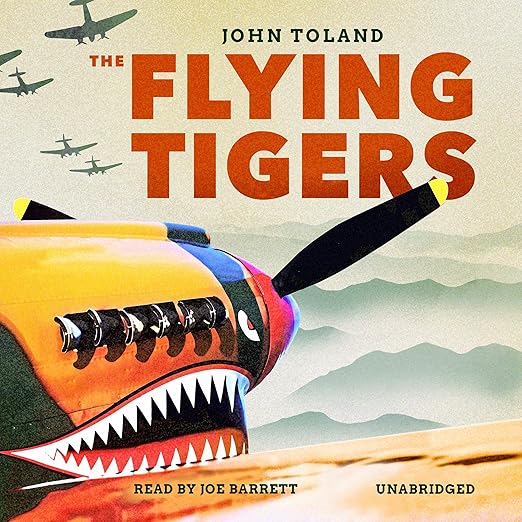
American fighter pilots over China and Burma, harassing the Japanese war effort without letup, flying tactics nobody else was using: the raw material here is as good as war stories get, and this audiobook covers all of it in three hours and twelve minutes. That figure deserves weighing before anything else. John Toland tells the story of Claire Lee Chennault and the volunteers he trained, men recruited out of the Army, Navy and Marines who went on to compile some of the most impressive air victory records of the war, and the telling is brisk to the point of severity.
Where This One Lands
Quick and easy is how a May 2017 five-star sums the book up, and the sentence runs on: a very quick and easy read about the AVG in China and the significant role it played in the Pacific war. Those initials are worth noticing, because the description never once uses them. The copy says volunteer group, the buyers say AVG, and anybody who goes looking for further reading on the outfit will need both. That mismatch is exactly the sort of thing a catalog record ought to repair.
What Toland does well is momentum. The book opens on the recruitment, moves through training in unconventional air-combat tactics, then delivers the combat record itself, and none of it stalls. Chennault is the organizing figure, described in the copy as a maverick, and the structure treats the whole group as an extension of one man's convictions about how aerial fighting ought to be done against a numerically superior enemy.
Compression has consequences. Three hours cannot hold a theater of war, and this book does not attempt it. Individual pilots arrive and disappear quickly, the political situation around Chiang Kai-shek's China gets a summary rather than an argument, and the Japanese side of the campaign appears mainly as the thing being harassed. What survives the compression is the shape of the story and the flying, which is a defensible choice at this length.
What Makes The Flying Tigers Worth Hearing
Four stars in April 2020 call this a concise history of an exceptional group of talented aviators, well written and recommended for all readers, with one revealing reservation attached: only a single mention of Greg Boyington, which the response is careful to note is not a problem. That note tells you something useful. Readers come to this subject with particular names already in mind, and a book of this size cannot service all of them.
One of the densest assignments in the genre falls to Joe Barrett. Place names from China and Burma, aircraft types, squadron structures and a rotating cast of pilots all arrive at speed, with none of the repetition a longer book would use to fix a name in your memory. One voice has to hold all of it legible without slowing the pace that makes the thing work at all. Sample the recruitment passages, where the proper nouns come thickest, rather than the opening minutes.
For a listener, the brevity is a genuine asset. One sitting covers the entire campaign, which is nearly unheard of in military history, and the format suits a narrative built on action rather than on analysis. This is the war book you actually finish, and finishing it leaves you far better equipped to choose the longer one you read next.
What Gives Us Pause
A three-star headed Not a serious work of history, though enjoyable, filed in May 2013, states the problem precisely. That buyer wanted a properly detailed account of these men and their operations in Asia and got what the response calls pop history instead, adding that the book was not inaccurate, simply not as extensively detailed as hoped, and that the author commands real respect regardless. Read as a warning about expectations rather than about quality, that is the most useful response on the page.
Part of that disappointment traces straight back to the classification. This record files a World War II narrative under teen and young adult with a biographies tag, which is a defensible call for a book written at this length and pitch, and which appears nowhere in the description. A buyer reading only the copy meets a straight military history. A buyer reading only the shelf meets a young-adult title. The two never meet anywhere on the page.
Length of response is the other tell, and the pool is thinner than 111 ratings would suggest. The newest entry, five stars from August 2024, consists of the words Well written beneath the heading Easy read: two words of body text carrying a top grade. Several of the others run barely longer. This is a page where the number is doing almost all of the talking, and the number cannot tell you which kind of reader gave it.
The Right Listener for The Flying Tigers
Aviation readers with a spare afternoon are the obvious buyers, and the oldest entry in this pool, five stars in March 2011, points to a second use for it. That buyer found the book in a grade-school library, read it cover to cover more than once, and bought a copy decades later to hand down to a son, nephews and grandchildren someday. This is a gateway title, the one that starts somebody on a subject rather than the one that settles it, and it has evidently been doing that job for a very long time.
Serious military historians already know what they will find missing. Anyone who wants operational detail, unit-by-unit records or the Japanese perspective should buy something several times the size and use this as the appetizer. Readers who want a biography of Chennault rather than a group portrait will also come away short, since the copy promises the story of the commander and his Tigers together, and the Tigers get much the better half of it.
As a fast and well-told introduction to one of the stranger outfits of the war, this earns its place on a shelf. My reservation is not with Toland at all but with the record around the book: nothing on the page tells a buyer it was pitched at younger readers, and that omission is what turns a good short book into a disappointing long one inside somebody's expectations. Treat it as a first book on the subject, never as a last one.
In Brief
- Performance: One Blackstone credit, Joe Barrett, with no cast, no maps and no supplementary document listed for a book this crowded with place names.
- What it covers: Volunteer airmen in somebody else's war, unorthodox tactics, a commander's reputation
- Feel: Brisk, admiring, old-fashioned in the best sense
- Our call: A first-rate introduction to the outfit, provided nobody sold it to you as the definitive history.