Before You Press Play
- Read by: Bob McGraw delivers a measured, authoritative read that suits the book's analytical tone; his pacing is deliberate without becoming stiff, though he brings slightly more warmth to the biographical passages than to the economic history.
- At its heart: American hero mythology, the machinery of celebrity, aviation as industrial catalyst
- Vibe: Brisk and illuminating, with flashes of genuine drama
- Short version: Thomas Kessner's account is the rare aviation history that's as interested in the boardroom as it is in the cockpit, and it pays off.
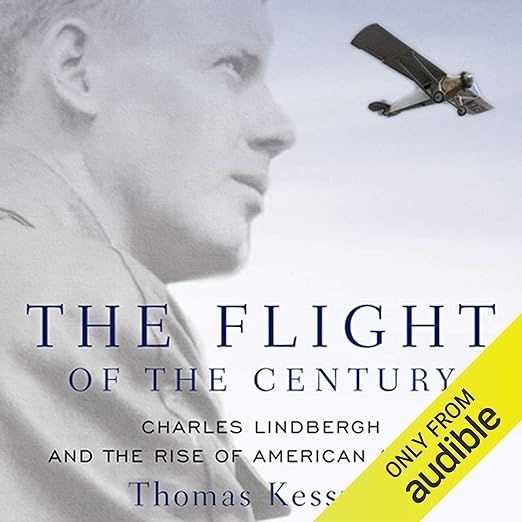
Charles Lindbergh crossed the Atlantic in thirty-three and a half hours. Thomas Kessner's audiobook about that crossing, The Flight of the Century: Charles Lindbergh and the Rise of American Aviation, takes eleven hours and seventeen minutes to unpack what the flight actually meant, and nearly all of that time is well spent. Bob McGraw narrates with the kind of settled authority that suits a work of serious popular history, and from the first chapter it's clear that Kessner is not interested in the sentimental version of the story.
The book sits in Oxford University Press's Pivotal Moments in American History series, which tells you something about its ambitions. Kessner is not writing a biography in the traditional sense. He's writing about a moment and the machinery that made it possible, and he's honest enough to complicate both the hero and the heroism. Lindbergh the individual was brave and genuinely skilled. But Lindbergh the symbol was carefully constructed and industrially deployed, and Kessner traces that construction with precision.
How The Flight of the Century Holds Up
Kessner's central argument is that the 1927 transatlantic flight was, at its structural core, a publicity exercise - an orchestrated event designed by a coalition of wealthy businessmen, Harry Guggenheim and Dwight Morrow foremost among them, to convince a skeptical American public that commercial aviation was safe, viable, and worth investing in. That argument is not cynical but clarifying. It doesn't diminish what Lindbergh did in the cockpit of the Spirit of St. Louis; it explains why the world's reaction to what he did was so explosive, and why that explosion was so precisely channeled afterward.
The statistical payoff Kessner cites is striking: commercial air passengers in the United States went from six thousand in 1926 to one hundred and seventy-three thousand in 1929. That is not the organic growth of a technology finding its market. That is the result of a deliberate campaign, and Lindbergh was its most powerful instrument. Kessner is at his best making this machinery visible without reducing Lindbergh himself to a passive tool. The young pilot from Minnesota understood what was being asked of him, and his refusal to cash in personally - even as his backers profited enormously - is one of the book's genuinely interesting tensions.
Why The Flight of the Century Works as an Audiobook
McGraw's narration is a consistent asset across this kind of material. Where a more theatrical reader might oversell the drama of the flight itself, McGraw keeps his delivery grounded, which means the passages describing the crossing carry weight without feeling manipulated. Kessner's recreation of the flight is vivid - the fog over Newfoundland, the disorientation over the open Atlantic, the moment when the Irish coast appeared below - and McGraw renders these scenes with enough restraint that they land harder than they would under a more emotive voice.
The book is equally strong on the transatlantic reception. The crowds in Paris numbered in the hundreds of thousands, and Kessner argues persuasively that much of that euphoria was channeled grief: a world still working through the disillusionment of the First World War finding, in this one young man's improbable solo flight, something it desperately needed. That framing - Lindbergh as symptom as well as individual - gives the book its intellectual weight and keeps it from becoming a straightforward celebration.
Weak Spots in The Flight of the Century
Listeners coming to this book expecting extensive coverage of Lindbergh's later years - the kidnapping of his son, his prewar isolationism, his Nazi sympathies - will find those chapters present but compressed. Kessner's focus is tightly on the period from 1927 through the early 1930s, when the aviation industry consolidated around the commercial model that Lindbergh helped legitimize. That choice is defensible and the book is stronger for its narrow scope, but it means some of the more troubling dimensions of Lindbergh's character get less examination than the aviation history does.
The economic history of early American aviation is dense in places, and McGraw navigates it with competence rather than flair. Listeners more interested in the flight itself than in the financing structures of early airlines may find some of the middle sections slow. But Kessner almost always brings those threads back to something human, and the discipline of his argument - that you cannot understand the flight without understanding the industry it was designed to launch - pays dividends by the final hour.
The Right Listener for The Flight of the Century
This audiobook works well for listeners who enjoy popular history that takes an analytical posture without becoming academic. If you've read A. Scott Berg's comprehensive Lindbergh biography and want a tighter, more thesis-driven account of the 1927 moment specifically, Kessner's book is a strong companion. It also rewards anyone interested in how celebrity functions as an economic instrument, which makes it as relevant to contemporary media culture as to aviation history.
Listeners expecting a purely inspirational account of individual courage may find the book's interest in commercial mechanics slightly deflating. And those who need extensive coverage of Lindbergh's full arc will want to supplement this with something broader. But as a focused, intelligent account of one of the twentieth century's most consequential publicity stunts, this audiobook earns its eleven hours.