
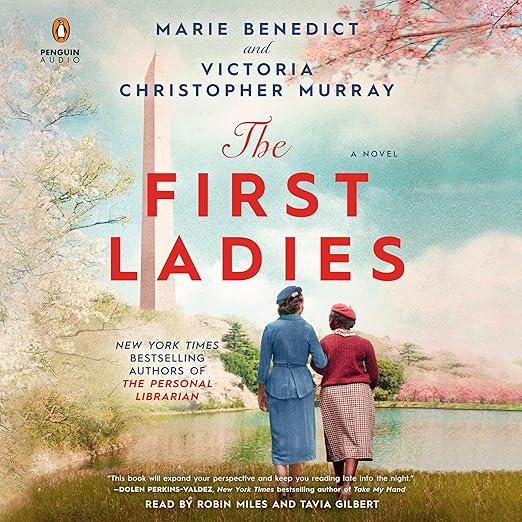
Two authors wrote The First Ladies. The audiobook listing credits one of them. That is not a guess on my part: the publisher's own description points back to the bestselling authors, plural, of The Personal Librarian, and three of the five written responses on the record name Marie Benedict and Victoria Christopher Murray together, one of them formatting the credit as a header before the review starts. The byline field holds a single name anyway. Anybody searching for this book under the second author's name will not find this record, which is a small failure with real consequences for a novel about who gets written out of the story.
A Closer Look at The First Ladies
Both women at the center are real, and the novel's whole proposition is that their friendship did political work. Mary McLeod Bethune, daughter of formerly enslaved parents, builds a reputation as an educator and activist until presidents recognize her. Eleanor Roosevelt seeks her out. What begins in shared conviction about women's rights and education turns into a working alliance once Franklin Roosevelt reaches the White House, and turns again once Eleanor discovers her husband's affair and starts building an agenda of her own. The threats that follow her civil rights positions do not separate the two women; the description is explicit that they push them closer.
Nine ratings hold up the 4.5 printed above them, and nine whole-star votes cannot average to 4.5. Work it through: forty stars across nine raters displays as 4.4, forty-one displays as 4.6, and nothing lands in between. The badge straddles a gap that the arithmetic does not contain. It is not a scandal, and the true figure is somewhere in that same neighborhood either way, but it does mean the number carries less information than its decimal place implies. With nine votes, one more grade in either direction would move it visibly.
Going in blind is apparently the way to do it. The five-star of February 5, 2026 reports arriving with no knowledge of Mary McLeod Bethune at all, beyond the back cover, and coming out with a permanently altered view of Eleanor Roosevelt. That is the reaction the novel is engineered to produce, and it is worth noting that the response describes reading with reference material at hand throughout, which tells you something about how much unfamiliar history the book moves through.
What Makes The First Ladies Worth Hearing
Friendship is a hard thing to dramatize and an easy thing to sentimentalize, and the material here resists the easy version. Two women divided by everything the era used to divide people, held together by a shared belief that education is the lever, confiding in each other through tragedy and through political calculation. The novel gets to have both registers: the private conversation and the public consequence. Historical fiction usually picks one.
Robin Miles is the only reader credited, which for this particular book is a structural decision rather than a budget one. Two protagonists, two authorial voices behind them, one performance to hold the seam. A dual-cast production would have made the alternation obvious; a single reader has to keep two women distinct across fourteen hours and thirty-three minutes while letting the prose sound like one novel. That is the harder assignment, and it suits a book whose entire argument is that these two lives belong in the same sentence.
Scale is the other reason to take it in audio. A five-star from August 2, 2024 measures the span at more than twenty years of American turmoil and change, and that response is right that the length is what makes the respect accumulate. You do not get the weight of Bethune's career from a summary. You get it from sitting with the years.
Things to Know Before Starting The First Ladies
Historical novels about real people carry a particular hazard, and this record does nothing to help you manage it. The description names actual figures, an actual affair and actual threats, and never marks where documentation stops. The four-star of August 26, 2024 came away having learned about both women, and also reports a reading group average of 3.8 against its own four stars, which is the only piece of dissenting data anywhere on the page. Nothing on the record flags an author's note, so treat the conversations as reconstruction.
Count the written responses before you trust the tone of the column. Five appear. One of them, written in Portuguese, says outright that its writer is only at the beginning of the book, having found it impossible to stop, and files five stars on that basis. Enthusiasm at page thirty is not the same evidence as enthusiasm at hour fourteen. Two of the remaining four arrive out of book club discussions, which shapes what they notice toward theme and away from craft.
The material also runs harder than the friendly framing suggests. White supremacist opposition to Bethune's work, threats aimed at a first lady for keeping the acquaintance, a marriage discovered to be a fiction, and a movement being built by people who knew what it might cost them. No warning of any kind sits on the page. None is strictly needed, but a listener expecting a comfortable two-hander about famous women should know the book has a temper.
Who Marie Benedict Is Writing For
Readers who want the human machinery behind the civil rights movement, rather than its monuments, are the audience. So is anyone who has read one of the writing team's earlier novels and wants the same method applied to a partnership instead of a single life. A June 12, 2025 five-star reduces the appeal to one clause, strong ladies who find their voice, and that plain summary sits closer to the experience than the description's language about the foundations of movements.
Give it a miss if you want the archive rather than the novel. This is a book of imagined conversations between documented people, and if the seam between the two bothers you, fourteen hours will not stop it bothering you. Give it a miss, too, if you need a plot; the structure is a chronicle, and it moves at the pace of a life rather than a story.
Anyone deciding on this one should know that the record is stingier than the book. One name in the byline, nine ratings, a badge the arithmetic will not support, and beneath all of it a novel two writers built together about two women who did the same.
Key Details
- Narration: Robin Miles takes both women alone, moving between an educator born to formerly enslaved parents and a first lady, across more than twenty years.
- Themes: Interracial friendship under Jim Crow, women's education as political work, the private cost of a public marriage.
- Mood: Warm, deliberate, quietly angry.
- Verdict: Worth the fourteen and a half hours if you want the friendship rather than the biography, and worth knowing the byline is short one name.







