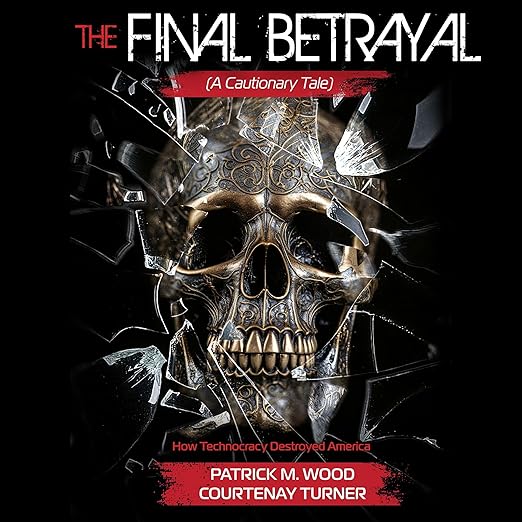
Technocracy, not communism, socialism, or fascism, is the real organizing threat behind the modern New World Order, according to the central argument Patrick Wood lays out across this three-and-a-half-hour audiobook, narrated by Katherine Quinton. Wood traces what he describes as a Technocracy movement back to the 1930s and argues it was deliberately revived by the Trilateral Commission in 1973 under the banner of what that organization itself called a New International Economic Order. The Final Betrayal presents itself explicitly as a warning rather than a balanced historical survey, and Wood states in his own synopsis that he has been making this same case for fifteen years and believes the moment for skeptics to start paying attention has arrived.
The book's specific claims run from the historical, the Trilateral Commission's founding and stated goals, through the contemporary, arguing that technocratic influence expanded significantly during the Trump presidency, and into the speculative, connecting ideas like asset tokenization, a political philosophy called the Dark Enlightenment, and artificial intelligence into a single continuous narrative Wood frames as a coordinated, decades-long project rather than a series of unrelated developments.
Framed as Preparation for a Technocratic Dictatorship
This is opinion and advocacy nonfiction built around a specific, contested political worldview, and it should be evaluated as exactly that rather than as neutral reporting or conventional history. Reviewer Don Holsclaw titles his review 'Very informative and well written book,' framing it as essential preparation for what he calls 'the Technocratic dictatorship.' Phil H. praises the research behind it and describes the book as revealing where the country is headed in the near future.
Dark Enlightenment Is a Real Political Strand
A third reviewer, writing under the handle Stormcrow Blogodidact, connects the book's arguments directly to recent government efficiency and oversight efforts, describing excitement at seeing those initiatives begin exposing what the review calls corruption schemes, before noting with some frustration that early momentum on that front seemed to stall. All three reviews share a common thread: readers who already hold some version of Wood's underlying worldview finding the book a confirming, organizing framework for concerns they arrived with, rather than listeners persuaded from a neutral starting point.
The Dark Enlightenment reference in the synopsis points to a real, named strand of political thought, sometimes called neoreaction, generally associated with skepticism toward democratic governance in favor of alternative models of authority. Wood folds it into his broader argument as one thread among several rather than treating it as his book's central focus, and listeners unfamiliar with the term should know it names an actual, documented body of political writing rather than a phrase Wood invented for this book specifically.
Quinton's Delivery Matches a Manifesto's Urgency
For listeners already engaged with Wood's broader body of work, built as the synopsis notes on fifteen years of consistent argument on this specific topic, this functions as a concentrated, up-to-date restatement of his core thesis connecting decades-old economic policy discussions to present-day concerns about artificial intelligence and digital currency. The short runtime works in the book's favor for that specific audience, delivering the argument as a focused briefing rather than padding it out with material returning readers have likely already encountered elsewhere in Wood's work.
Katherine Quinton's narration, per the urgent, declarative tone the synopsis itself uses throughout, suits a manifesto-style delivery over a measured academic one, matching the book's own rhetorical register of short, forceful claims rather than qualified historical analysis. For an audience already primed to receive this material as a call to action rather than a neutral survey, that register is the appropriate choice rather than a stylistic mismatch.
The short runtime also means this works as a single-sitting listen for anyone approaching it with real interest, rather than a multi-week commitment that risks losing the thread of Wood's connected argument between sessions. That format choice suits a book built around one continuous, escalating argument more than it would suit a work with distinct, separable chapters meant to be revisited individually.
Nearly a Century of Activity, Told as Manifesto
At three hours and thirty-six minutes, this covers an enormous claimed scope, nearly a century of alleged coordinated activity spanning economic policy, political philosophy, and emerging technology, in a genuinely short runtime. That brevity means the book functions much more as a manifesto or briefing document than as a researched historical account with room to weigh competing evidence or address counterarguments in depth, and listeners should adjust expectations for depth of evidence accordingly.
The central claims here represent Wood's own interpretation and argument rather than settled historical consensus, weaving several separate, contested ideas into a single throughline. Listeners outside Wood's existing readership should know going in that this book advocates a specific, contested reading of these institutions and events rather than presenting a neutral account both supporters and skeptics of the underlying claims would recognize as balanced.
That Decade-Old Phrase Carries the Whole Thesis
The phrase 'you will own nothing,' which the synopsis uses directly, originated in commentary connected to the World Economic Forum nearly a decade ago and has since become a widely circulated shorthand across a range of political critiques, adopted and reinterpreted well beyond its original context. Wood uses it here as connective tissue between his tokenization argument and his broader technocracy thesis, and listeners should know they are hearing one specific, contested interpretation of a phrase that has taken on a life of its own in political commentary generally.
One structural imbalance is worth flagging directly: the historical grounding early in the book, the actual founding and stated goals of the Trilateral Commission in particular, gets noticeably less runtime than the speculative material Wood builds toward by the end. Listeners hoping for the book's strongest, most verifiable historical claims to receive proportionally the most development may find the balance tilted instead toward the more speculative, forward-looking warnings that close out the audiobook.
Political Argument, Not a Financial Guide
Wood's existing readership, and listeners already engaged with technocracy-critique ideas or broader skepticism toward international economic institutions, will find this a concentrated, current restatement of his core argument, backed by a notably strong 4.6 average across 72 ratings within that specific audience. The short runtime makes it an efficient way to get an update on Wood's thinking without committing to a much longer treatment.
It is also worth naming plainly that this book covers ground far outside a conventional technology or personal-finance title; nothing here walks through software, coding, or investment strategy. Listeners expecting either of those more practical genres should know in advance that the actual content is a political argument about institutional power, not a technical or financial guide.
Readers outside Wood's existing worldview, or anyone wanting a balanced, historically rigorous account of the Trilateral Commission and related institutions that weighs mainstream and critical perspectives against each other, should look elsewhere, since this book argues a specific position rather than surveying the debate. Listeners uncomfortable with conspiracy-adjacent political nonfiction generally should also know that framing runs through the entire runtime rather than being confined to a single chapter.
Is this audiobook a neutral history of the Trilateral Commission?
No. It presents Patrick Wood's own contested interpretation as advocacy nonfiction, not a balanced account weighing mainstream and critical perspectives.
How long is this audiobook and does that match its claimed scope?
It runs three hours and thirty-six minutes covering nearly a century of claimed history, which plays out more like a manifesto or briefing than a deeply researched account.