Four grand duchesses signed their letters OTMA, using the initials of their first names, and the audiobook of The Family Romanov keeps circling back to details of exactly that size. Olga, Tatiana, Marie and Anastasia wore identical white dresses and lived almost wholly apart from the country their father ruled. Candace Fleming builds nine hours out of the gap between the palace and everything outside it, and that gap turns out to be the book's entire argument.
What Candace Fleming Delivers
Candace Fleming is working with material picked over for a century, and the description names the method precisely: first-person accounts and photographs, moving between the plight of Russia's poor masses and the extravagant lives of the family. That structure is what the readers here single out. D_shrink's five-star response calls it three spellbinding stories rolled into one and then lists them, which is the most useful summary anybody has posted on this page.
A century of Romanov books have chosen one thread. Fleming runs three at once. The intimate life of the family sits alongside the political chronology from the worker strikes of 1905 through to Vladimir Lenin taking power in 1917, and alongside the daily life of an average peasant at the turn of the twentieth century measured against the very wealthy. Jack K.'s response supplies the number that makes the third strand land: the angry and discontented peasants and factory workers made up 98.5 percent of Russia.
Kimberly Farr is credited with the whole nine hours and twenty-three minutes. The demand is a switching problem rather than a range problem: the book moves between palace correspondence, political chronology and testimony from people at the bottom of the empire, and each of those wants a different footing. The listing states the credit and the runtime and stops, which is standard practice, and leaves the switching to be discovered.
Cun Yeu's response reconstructs the spine of the book and then breaks off. It sets out how Nicholas II never wanted the throne and was forced into it after his father died, how he married Alexandra, and how their five children arrived. Then it turns toward the turmoil engulfing ordinary citizens and stops mid-sentence, right at the pivot. That is a genuine loss, because the pivot is exactly where the book does its work. The response carries an August 2023 date, nine years after publication, which is its own signal on a nonfiction title: the book is still being found by readers willing to summarize it at length for strangers.
Nicholas II is drawn in the description through one arresting pair of numbers: he ruled over 130 million people and one-sixth of the earth's land surface, and turned a blind eye to the abject poverty of his subjects. Alexandra gets a different treatment, stern and reclusive and painfully shy, a deeply religious woman fixed on the corrupt mystic Rasputin. Alexei, heir to all of it, was a hemophiliac whose debilitating illness was kept secret from the rest of the world.
Orbis Pictus Award for Outstanding Nonfiction for Children is what sits in the series field on this listing, with no volume number attached to it. That is an award, not a series. The Family Romanov is a standalone book, and anyone reading the metadata literally would go hunting for the rest of a sequence that has never existed. It is a small filing error with a real consequence, because a series field is the kind of thing a reader trusts without checking.
Where Candace Fleming Loses Some Ground
Set it aside if you want a forensic account of the murders themselves, because the awards and the press quotations point somewhere else entirely. The Wall Street Journal called it superb history. The Washington Post said it has all the elements of a fictional thriller woven into a fascinating work of history. Both are describing a book about how a system collapsed, with a family at the center of it, rather than a killing with a monarchy attached.
Camel's Toe, writing from the United Kingdom, awards five stars in a single line: compelling, history written like a novel, gutted to have finished it. Cher, from Canada, is shorter still, calling the information good and the writing solid. Those two responses do something the longer ones cannot, which is show that the book travels well and holds readers with no particular investment in Russian history before they start.
Young adult is the shelf, and the awards mostly agree with it: the Los Angeles Times Book Prize for Young Adult Literature, a Boston Globe and Horn Book Award for Nonfiction, a Robert F. Sibert Honor, a YALSA Excellence in Nonfiction finalist placing, and a spot on a Kirkus Reviews list of the best young adult books of the century. The reviewing press quoted here is adult, though, and so are the readers on this page. D_shrink arrives openly as a history buff with a standing interest in Tsarist and Czarist history. Two shelves are being served at once here, and the listing picks only one of them.
Who Should Pick Up The Family Romanov
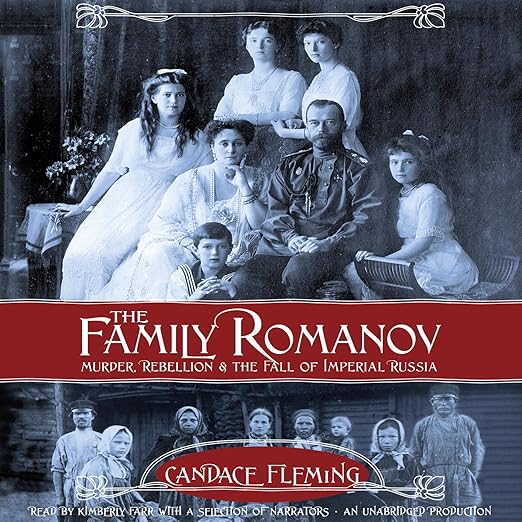
History for younger listeners often means simplification, and nothing on this page suggests that is what happened. Jack K. describes a nonfiction book that reads like an ordinary novel, with true stories and letters folded through it. The photographs the publisher promises are the one element a recording cannot deliver, and the description leans on them, calling them captivating and pairing them with the first-person accounts. In this format you get one half of that pairing. Anyone who wants the images will want the printed pages open beside the recording, and on a book this dependent on faces that is a recommendation rather than a quibble.
Listening Library published this on July 08, 2014, and the vote counter still reads one. Beneath it sit five signed and dated responses, four of them at five stars and one at four. A single vote cannot produce 4.5, and it certainly cannot produce five signatures, so whatever that badge is counting is not what a reader can see. Nine hours and twenty-three minutes on the last Romanovs is a serious ask for a young adult shelf, and the adults writing here plainly did not mind.
- Voice: Kimberly Farr is credited with the whole nine hours and twenty-three minutes, switching between palace letters, political chronology and testimony from the poor.
- Big ideas: Autocracy and willed blindness, a family sealed off from its own country, revolution arriving from below.
- Atmosphere: Absorbing, cold-eyed, novelistic.
- Worth it?: Shelved for teenagers and read by adults, which tells you most of what you need.
Questions Listeners Ask
Is The Family Romanov audiobook suitable for younger teens?
The awards point that way, among them a Los Angeles Times Book Prize for Young Adult Literature and a Sibert Honor. The subject matter is not gentle: mass poverty, autocratic indifference, a hidden illness and the family's murders at the end. Readers writing here are mostly adults, which cuts both ways.
How long is the audiobook, and how is it structured?
Nine hours and twenty-three minutes, read by Kimberly Farr. One response describes three interlocking stories: the family's private life, the political chronology running from the 1905 strikes to Lenin taking power in 1917, and the daily reality of an ordinary peasant set against extreme wealth.