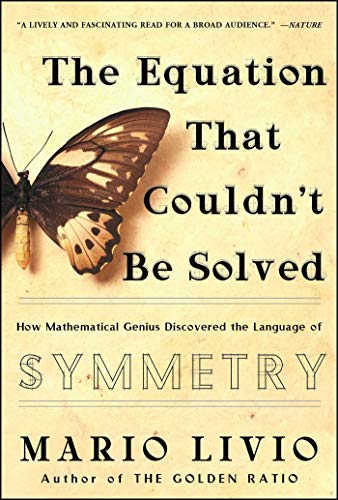
The Short Version
- Read by: Tom Parks handles the interweaving of mathematical history and cultural biography with clarity, finding the human warmth in material that could easily become dry.
- At its heart: Mathematical symmetry and group theory, the lives and deaths of Galois and Abel, the nature of mathematical genius
- Vibe: Intellectually absorbing and unexpectedly moving, the biography pulls harder than you expect
- Short version: One of the better popular mathematics audiobooks available, particularly strong for listeners who want the human story behind the equations.
I picked up The Equation That Couldn't Be Solved after finishing Mario Livio's Is God a Mathematician? and wanting more of his particular skill, which is making the history of abstract mathematical thinking feel urgently connected to everything else that was happening in the world at the time. The central subject of this book is the quintic equation, a polynomial of the fifth degree that mathematicians had struggled to solve by radicals for centuries before two young men, Niels Henrik Abel and Evariste Galois, proved independently that it could not be solved that way and, in doing so, founded an entirely new branch of mathematics.
Tom Parks narrates the eleven-hour-and-forty-five-minute audiobook, and the challenge he faces is genuine: the audience for popular mathematics books comes in at least two varieties, those with mathematical training and those without, and Livio is writing for both simultaneously. Parks calibrates his delivery to the shifts in register, slowing slightly for the more technical passages and picking up pace when the narrative returns to the biographical sequences, which is the correct instinct.
How The Equation That Couldn't Be Solved Holds Up
What distinguishes this book from other popular mathematics histories is the weight Livio gives to symmetry as a concept rather than treating it purely as a mathematical tool. He argues that symmetry is a fundamental organizing principle not just of mathematics but of music, visual art, and the physical laws of the universe, and he builds this argument across the book in a way that earns its ambition. By the time he reaches the mathematical formalization of symmetry in group theory, the reader has enough cultural context that the abstraction feels grounded.
The lives of Abel and Galois are genuinely extraordinary and genuinely tragic. Abel died at twenty-six of tuberculosis, his mathematical work ignored or dismissed during his lifetime. Galois died at twenty, killed in a duel whose circumstances remain unclear, the night before which he reportedly stayed up writing mathematical notes he believed would be his last. These are stories that sound like romantic myth and are, in fact, historically documented. Livio renders them with the precision of someone who knows the archives and the imagination of someone who understands what it means to do something brilliant in obscurity.
Why The Equation That Couldn't Be Solved Works as an Audiobook
The audio format does something particular for this book that the print edition cannot quite replicate. The shifts between mathematical exposition and biographical narrative benefit from the continuous voice of Tom Parks, who holds the tonal consistency that makes the book feel like one extended argument rather than two books in uncomfortable proximity. Parks's voice in the Galois section, where the narrative tension is highest, carries an urgency that the typography of a print book cannot convey.
Livio is also one of the more literate popular science writers working in English today, and that shows in the prose. He draws connections between the mathematics and other fields, between symmetry in group theory and the symmetry of biological organisms, between the structure of mathematical proof and the structure of musical composition, with genuine insight rather than forced analogy. The book's breadth is earned rather than gestured at.
Weak Spots in The Equation That Couldn't Be Solved
Listeners who come to this book primarily for the mathematical content should know that the rigor of the exposition is calibrated for a general audience. Group theory is introduced and made navigable, but it is not taught in depth. Those with mathematical backgrounds may find the technical treatment lighter than they want. This is a book about the ideas and the people behind them rather than a course in abstract algebra.
The book was published in 2005, which means some of the more speculative connections Livio draws, particularly in the sections linking mathematical symmetry to physics and cosmology, should be read in light of what has been learned since. Nothing in the historical and biographical material has aged, but the science-adjacent claims deserve a reader's critical attention.
Who Should Listen to The Equation That Couldn't Be Solved
This is an excellent listen for anyone who enjoyed books like Simon Singh's Fermat's Last Theorem or Marcus du Sautoy's The Music of the Primes and is looking for the next entry in that tradition of biography-driven mathematical popular science. It is specifically valuable for listeners who want to understand why symmetry matters beyond the decorative, and for those curious about why two nineteenth-century mathematicians who barely lived into adulthood continue to define how mathematicians think about structure and transformation.
Those who want strict mathematical rigor should look elsewhere. But for the listener who wants to understand what group theory is, where it came from, and why the people who discovered it lived the way they did, Livio and Parks have produced something that will stay with you past the final chapter.
Do I need a mathematics background to follow The Equation That Couldn't Be Solved?
No. Livio writes for a general audience and introduces all necessary mathematical concepts. Listeners with no mathematics beyond high school will follow the argument, though those with university-level math will find some passages lighter than they might prefer.
Does Tom Parks's narration handle both the mathematical and biographical sections effectively?
Yes. Parks adjusts his pacing for the different registers, slowing in the more technical passages and picking up speed in the narrative sequences. The result is a continuous listening experience rather than a textbook punctuated by biography.