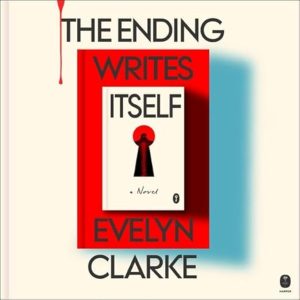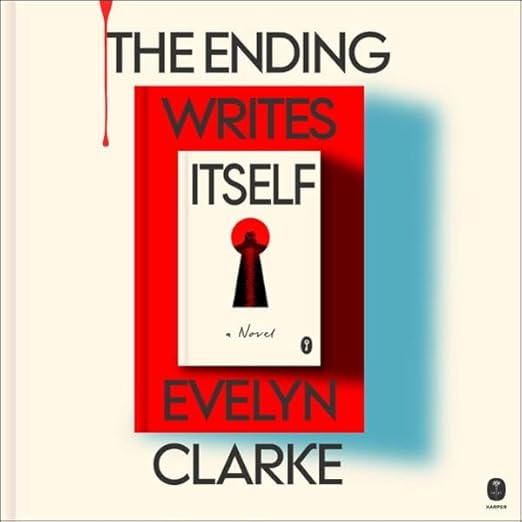
Fiona Hardingham's voice carries a particular quality of controlled revelation, and that quality is exactly what The Ending Writes Itself requires from a narrator. The debut novel from Evelyn Clarke, the collaborative pen name of Cat Clarke and V.E. Schwab, is a puzzle-box mystery that layers its misdirections with precision, and Hardingham's delivery honors the architecture without getting ahead of it or softening its edges. This audiobook rewards listeners who enjoy mysteries that know exactly what they are doing with the genre they inhabit.
What We Made of It
The premise is elegant in its construction: six struggling authors, a deceased reclusive novelist, an unfinished manuscript, and a private Scottish island. Arthur Fletch built his reputation on fiendish twists, and the authors invited to complete his final chapter quickly discover that the situation around them is doing something very similar. The meta-fictional dimension, writers inside a mystery behaving as though they are characters in one, is not merely decorative. Clarke and Schwab use it to complicate the usual mystery mechanics in ways that keep attentive listeners genuinely uncertain about what kind of story they are inside.
The Stephen King blurb comparing the book to Agatha Christie is the right reference point. The Ending Writes Itself operates in the classic closed-location tradition with specific affection for the genre it inhabits. The six authors are distinct characters rather than types, and the professional anxieties that animate them, desperation for career renewal, competitive resentment, the particular ego-bruising of literary decline, give their behavior a credible psychological texture that pure whodunit mechanics rarely achieve. These are people whose motivations make complete sense in the world they inhabit, which is harder to arrange than it looks.
Hardingham navigates the six-character ensemble with real skill. In a book where six central characters plus supporting figures need to remain distinct across nearly twelve hours of audio, maintaining clarity without making the differentiation feel mechanical is demanding work. Each character's emotional register is audible without becoming caricature, and the Scottish island setting is rendered with atmospheric restraint: sensory texture enough to feel the isolation without being buried in description that slows the mystery's momentum.
The 72-hour deadline structure gives the novel a propulsive quality that might otherwise be harder to sustain at this length. Clarke and Schwab understand how to use time pressure as a narrative engine without making it feel artificial, and the deadline creates genuine decisions rather than simply accelerating the plot. Characters must choose how to spend limited hours under pressure, and those choices reveal character as effectively as any set-piece scene could do.
The prize at stake, ghost-writing the final chapter plus guaranteed career revival, is smartly constructed as a motivator because it creates a situation where every character has legitimate reason to stay on the island and legitimate reason to be suspected. The irresistible-offer structure is a mystery tradition dating back to Christie, but the specific nature of this offer, literary success and financial security for writers who have lost both, gives it a contemporary resonance that makes the ambition and desperation driving behavior feel immediately recognizable.
The meta-fictional framing rewards active listening in ways that passive listening will miss. Clarke and Schwab seed references to Arthur Fletch's fictional techniques in ways that comment obliquely on what the book itself is doing. Listeners who enjoy that kind of layered engagement will find additional pleasure in tracking those resonances. Listeners who simply want the mystery delivered cleanly will also find it delivered cleanly, because the meta-fictional dimension operates as enhancement rather than replacement for the central puzzle.
The collaborative authorship produces something distinct from either writer's solo work: sharper in its mystery mechanics than Schwab's usual fantasy territory, with darker edges than Clarke's YA output. The synthesis reads as genuinely original rather than as a compromise between two styles, which is the best outcome of any serious literary collaboration and not something to take for granted.
What to Watch For in The Ending Writes Itself
Six protagonists require careful management, and the early chapters move quickly between perspectives to establish each character's situation. Some listeners may find the initial period slightly crowded before the ensemble settles into its rhythm. By the midpoint, the group dynamics are clear and the novel's pace becomes easier to inhabit without losing the thread of who wants what from whom.
The book's climax relies on a structural revelation that retroactively recontextualizes earlier events. This is the Christie tradition executed faithfully, and it works well in execution, but it means that the ending will be either completely satisfying or slightly strained depending on how each listener responds to retrospective reframing. Most who enjoy this type of mystery will find it genuinely surprising; those who resist the convention may need to recalibrate expectations.
The Scottish island setting is atmospheric but not deeply inhabited as a place in the way that some location-focused mystery fiction operates. Hardingham conveys the isolation effectively, but the island is primarily a pressure device rather than a setting to be inhabited fully. The book's energy is directed at character and puzzle rather than environment, which is the right priority for this kind of story.
Who Will Get the Most From It
Mystery fans who enjoy the closed-location tradition, particularly Christie-adjacent plotting with a contemporary literary sensibility, will find this audiobook a strong and satisfying choice. The meta-fictional dimension adds a layer of pleasure for readers who enjoy mysteries that are self-aware about what they are doing with the genre without becoming ironic about it.
Fans of either Cat Clarke or V.E. Schwab will find the collaboration producing something distinct from either author's solo work. Fiona Hardingham's narration is a genuine asset throughout the nearly twelve hours of material. For anyone who wants a puzzle-box mystery that takes its reader seriously, builds its ensemble with psychological credibility, and delivers a genuine surprise at the close, this is an excellent choice from two writers who clearly understand what the tradition demands of them.
Frequently Asked Questions
Is this audiobook part of a series or does it work as a standalone?
The Ending Writes Itself is a standalone novel. No prior knowledge of Cat Clarke's or V.E. Schwab's previous work is required. The book is complete in itself and does not set up a sequel.
How does the audiobook handle the six-character ensemble across nearly twelve hours?
Fiona Hardingham differentiates the six authors clearly through voice and tone, making it easy to track who is speaking and what their emotional state is at any given moment. The early chapters move quickly to establish the ensemble before the mystery fully takes hold.
Is this audiobook appropriate for fans of classic mystery fiction?
Yes, and specifically for fans of Agatha Christie and the closed-location tradition. The book operates in that mode with full awareness of its conventions. Stephen King's comparison to Christie is the most accurate available framing for what the book is doing and how it delivers its central surprise.
Does the meta-fictional element of writers solving a mystery make this audiobook feel gimmicky?
Not in practice. Clarke and Schwab use the literary-world setting to add psychological texture to motivation rather than as a surface effect. The professional anxieties of struggling authors give behavior a credible grounding, and the references to Arthur Fletch's techniques add resonance rather than distraction from the central puzzle.