
In Brief
- Narration: Marc Cashman reads for Penguin Audio, carrying a thirty-six factor protocol whose diagrams the copy parks on two outside websites.
- Themes: Metabolic causes of cognitive decline, prevention protocols, caregiving, contested evidence
- Mood: Urgent, technical, and quietly evangelical
- Verdict: Worth nine hours as the origin document for one framework, provided you hear the sample size as clearly as the promise.
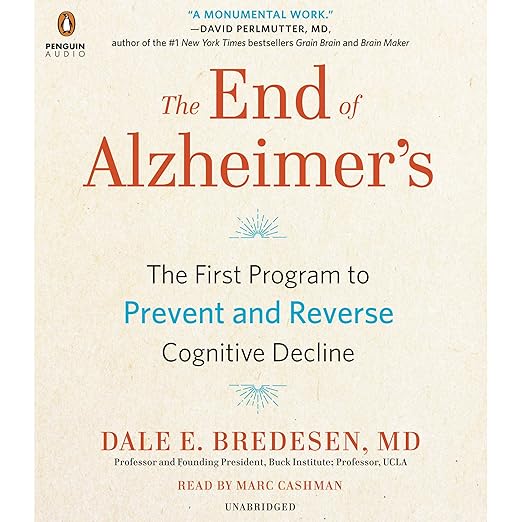
Nine hours of protocol makes for an awkward audiobook, and The End of Alzheimer's knows it. Dale Bredesen argues that the disease is not one condition but three, driven by inflammation, by shortages of the nutrients and molecules synapses depend on, and by toxic exposure, and that thirty-six metabolic factors can be rebalanced to hold off the downsizing that follows. Penguin Audio issued the recording in August 2017 with Marc Cashman reading. What reaches the ear is the case; what never reaches it is the apparatus, because the copy sends listeners to two websites for the articles and diagrams that would otherwise sit at the back of a printed edition.
Where This One Lands
Craft, in a book like this, means deciding how much a lay listener can carry. The write-up filed from Canada in September 2017 shows the framing landing exactly as designed: it reports thirty years of research, calls the result a paradigm shift, notes that roughly two hundred people had been helped by that point, and then restates the old amyloid-plaque model in a few sentences before setting the new one against it. That is the book's own rhetorical move, handed back by a reader. The argument works by demolishing a single-cause story first, which is efficient, persuasive, and worth recognizing as a technique rather than swallowing as a result.
The trouble with that shape is the evidence sitting at its center. Penguin's copy states that nine of the first ten patients on the protocol improved significantly within three to six months, and that hundreds more have followed. Ten is a small number to hang a paradigm on, and audio does nothing to slow you down at the moment it arrives. On a page you would stop at that sentence and read it again. Delivered aloud at pace, it passes with the same weight as the sleep advice and the oral hygiene advice on either side of it. Cashman's job is to deliver the line, not to flag it, and no reader could.
What Makes The End of Alzheimer's Worth Hearing
Detail is what makes the nine hours worth spending. The bilingual write-up, also from September 2017, works through the structure at length, restating the theory that the disease is a protective response to three separate processes and describing the Recode protocol that follows, which begins with a detailed exploration of the factors involved. That reviewer then appends a complete Spanish version of the whole review beneath the English one, which is unusual and quietly informative, since it shows the material being passed between languages and households rather than staying inside a clinical readership. A summary that thorough is useful before you buy, too, because it reveals how much of the book is taxonomy. A listener who wants the three-process theory without the full inventory of contributing factors can see the shape of the thing in advance and decide accordingly.
Practical value tracks with how specific the book is willing to get. Micronutrients, hormone levels, sleep, gluten, B12, oral hygiene: these are levers a person can pull without waiting for anyone's permission, which explains the audience the book found. Bredesen also hands caregivers a vocabulary. Once you can name what you are trying to move, conversations with a physician change character, and that shift is a real outcome even for a listener who ends up rejecting the protocol wholesale. Nine hours and twenty-three minutes is a long briefing, and a briefing is genuinely what it is rather than a pep talk.
What Gives Us Pause
Read the oldest response on the listing before you buy, because the site has logged it at five stars while its own headline says one. Written days after the August 2017 release and revised since, it explains that the reviewer's opinion changed: the diet and lifestyle material still holds up, but the author's later focus on expensive and unproven products and methods does not, and the recommendation now points toward The Alzheimer's Solution by Dean and Ayesha Sherzai, or Keep Sharp by Sanjay Gupta. The star field records none of that reversal. Layering an update onto an older review is ordinary enough on a retail page. What is not ordinary is a page that has kept the star value from the first pass and the text from the second, leaving the two halves of a single response to contradict each other in public.
Now check the aggregate. A 4.5 average is displayed against five ratings, yet five whole-star ratings can only average out at 4.4 or 4.6, never the figure shown. All five written responses meanwhile carry a five-star value, including the one whose text argues the opposite. Very little in that column can be taken at face value. The deeper caution is structural: the protocol as published rests on a very small initial series, and a listener who wants trial data, control arms and replication will not find any of the three inside these nine hours.
Who Should Listen to The End of Alzheimer's
Aubergine, writing from the United Kingdom in April 2018, draws the most practical boundary anyone has drawn around this book. The information is sufficient for a sympathetic doctor to work from, that response says, but someone already experiencing cognitive impairment would need considerable support to follow the protocol to the letter, and doing it in conjunction with the author's organization could start to get costly, though still cheaper than the care Alzheimer's eventually demands. That is the cost-benefit statement the book itself never quite makes about its own program. Three of the five responses on file were written outside the United States, which is worth knowing before you assume the plan travels unchanged across health systems, laboratory conventions and grocery aisles.
Listen if you are a caregiver assembling questions, a physician curious about the metabolic framing, or someone with a family history who wants the levers named out loud. Approach with caution if you want a treatment you can begin unsupervised, since the program assumes lab work, a clinician, and a household willing to change how it eats. The audience the copy addresses is patients, caregivers, physicians and treatment centers together, which tells you how many people are expected in the room. Nine hours will not settle whether the protocol works. It will leave you considerably better equipped to ask.
Good to Know
Does the End of Alzheimer's audiobook include the diagrams and reference charts?
No. The recording gives you nine hours and twenty-three minutes of argument and instruction, and the copy directs listeners to two websites for the articles and diagrams instead. On a program with thirty-six moving factors, that is a real gap. Plan on keeping a browser open, or the reference material simply stays out of reach.
Is the audiobook usable without a doctor involved?
Only partly. Diet, sleep, gluten and oral hygiene are changes anyone can start alone. The core of the program depends on lab work, hormone levels and micronutrient measurement, none of which a listening app can order for you. The copy addresses patients, caregivers, physicians and treatment centers together, which tells you who belongs in the room.
How current is the research behind a 2017 release?
The recording carries the argument as it stood in August 2017, built on the first ten patients to follow the protocol with hundreds reported afterward. Nothing published later appears in these nine hours. Treat the audiobook as the origin document for one framework rather than a survey of where the field stands now.
What does the protocol actually ask you to change day to day?
The copy names micronutrients, hormone levels and sleep as the categories, with B12, eliminating gluten and improving oral hygiene given as worked examples. The full program runs to thirty-six factors, which is why the book keeps circling back to measurement. Expect a long list of small adjustments rather than one decisive intervention.







