Key Details
- Narrator: One reader across a book that keeps switching between bedside scenes and institutional history, where consistency matters more than color.
- Subjects: The history of oncology, medical ambition and its costs, the machinery behind the science, a disease told as biography.
- Tone: Sober and absorbing.
- Bottom line: Worth every one of its hours, provided you actually have them to give.
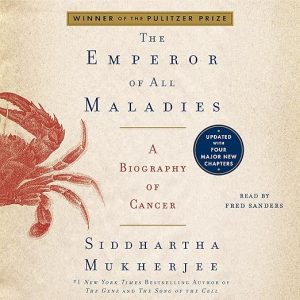
Length is the first decision you make here, and it is not a small one: twenty-seven and a half hours spent on oncology, running from the earliest recorded appearances of the disease through a century of campaigns to cure it, plus four new chapters written fifteen years after the original. The verdict is straightforward and the caveat is entirely about stamina. Siddhartha Mukherjee's biography of cancer won the Pulitzer, and this audiobook, narrated by Fred Sanders for Simon and Schuster Audio, is the updated 2025 edition rather than the one that built the book's reputation. What has changed since 2010 in detection, prevention, treatment and the basic understanding of the cell is why the new material exists, and the reason a listener who already knows the book might come back to it.
Four New Chapters Update a Cancer Biography
Calling a book about a disease a biography sounds like a conceit until you hear it work. Mukherjee gives cancer a life story: an origin in the earliest medical texts, a long adolescence of trial and error, and a maturity in which the disease turns out to be a distortion of our own cells. Running through it is the author's own formation, which the review column traces back to his residency at Dana Farber, where an oncologist, researcher and professor of medicine started writing the thing while still in training. The double structure is what keeps twenty-seven hours moving, since every scientific advance arrives attached to somebody who wanted it badly.
Additions in this edition are substantial rather than cosmetic. The description promises four new chapters covering what has changed in detection, prevention, treatment and understanding across the fifteen years since first publication, describes them as essentially a new book about cancer, and says they combine a wide view of the landscape with a tight focus on the role of the cell before turning toward studies still to come. Structurally that means the update sits at the end of an already enormous book, so anyone returning specifically for the new material faces a choice between skipping ahead and re-listening to a masterwork they have already finished once.
Sanders Keeps the Recurring Figures Memorable
Prose is the reason this book escaped the medical shelf, and the responses keep circling that quality without quite naming it. The second-newest of them credits the sheer volume of research behind the text while insisting the writing stays fluid, and singles out the way people and concepts reappear at different moments of the story, so that a figure introduced in one decade turns up transformed two chapters later. That recurrence is what audio does well. Names you would flip back to check in print instead accumulate in memory, and by the final stretch the century of research feels less like a chronology of discoveries than like a cast of people arguing across time.
Weight comes from the numbers, and the book never lets you forget what is being counted. The oldest response opens on Voltaire's line about doctors prescribing medicines of which they know little to cure diseases of which they know less, then sets against it the scale of the problem as it stood when the book appeared: six hundred thousand deaths in the United States in 2010 alone and seven million worldwide. Mukherjee writes with those figures always present, which is why the laboratory chapters never read as abstract. Somebody is dying while the argument about mechanism goes on, and the book keeps that fact in the room.
Original 2010 Reviews Never Read the New Chapters
Written evidence on this record belongs to a different edition. Four of the five responses were filed between 2011 and 2016, judging the original 2010 book rather than the recording released in November 2025, and none of them can have read the four new chapters that are the reason this version exists. One counts the book at six hundred and eight pages, which is a print measurement attached to an audio product. The newest response is not in English at all and grades the printing and physical quality of a paper copy. Useful information for somebody, but not for anyone deciding on this file.
Pacing is the substantive complaint, and it comes from the only response that withholds a star. That four-star praises the way the strands of historical oncology are pulled together, then reports the book dragging at times and spending too long on what it calls the administrative side of medicine, adding that the whole may be more useful to non-medical listeners than to clinicians. Both halves of that ring true. Administrative history occupies real stretches of the running time, and a listener who came for bedside drama will feel the shift into institutional history every time it happens.
Twenty-Seven Hours Demand Real Reader Stamina
Readers of narrative nonfiction who want a subject large enough to justify a month of listening are the obvious audience, and so is anyone working in or near medicine who has never seen their field's history laid out whole. Patients, survivors and the people around them may find the context steadying, provided they know in advance that nothing here gets softened. Students of the history of science get a demonstration of how knowledge actually advances, through error, ego and institutional inertia as much as through insight. And listeners who enjoyed the book years ago now have a version with the last fifteen years attached.
Three things decide against it. The first is stamina, since twenty-seven hours is a genuine commitment and the density never lets up enough for casual listening. The second is the material itself, which is unsparing about suffering and about treatments that did more harm than good. The third is expectation: anyone arriving from the health and wellness shelf, where this record is partly filed, will find no advice, no protocol and no prevention plan, because the book is a history of a disease and of the people who fought it, not a guide to avoiding it.
Before You Listen
Is this audiobook the updated edition with the four new chapters?
Yes. Simon and Schuster Audio issued this version in November 2025, and the additional chapters are the reason it exists at all. Anyone who already owns an older recording is paying for what has changed since 2010 rather than for a fresh pass through familiar ground, so weigh that before buying twice.
How difficult is the science in this audiobook for a general listener?
Manageable throughout. The book explains as it goes and builds each advance around the person who pursued it, so cell biology arrives inside a story rather than ahead of one. No prior science is assumed; what the material demands instead is patience across a very long stretch.