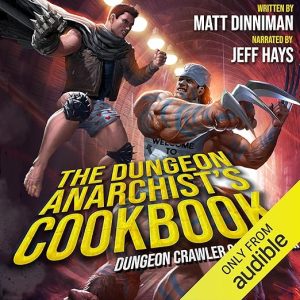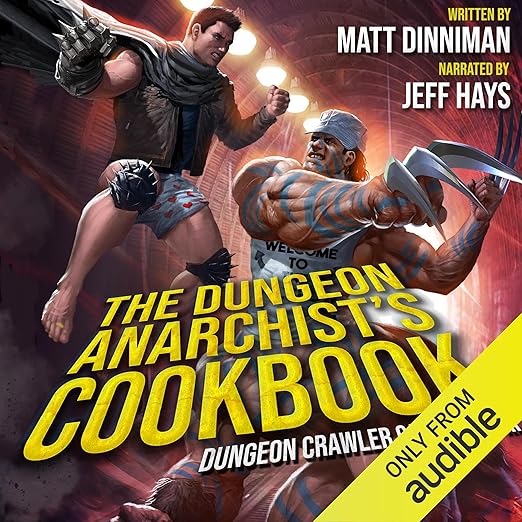
Carl and Donut are back, and the fourth floor of the dungeon is an impossibly complicated subway system assembled from the world's subterranean rail networks, knotted together into something that should not be survivable. Reviewer Jim Hardison ordered the fourth and fifth Dungeon Crawler Carl books while he was still halfway through this one, and that is perhaps the most accurate possible summary of what The Dungeon Anarchist's Cookbook delivers as an audiobook: the kind of experience that makes you want more before it has finished giving you what you came for.
This is book three in Matt Dinniman's Dungeon Crawler Carl series, narrated by Jeff Hays, and it runs sixteen hours and fifty-four minutes. The LitRPG and GameLit spaces have produced a substantial volume of content in recent years, but this series has maintained a reputation that stands clearly apart from the field, and this third entry demonstrates why. Hays's performance is a significant and central part of that reputation, and the audiobook format is arguably where Dungeon Crawler Carl is most fully realized as a creative work.
Dinniman's central formal innovation across this series is the way he uses the game's mechanics, the sponsorship program now open, the difficulty ramping up, the top ten list populated, simultaneously as both narrative structure and satirical target. The dungeon is a spectacle designed for alien entertainment, and the crawlers are contestants who have fully internalized that they are being watched and judged. That self-awareness is what separates the series from simpler LitRPG fare and from the earnest power fantasy that defines much of the adjacent genre space. Carl and Donut are not simply trying to survive the next floor. They are navigating a system that wants them dead while learning to understand and exploit that system's own internal logic.
The Iron Tangle, the fourth floor's central geography, is the most elaborately designed environment Dinniman has constructed to this point in the series. Up is down. Down is up. Close is far and far is close. The subway cars move through the tangle carrying monsters, the stations are hostile and unreliable, and the exit is always conceptually near but practically unreachable. As a spatial puzzle, the Iron Tangle requires more sustained attention from the listener than the earlier floors, and Hays's narration keeps the geography coherent even when the rules of the space are deliberately designed to be disorienting and contradictory.
Hays Voices Every Name on Lesser's List
Jeff Hays. Any evaluation of this audiobook series must eventually return to his performance, and the reason is simple and observable: Dungeon Crawler Carl has an enormous and varied cast of characters with sharply distinct personalities, voices, and registers, and Hays differentiates all of them while maintaining Dinniman's narrative voice as a consistent and reliable through-line across every installment. Carl's deadpan exterior concealing a constantly running tactical mind is distinct from Donut's theatrical self-aggrandizement, which is distinct from the various crawlers, monsters, and AI entities that populate the fourth floor. Maintaining those distinctions across sixteen-plus hours without the vocal palette ever feeling depleted or repetitive is a real technical achievement.
Reviewer Lisa Lesser identifies the appeal as a combination of mind-bending puzzles, terrifyingly strong creatures, and Earth-destroying aliens wrapped in strategy and dark comedy, and that list captures the tonal range Hays is managing throughout. He moves from genuinely threatening combat to a comic Donut announcement to a quietly devastating emotional moment within the span of a few pages, and he handles each register with appropriate weight and timing. The massive emotional wallops that Jim Hardison mentions are genuinely earned through everything the narration builds before they arrive, and their impact depends on the tonal consistency Hays maintains across the full runtime.
Her Least Favorite Carl Book, Still Four Stars
The shift in this installment toward ensemble cooperation is the narrative development most worth tracking as you listen. The synopsis notes explicitly that for the first time, the crawlers are all working together, and that change affects the tone of the book significantly. The series began with Carl largely improvising alone, relying on his own tactical intelligence and Donut's particular set of abilities. The fourth floor requires coalition building, shared strategy, and a degree of trust between characters who have rational reasons not to trust each other. Dinniman handles that transition with more psychological nuance than the premise strictly requires, and it is characteristic of how he operates throughout the series.
Reviewer Karissa Eckert's note that this is her least favorite Dungeon Crawler Carl book while still rating it four stars is worth taking seriously as calibration for expectations. The Iron Tangle's design as a spatial puzzle is more abstract than the physical environments of the earlier floors, and that abstraction occasionally slows the momentum in ways that book one and book two do not. The payoff when the secret hidden in the seemingly useless book finally comes into focus is substantial and worth the patience required to get there, but some listeners may find the middle section of the fourth floor demanding more attention than it immediately rewards.
Begin at Book One, Not Here
Begin at book one. This is not a series entry point, and the emotional investment in Carl and Donut, the specific horror of the dungeon's systemic cruelty, and the significance of what is finally revealed about what happened to Earth all require the full context of the first two audiobooks to land with the force they are designed to carry. Arriving here without that foundation means encountering a story that works on the surface but misses most of what makes it moving.
For listeners already committed to the series, The Dungeon Anarchist's Cookbook delivers on every promise the earlier books have made and introduces complications that make clear the fourth and fifth installments are worth the further investment. LitRPG and GameLit readers who have somehow not yet found Dungeon Crawler Carl should start immediately and let Jeff Hays and Matt Dinniman work their particular combination of satirical intelligence and genuine emotional investment on them from the beginning. The series earns its fanbase's enthusiasm.
What makes Jeff Hays's narration of this audiobook series stand out?
Hays maintains a large and distinctive cast across a long runtime while keeping the narrative voice coherent and his vocal range wide. He differentiates Carl's deadpan tactical interior from Donut's theatrical imperious commentary from the various monsters and crawlers with enough distinctness that the listener never loses track of who is speaking, and his handling of the emotional passages is as strong as his comedic delivery.
How long is The Dungeon Anarchist's Cookbook audiobook, and is it worth the time investment for series fans?
The audiobook runs sixteen hours and fifty-four minutes. Multiple reviewers ordered the fourth and fifth books before finishing this one, which is the clearest possible testimony about the investment being worth the time. If you are already a series fan, this installment rewards patience particularly well in its second half.