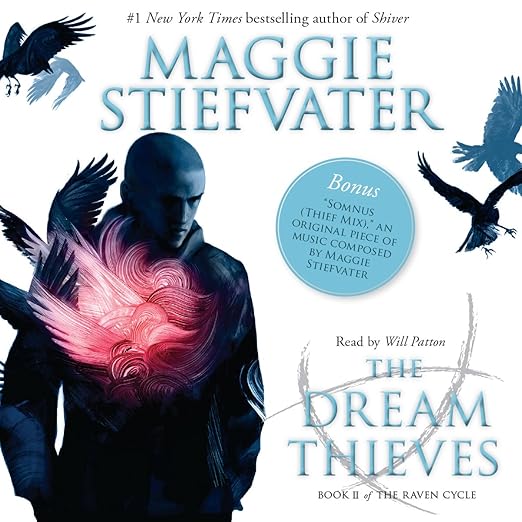
Ronan Lynch is the character Maggie Stiefvater held back in The Raven Boys, and The Dream Thieves is what happens when she finally puts him at the center. I finished this audiobook on a long road trip that happened to line up with the shift in tone from Book 1 to Book 2, and that turned out to be the right context for it. Stiefvater's prose in the second Raven Cycle entry is darker and stranger than the opener, built around dreams as literal reality and the specific terror of not knowing which is which. Will Patton narrates. That matters considerably more than it might with a different text. Stiefvater's world requires a voice that can hold the surreal alongside the mundane without the seams showing, and Patton has been doing that across this series in a way that is now inseparable from how the Raven Cycle sounds.
The audiobook is twelve hours and forty-five minutes, slightly shorter than The Raven Boys, but denser. Stiefvater is not repeating the first book's orientation arc. She is assuming you already know the geography of Cabeswater, the dynamics between Gansey, Adam, and Blue, and she proceeds directly into what changes now that the ley lines are awake.
Why The Dream Thieves (The Raven Cycle, Book 2) Works as an Audiobook
Will Patton's performance across the Raven Cycle has become one of the defining audiobook narrator-text pairings in contemporary YA. His Ronan Lynch is not the performance of a complicated character; it is the inhabitation of one. Ronan's voice in Patton's reading carries the exhaustion and the aggression and the buried care simultaneously, without any of those qualities overriding the others. That tonal complexity is exactly what the book requires, because Ronan in The Dream Thieves is a character at war with himself in ways that would read as melodramatic in lesser hands. Patton makes it feel inevitable.
The subplot involving Kavinsky, a character who functions as a dark-mirror version of Ronan, is where the audiobook is at its most compelling and also where Stiefvater's craft is most visible. Kavinsky is written as what Ronan could become without the constraints of loyalty and love, and the scenes between them in audio have a particular charge that Patton carries by keeping both characters at the same register of controlled danger. Neither character registers as safe in those scenes. Both voices sound like they are capable of anything.
Weak Spots in The Dream Thieves (The Raven Cycle, Book 2)
This audiobook requires you to have listened to The Raven Boys first. Stiefvater does not re-establish her world or her characters; she builds on them. Listeners who come to The Dream Thieves without that foundation will miss why the awakening of the ley lines in Cabeswater represents a shift in stakes, and why Ronan's particular ability, which the audiobook reveals and develops, carries the weight it does for the group dynamic. Series order is not optional here.
One reviewer described this as a book that surpassed The Raven Boys, and the specific reason they gave is worth noting: the main conflicts and subplots from the first book finally resolve and escalate in the second. For listeners who felt The Raven Boys was building toward something and wanted to see that something arrive, The Dream Thieves delivers on that expectation more forcefully than sequels typically manage. The book is not marking time between Book 1 and Book 3. It is a significant development in its own right.
The surreal quality of Stiefvater's dream sequences is a potential sticking point for listeners who prefer grounded YA fantasy. The lines between sleep and waking, between what Ronan creates in dreams and what he brings into reality, are deliberately blurred. Stiefvater is not interested in making that easy to follow. Patton's reading reflects that instability rather than clarifying it, which is the correct interpretive choice but one that requires listener patience with ambiguity.
Stiefvater's decision to refocus the second Raven Cycle book on Ronan was not inevitable. Many YA series keep their focus on the character who anchors Book 1 and treat the ensemble as supporting. The Dream Thieves essentially demotes Gansey from protagonist to ensemble member for most of its runtime, which is an authorial confidence move that a less assured writer would not attempt midway through a planned series. The bet pays off because Ronan's interiority, his relationship to his dreams and to what he is capable of doing with them, opens a dimension of the Raven Cycle that the first book could only gesture toward. The cost of that shift is that Blue's perspective, which anchored much of The Raven Boys, is less present here. Listeners who came to the series primarily for Blue's voice will notice the shift. Those who were drawn to Ronan's marginal role in Book 1 and wanted more of him will find Book 2 answers that precisely.
The Right Listener for The Dream Thieves (The Raven Cycle, Book 2)
Listeners who completed The Raven Boys and want to continue with Will Patton narrating should have no hesitation. The audiobook is a strong continuation that deepens what the first entry established without simply extending it. Reviewers who found the Raven Cycle characters unusually real, 'hitting so close to home' as one reviewer put it, will find that quality intensified here. Stiefvater is doing serious work with these characters, and Patton's narration honors that.
Listeners who have not started the Raven Cycle and are considering where to begin should start with The Raven Boys. This audiobook is not a standalone entry point. For YA listeners who want fantasy that trusts them to hold complexity and ambiguity without resolving everything neatly, the Raven Cycle is one of the strongest series in the genre, and The Dream Thieves is where it commits to the full weight of what it was building.
Can I listen to this audiobook without having heard The Raven Boys first?
No. Stiefvater does not re-establish her world or characters in this book. The Dream Thieves builds directly on the first entry's events, character dynamics, and the awakening of the Cabeswater ley lines. Listeners who start here will miss the foundation that makes the second book's developments meaningful.
Is Will Patton's narration consistent across the Raven Cycle audiobook series?
Yes. Patton has narrated the full Raven Cycle series and has developed a consistent voice for each character across the books. His Ronan Lynch in particular has become inseparable from how the character is understood by audiobook listeners. Series listeners who started with Patton should continue with him.
At what age range is this audiobook appropriate, and does the YA label limit its appeal?
The Raven Cycle is shelved as YA but regularly read by adults, and The Dream Thieves is written for that full range of readers. The emotional and thematic complexity is not age-limited; the YA label reflects the age of the protagonists rather than the depth of the material. Adult listeners who dismissed the series on genre grounds have consistently found the Stiefvater-Patton pairing rewarding.