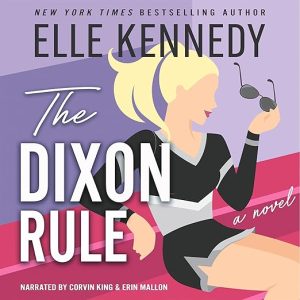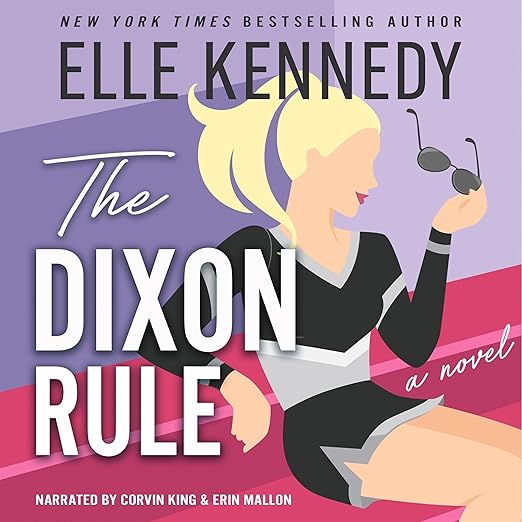
Diana Dixon established herself in The Graham Effect as a character with strong opinions and a precise sense of where her boundaries are. The Dixon Rule, the second book in Elle Kennedy's Campus Diaries series, gives her the full lead. Shane Lindley, new neighbor and hockey player working through the end of a long-term relationship, impulsively tells his ex that he has a new girlfriend, and then names Diana. The setup is efficient and plausible within the logic of two people who have good reasons to need the arrangement to work. This audiobook runs thirteen hours and seventeen minutes, narrated by Erin Mallon, and it is set in the same extended universe as Off Campus and the Briar U novels.
Kennedy's particular skill in this genre is making the comedy feel earned rather than constructed. The fake relationship here is not simply a device to get two attractive people into proximity. It has real stakes for both: Diana's ex cannot take the hint that it is over, and having a credible boyfriend solves a specific problem for her. The mutual utility of the arrangement is what makes the early chapters work so well. Mallon executes the dialogue with the timing of someone who understands that in Kennedy's books the banter is where the romance lives, not just the emotional peaks.
A Closer Look at The Dixon Rule
Mallon is one of the more reliable narrators working in this genre, and her rendering of Diana is the audiobook's consistent strength. Diana is introduced in the series with a specific personality profile: competent, carrying real preconceptions about who Shane is, and not especially interested in revising them. Mallon gives her a voice that is critical without being shrill, and she modulates it precisely as Diana's defenses start developing genuine cracks over the course of the thirteen hours. The ballroom dance competition subplot, which runs alongside the hockey season and the ex-boyfriend complications, gives Mallon additional texture to work with, and she uses it well.
Shane is one of Kennedy's more interesting male leads in this universe. He is explicitly characterized as someone sick of hookups, actively wanting a relationship, and operating from a place of genuine emotional availability rather than performing tortured unavailability. That characterization makes the fake-dating dynamic function differently than it does in a book where the male lead is the resistant one. Here, Shane is doing most of the wanting, and the interesting friction is Diana's resistance rather than his. Reviewers note this dynamic as one of the book's pleasures: Diana's preconceptions about who Shane is being gently dismantled by the reality of actually knowing him.
What Makes The Dixon Rule Worth Hearing
The Campus Diaries series benefits from the enormous world Kennedy has built across Off Campus and Briar U. Listeners already embedded in that universe will find returning characters and familiar settings that enrich this installment without being necessary for following the plot. New listeners can enter The Dixon Rule without prior reading, though some of the resonance of returning characters will be lost. Several readers arrived here directly from binge-reading The Graham Effect and found the transition smooth.
At thirteen hours and seventeen minutes, this is not a short listen, but Kennedy's pacing ensures the length never becomes deadweight. The multiple plot threads, the ballroom competition, the hockey season, the ex-boyfriend management, and the fake-relationship escalation, are braided together in a way that keeps different sources of tension active across the runtime. Mallon handles the transitions between these threads with clarity, and her ability to distinguish the characters by voice, without resorting to cartoonish differentiation, makes the longer conversation-heavy sections easy to follow without losing the individual texture that makes Diana and Shane worth spending thirteen hours with.
Things to Know Before Starting The Dixon Rule
Listeners who have read or listened to The Graham Effect will notice structural parallels between the two Campus Diaries books in how Kennedy constructs her romances. The fake relationship architecture here echoes the forced proximity mechanics of the first book. Whether that consistency reads as a signature style or a repetitive formula depends on what you are looking for from the series. Readers who loved the first book will find the familiarity reassuring rather than limiting.
The spice level is consistent with Kennedy's reputation and with the new adult romance category: meaningful, present, and handled with Mallon's characteristic directness. The book is not exclusively focused on its physical dimension, but listeners who prefer their romance lower-heat will want to know the temperature before committing to thirteen hours. The resolution of the ex-boyfriend subplot provides a satisfying secondary emotional payoff alongside the main romantic arc, and Kennedy wraps both threads with her usual clean efficiency.
Who Elle Kennedy Is Writing For
Readers already in Elle Kennedy's campus romance universe will find this an easy and enjoyable next step, particularly those who formed an attachment to Diana in The Graham Effect and wanted more of her perspective and voice. Mallon's narration is a genuine asset for anyone who responds to strong character voice work in audio rather than on the page.
New listeners to Kennedy's work can begin here without difficulty, though the Briar U and Off Campus context adds richness that rewards more extensive reading of the extended universe. Listeners who prefer their fake-dating romance with clear emotional interiority, real comedic investment, and a protagonist who earns her happy ending through specific character growth rather than simply capitulating will find both Diana Dixon and Kennedy's plotting reliably satisfying across the runtime.
Do I need to have listened to The Graham Effect before starting The Dixon Rule audiobook?
The Dixon Rule works as a standalone. Diana is a returning character from The Graham Effect, and some plot resonance will be deeper with that context, but Kennedy does not require prior knowledge to follow the romance or its resolution.
How does Erin Mallon's narration handle Diana Dixon's voice specifically?
Mallon gives Diana a sharp, sardonic quality that suits her established character: she is critical and guarded by default, and Mallon tracks the gradual softening of that stance across the audiobook's thirteen hours with precision. The banter with Shane benefits significantly from her comedic timing.
Is The Dixon Rule audiobook better as a series entry or as a standalone romance?
It functions well as both, but listeners already embedded in Kennedy's campus universe will get additional texture from the returning characters and settings. The fake-dating romance itself is self-contained and does not require the extended universe for full emotional payoff.
What is the spice level of The Dixon Rule audiobook?
The romance has a meaningful and present physical dimension, consistent with Kennedy's new adult romance catalog. Mallon narrates those sequences with directness and maintains them within the emotional arc of the relationship rather than treating them as isolated set pieces.