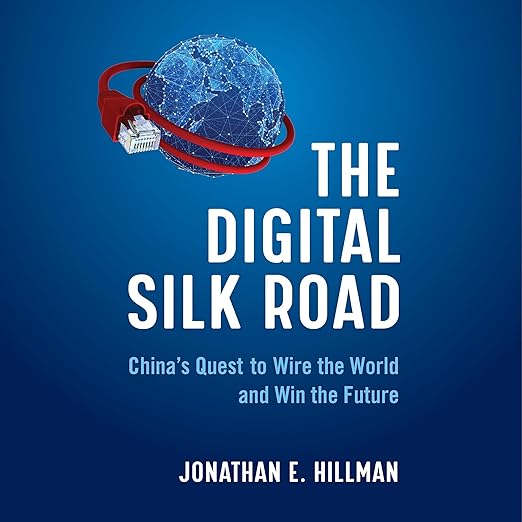
Quick Take
- Narration: James Fouhey delivers assured, authoritative narration that handles geopolitical complexity with clarity, giving the investigative material the gravitas it needs.
- Themes: Chinese tech expansion, digital infrastructure as geopolitical power, US-China strategic competition
- Mood: Urgent and investigative, with a policy journalist’s precision
- Verdict: One of the more rigorous and grounded accounts of China’s digital infrastructure ambitions, recommended for anyone trying to understand how the competition for global networks actually works on the ground.
I listened to The Digital Silk Road over three evenings, mostly because it has the rare quality of investigative nonfiction that compels you to schedule the next listening session before the current one has ended. Jonathan Hillman is a senior fellow at the Center for Strategic and International Studies, and the authority that credential implies is backed up in practice: this is not a book assembled from news headlines and think-tank reports, but a work of original research that took Hillman from inside China’s surveillance state to rural America to Africa’s megacities.
The question at the center of the book is deceptively specific: what does China’s expanding digital footprint actually look like when you get close enough to see it? Hillman’s answer moves through submarine cable networks on the ocean floor, satellite systems in low Earth orbit, 5G infrastructure negotiations in developing nations, and the specific business practices of companies like Huawei and ZTE in markets the United States has neglected or exited. The scope is enormous, but the book’s on-the-ground methodology keeps it concrete.
The Ground-Level Reporting That Distinguishes This Work
What separates The Digital Silk Road from policy papers covering the same territory is Hillman’s commitment to showing rather than asserting. When he describes how Chinese infrastructure investment in an African nation works in practice, he is describing something he has seen and documented, not summarizing a diplomatic cable. When he discusses the commercial incentives that drive Huawei’s international expansion, he is drawing on interviews with the people involved in those decisions, not just government statements.
James Fouhey’s narration is precisely calibrated to this material. He brings the measured authority of a documentary narrator without flattening the urgency of what Hillman is describing. The book has genuine stakes, Hillman’s argument is that if China becomes the world’s chief network operator, the United States faces a structural loss of commercial, intelligence, and diplomatic advantage that cannot easily be reversed, and Fouhey communicates those stakes without editorializing.
The Strategic Argument and Its Nuances
Hillman resists the temptation to make his argument simpler than the evidence supports, which is both the book’s intellectual integrity and its occasional cost in narrative momentum. He is clear that China’s digital dominance is not yet assured, that Beijing remains vulnerable in specific dimensions, and that the United States and its allies have genuine opportunities to offer alternatives. This is more honest than a straightforward threat narrative, but it means the book’s policy implications require the listener to work slightly harder than a cleaner argument would demand.
The analysis of why the United States ceded ground in emerging markets, a combination of commercial risk aversion, regulatory complexity, and strategic inattention, is among the most useful sections for American listeners. Hillman is not interested in assigning blame as much as in diagnosing the structural conditions that produced the current situation, and that diagnostic approach makes the book’s recommendations more credible than advocacy-oriented alternatives.
Reviewers Who Know the Territory
The 4.4 average from 101 reviews is notable for a policy-oriented technology book, which typically attracts smaller but more discerning audiences than popular business titles. The reviewer who identifies Hillman as a “top China scholar with chops to really look at China’s long-game approach” is describing what the research base confirms: this is not a pop-geopolitics book written for a general audience by a journalist working from secondary sources. It is a specialist’s work made accessible.
The reviewer who describes it as “occasionally turgid but mostly readable” is being accurate rather than critical. Dense analytical content organized around a geopolitical argument will have sections where the documentation weight slows the narrative. For listeners who want to understand the Huawei question and the 5G debate at a level beyond what news coverage provides, those sections are necessary rather than optional.
Listen if you want to understand the actual mechanics of how China is building digital infrastructure leverage across developing nations and what the United States would need to do differently to compete effectively. Listen if you follow technology policy at a level beyond news headlines. Skip this one if you are looking for a technology thriller or a simple villain narrative; Hillman’s approach is too analytically rigorous and too honest about American failures for that kind of reading.
Frequently Asked Questions
Does The Digital Silk Road require deep knowledge of China-US relations to follow?
No, though some familiarity with the general contours of the US-China technology competition, Huawei, 5G, and Belt and Road Initiative, will help listeners move through the early chapters more efficiently. Hillman contextualizes his reporting clearly enough that general readers can follow, but the book is most rewarding for listeners who bring at least a working knowledge of the diplomatic and commercial background.
How current is the research given how quickly the US-China tech competition moves?
Hillman’s on-the-ground reporting and structural analysis of why the competition developed as it did remain relevant and durable. Specific policy positions and individual company situations will have evolved since publication, but the underlying dynamics, China’s strategic patience in infrastructure investment, America’s structural challenges in competing in emerging markets, are if anything more pronounced now than when the book was written.
James Fouhey narrates a lot of nonfiction. Does his style fit the material here?
Fouhey is well-matched to this content. He brings the measured authority that investigative policy nonfiction needs without flattening the urgency of Hillman’s argument. The narration is clear and consistent across nearly ten hours of geopolitically dense material, which is not a trivial accomplishment.
Does the book take a political position on the US response to China’s digital expansion?
Hillman makes specific policy arguments, particularly around the need for the United States to take greater risks in emerging markets and to innovate its approach to network infrastructure investment. These are identifiable positions, but they are grounded in documented evidence rather than ideology. The book acknowledges US failures and Chinese vulnerabilities with equal attention, which makes the policy recommendations feel earned rather than partisan.