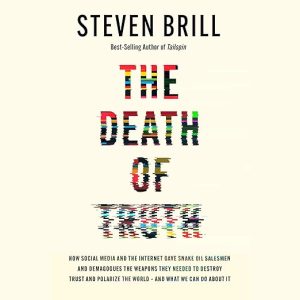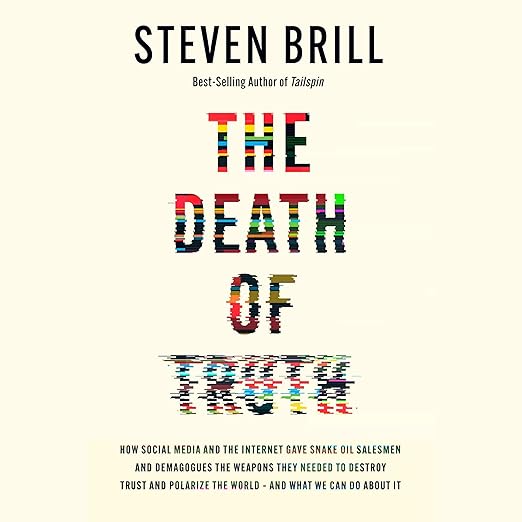
Steven Brill cofounded NewsGuard to track online misinformation, and this audiobook is his attempt to explain, in plain terms, how a shared sense of fact fell apart across an entire information ecosystem. He moves from Silicon Valley boardrooms where engagement-maximizing algorithms get coded, to the advertising exchanges that quietly reward divisive clickbait over reliable journalism, to Moscow-linked disinformation campaigns, to Washington politicians who found it useful to exploit all of it. The stakes are not abstract for Brill personally either; his company's role exposing Russian disinformation operations reportedly drew the attention of a Russian agent targeting him and his family. This is investigative journalism with real teeth, narrated for listeners who want to understand the machinery behind the chaos rather than just another op-ed about polarization.
Woren Lets the Material's Urgency Come Through
Dan Woren narrates with the same even, well-paced authority that has made him a reliable choice for long-form investigative journalism before, and that steadiness matters for a book covering this many fronts at once. Brill's argument moves across tech policy, advertising economics, foreign intelligence operations, and domestic politics within a single chapter sometimes, and a narrator prone to over-dramatizing any one thread could easily tip the whole thing into alarmism. Woren does not do that. He treats each register, the technical explanation of ad-tech auctions, the more personal account of Brill's family being targeted, the policy proposals near the end, with the same measured clarity, letting the material's own urgency come through instead of performing urgency on top of it.
The book's credibility is helped by who is willing to vouch for it. Timothy Snyder, the historian behind On Tyranny, called it 'a precise description of the punishment cell we have built around our minds and the first few steps back towards light and air,' and Bob Woodward offered similarly strong praise. Brill's own background as a veteran journalist, having spent decades investigating institutions before founding a company built specifically to fact-check news sources, gives the book a reporter's texture rather than a pundit's. He names specific companies, specific ad-tech mechanisms, and specific decisions made by named executives, which keeps the argument grounded in documented behavior instead of vague hand-wringing about the internet in general.
AI Threatens to Make This Exponentially Worse
What distinguishes this from the many other books about misinformation is how far into the machinery Brill is willing to go. He does not just assert that algorithms reward outrage; he walks through how automated advertising buying systems actually work, how they financially reward click-baiting content while penalizing reliable publishers, and how that specific financial incentive, not just human gullibility, shaped the last decade of online discourse. The book also covers how America's own social media and advertising tools have been turned against the country by foreign adversaries running disinformation campaigns, and closes with concrete prescriptions rather than vague calls for more civility. Listeners who want the how, not just the what, will find that here in real detail.
Reader reaction bears this out. One listener called it a book focused on perhaps the most dangerous threat facing democratic society, and another wrote, half joking, that after finishing it they were not sure they could believe anything they see, read, or hear anymore, a reaction that speaks to how thoroughly Brill builds his case before offering any way out. That second listener's proposed fix, teaching logic and rational thought processes more broadly, echoes a theme Brill himself returns to in his closing chapters: media literacy and structural reform have to work together, since neither one alone is enough to undo a decade of algorithmic incentive.
Brill does not treat the misinformation problem as a solved-shape crisis either; he explicitly warns that the arrival of generative artificial intelligence threatens to make everything covered in the book exponentially worse rather than better, since the same automated systems that already reward divisive content will soon be able to manufacture that content at a scale no human troll farm could match. That forward-looking warning keeps the book from reading as purely retrospective reporting on a crisis that already peaked; Brill is explicit that the trends he is documenting are accelerating, not leveling off, which gives the closing chapters real urgency beyond simply cataloguing what already went wrong.
Pushback Focuses on the Anonymity Argument
Not every listener signs onto Brill's proposed fixes without reservation. One reviewer, while praising the reporting, pushed back specifically on Brill's argument that online anonymity is a central driver of misinformation and on his suggestion that platforms should require users to give up their identities, arguing in detail that the sourcing of the problem runs deeper than anonymous accounts alone. That kind of disagreement is worth going in aware of; this is a book with a clear point of view about solutions, not a neutral survey of the debate, and readers who want Brill's specific policy prescriptions treated as settled fact rather than one strong argument among several may find themselves wanting to argue back.
The scope is also genuinely wide, spanning tech policy, foreign intelligence, advertising economics, and domestic politics inside ten and a half hours, and a listener distracted during any one transition may need to rewind to catch how Brill connects one front to the next. This is not a book built around a single villain or a single fix; it deliberately spreads responsibility across Silicon Valley executives, ad-tech architects, foreign intelligence services, and the politicians who exploit all of it. That breadth is a strength for anyone wanting the full picture, but it does mean the argument asks for sustained attention rather than the kind of half-listening a simpler, single-thesis book might tolerate.
Personal Stakes Give This Book Lived-In Urgency
Anyone trying to understand the actual mechanics behind online misinformation, rather than just its symptoms, is the clear audience here, and that includes listeners well beyond the tech-industry crowd the genre tag might suggest. Journalists, policy-minded listeners, parents worried about what their kids encounter online, and anyone who has ever wondered exactly how a fringe conspiracy theory ends up dominating a news cycle will find Brill's reporting genuinely clarifying. The personal stakes he describes, a Russian agent targeting his own family over his company's disinformation research, give the argument a lived-in urgency that purely academic treatments of the same subject usually lack.
Readers hoping for a single simple villain to blame, or a quick fifteen-minute explainer rather than a fully worked argument, should look elsewhere; Brill spreads responsibility across too many actors for that kind of tidy framing. Anyone who already firmly disagrees with the idea that reduced online anonymity could help, and is not interested in hearing the argument made in full before dismissing it, may find the middle chapters frustrating rather than persuasive. And listeners wanting a purely descriptive history of misinformation, without Brill's own policy opinions mixed in, will notice fairly quickly that this book has a clear stance it is arguing for throughout.
Common Questions
Does this audiobook explain how Steven Brill's own company, NewsGuard, factors into the story?
Yes. Brill discusses NewsGuard's role tracking online misinformation directly, including how its work exposing Russian disinformation operations reportedly drew the attention of a Russian agent targeting him and his family.
Is this audiobook mainly about social media, or does it cover other institutions too?
It covers social media in detail, but also moves through advertising economics, Silicon Valley decision-making, foreign intelligence operations, and domestic politics, treating misinformation as a systemic problem rather than a single-platform issue.
Does Dan Woren's narration lean toward alarmism given the subject matter?
No. Woren maintains a measured, even delivery throughout, letting Brill's reporting carry its own urgency rather than performing outrage on top of already unsettling material.