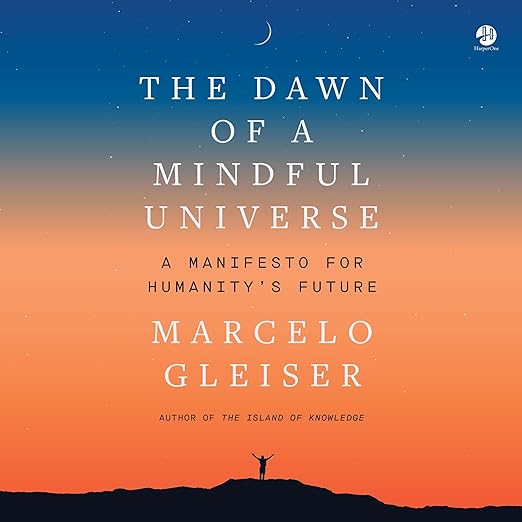
Quick Take
- Narration: Timothy Andres Pabon gives Gleiser’s layered argument a steady, thoughtful delivery that suits the book’s blend of scientific rigor and philosophical aspiration.
- Themes: Life-centric cosmology, the moral mission of science, the Enlightenment rethought for climate crisis
- Mood: Intellectually charged and occasionally urgent, the kind of book that makes you look differently at the sky
- Verdict: Gleiser’s argument is provocative and well-supported, though listeners wanting strict scientific neutrality will bump against the book’s openly moral framing.
I had just finished reading a piece about the Fermi paradox when I started this one, which turned out to be excellent timing. Marcelo Gleiser’s central argument, that the silence of the cosmos might be meaningful rather than merely statistical, was already turning in my head. By the time Timothy Andres Pabon had delivered the first chapter, Gleiser had the thread of my attention and did not let go.
Gleiser is a Brazilian physicist and astronomer who won the 2019 Templeton Prize, which is awarded for contributions to exploring the deepest questions about existence and the universe. His proposition in this book is both simple and radical: since Copernicus, modern science has progressively decentered humanity, insisting that Earth is an unremarkable rock in an unremarkable corner of an unremarkable galaxy. Gleiser argues this narrative has done serious moral damage, contributing to the sense of cosmic purposelessness that makes it harder to summon the collective will to address climate change and other existential threats.
Our Take on The Dawn of a Mindful Universe
The counter-argument Gleiser builds is a life-centric cosmology. Given everything we know about the conditions required for life, complex conscious life may be extraordinarily rare in the universe. If that is true, then the Copernican diminishment is scientifically incomplete. We are not an insignificant speck; we are, so far as the evidence shows, one of the universe’s most remarkable experiments. That rarity should instill a sense of moral obligation to preserve rather than exhaust what we have.
This is a carefully argued position, not a mystical claim. Gleiser is rigorous about what the science can and cannot support. But he is also unabashedly writing a moral argument dressed in scientific language, and that is where reader reactions split. One reviewer found the book simultaneously scientific and deeply spiritual in a way they found extraordinary. Another felt Gleiser went too far into what they called hippie mode, lecturing readers on human habits with more fervor than the evidence strictly warranted. Both responses are honest, and both capture something real about the book’s ambition.
Why Listen to The Dawn of a Mindful Universe
Timothy Andres Pabon is a careful choice for this material. Gleiser’s prose oscillates between scientific exposition and lyrical philosophical argument, and a narrator who treats both modes identically risks flattening the difference. Pabon modulates his delivery enough to let the passages where Gleiser is genuinely moved by his subject breathe without tipping into performance. At six hours and fifty-five minutes, the book is dense enough that the narration’s measured quality helps rather than hinders.
The book’s most useful sections for general listeners are those where Gleiser connects cosmological argument to the immediate practical question of climate ethics. He is not making an abstract philosophical point for its own sake; he is trying to provide a different psychological foundation for why the stakes of environmental destruction are what they are. That practical urgency gives the more technical passages a reason to exist beyond intellectual exercise.
What to Watch For in The Dawn of a Mindful Universe
Gleiser is openly advocating a position, which means this is not a survey of competing cosmological philosophies. Readers expecting the neutrality of a textbook will be surprised. The book has a point of view, pursues it consistently, and is upfront about doing so, but listeners should know they are in the hands of an advocate rather than a dispassionate surveyor.
Note also that this title occasionally appears under incorrect genre tags in some storefronts. It is a science, philosophy, and cosmology work, not a home or lifestyle title. Listeners finding it through unexpected categories should recalibrate their expectations accordingly.
Who Should Listen to The Dawn of a Mindful Universe
Readers with existing interest in cosmology, philosophy of science, or the ethics of climate response who want something that connects those threads with genuine intellectual ambition. Fans of Carlo Rovelli’s accessible physics writing, or of Stephen Jay Gould’s essays on science and meaning, will recognize a similar voice here. Skip it if you want strict scientific neutrality or if you find moral advocacy from a scientist uncomfortable.
Frequently Asked Questions
Is this book primarily a science text or a philosophy book?
Both, and Gleiser is upfront about that. He uses rigorous scientific argument as the foundation for a moral and philosophical case. Readers expecting pure scientific exposition will find it more argumentative than they anticipate; readers expecting pure philosophy will find it more technically grounded than expected.
How accessible is The Dawn of a Mindful Universe to listeners without a science background?
Gleiser writes for general educated readers rather than specialists. The astrophysics and astrobiology concepts are explained clearly enough that no prior scientific background is necessary, though some familiarity with cosmological basics will deepen the listening experience.
How does Gleiser’s life-centric argument relate to religious fine-tuning arguments?
Gleiser is careful to distinguish his life-centric position from theological fine-tuning arguments. He grounds his case in observational evidence about the rarity of life’s conditions rather than in inference about a designer. The Templeton Prize context means he engages with questions of meaning without committing to specifically religious conclusions.
Is there a strong connection between the cosmological argument and practical climate ethics in the book?
Yes, and it is one of the book’s genuine strengths. Gleiser explicitly connects the case for life’s cosmic rarity to the moral argument for preserving it. The second half of the book applies the cosmological framework directly to questions about collective human responsibility.