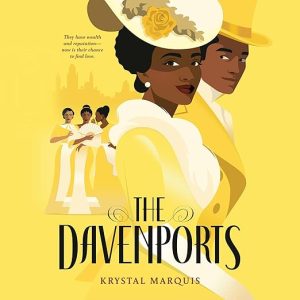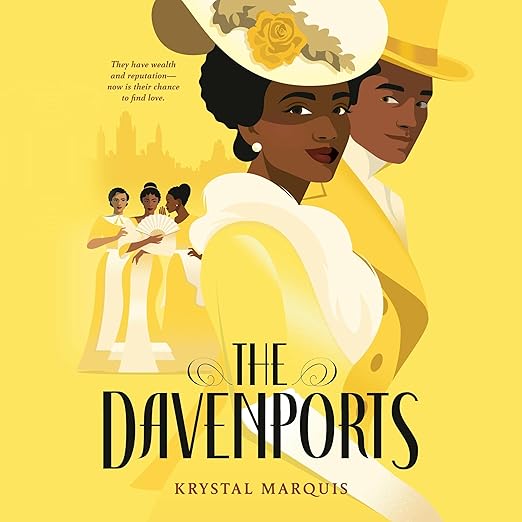
William Davenport built a carriage-company fortune after his own enslavement, and by 1910, when this audiobook opens, his children are navigating a Black high society most historical romance never bothers to depict. The Davenports is inspired by the real Patterson family of Greenfield, Ohio, whose C.R. Patterson and Sons became the only Black-owned automobile manufacturer in American history, and that true foundation gives Krystal Marquis's very romantic plot an unusually sturdy floor to stand on.
I went in expecting a straightforward Bridgerton-adjacent romance and found the historical specificity to be the real draw. Marquis is clearly interested in what wealth without full social power looked like for a Black family in 1910, and that tension threads through even the lightest romantic scenes.
Is The Davenports Worth Your Time?
The novel splits its attention across four young women rather than a single heroine, and the structure mostly earns that complexity. Olivia, the elder Davenport daughter, is drawn toward civil rights leader Washington DeWight against her family's expectation that she marry within their own social circle. Helen, her younger sister, cares more about automobiles than suitors, until she falls for the very suitor meant for Olivia. Amy-Rose, the family's maid and childhood friend to the sisters, dreams of her own business while loving John Davenport, the family's son, from a distance her position will not let her close. Ruby, Olivia's best friend, wants John too, and family pressure pushes her toward scheming rather than honesty.
Joniece Abbott-Pratt narrates all four threads, and differentiating that many young women in close, intimate voice could easily blur into one performance. It does not here. Each woman gets a distinct emotional register, Helen's impatience reads differently from Amy-Rose's careful restraint, which matters enormously across a 12-hour runtime carrying this much ensemble plotting.
The real C.R. Patterson and Sons company, which the novel draws from, operated from 1893 until 1939, transitioning from horse-drawn carriages to automobiles before finally closing during the Great Depression, unable to compete with Ford's mass production and the discriminatory lending practices that kept Black-owned manufacturers from scaling the way white-owned competitors could. Marquis folds that larger economic story into the Davenports' fictional carriage business believably.
The Best Parts of The Davenports
Reviewer Paula Stewart singled out exactly what makes this more than a costume romance: Marquis explores a child's obligation to parental expectation against the pull of their own heart, and does it with characters the reviewer describes as layered and complex enough to root for even when their choices frustrate.
The book was an instant New York Times bestseller and picked up a blurb from NBC's Today calling it the perfect read for fans of escapist historical fiction, and the audiobook format suits that escapism well, letting Abbott-Pratt's warm delivery carry listeners through crystal chandeliers, servants, and endless parties without losing the more serious history underneath the glamour.
Reviewer Janine Pipkin's response, wanting to immediately download the next book in the series, points to something real about the pacing: this is book one of an ongoing Davenports series, and Marquis ends several threads open enough to pull listeners directly into book two.
Washington DeWight, Olivia's love interest, is written as an early civil rights organizer, and his scenes give the novel a political backbone beyond the romance plot, grounding Olivia's personal choice between duty and desire in the larger context of what Black leadership looked like in 1910 America, years before the more widely taught civil rights movement of the mid-20th century.
Joniece Abbott-Pratt's pacing also handles the novel's parties and social set-pieces, debutante balls, family dinners, business negotiations, with enough variation in energy that these recurring scene types never start to blur together despite the ensemble structure repeating them often.
Helen's specific fascination with automobiles takes on extra resonance against the family's carriage-manufacturing fortune: she represents the industry's future arriving inside a family whose wealth was built on the mode of transportation cars were actively replacing during this exact period, a detail Marquis lets sit quietly in the background rather than spelling out as commentary. That quiet historical irony is typical of how the novel handles its research generally, present and consistent without ever slowing the romance plot down to lecture the listener.
Before You Commit to The Davenports
With only one rating attached to this listing despite the book's real bestseller status, this specific audiobook edition has limited crowd-sourced feedback so far, worth knowing if you rely heavily on review volume before committing 12 hours.
Four simultaneous romantic threads is a lot to track by ear, and listeners who prefer a single clear protagonist may find themselves needing to concentrate harder than usual to keep Olivia's, Helen's, Amy-Rose's, and Ruby's arcs distinct, especially in early chapters before each woman's voice has fully settled.
Because Marquis is writing young adult fiction, the historical racism and social barriers the Davenports navigate are present and consequential but not depicted with the same graphic intensity an adult historical novel might use. Younger listeners get real historical weight without gratuitous detail, though adult listeners wanting a harder-edged treatment should know the register stays calibrated for a teen audience throughout.
Should You Listen to The Davenports?
This audiobook is a strong fit for readers of Bridgerton-style ensemble historical romance who also want real historical grounding, and specifically for anyone interested in Black wealth and civil rights history that mainstream historical fiction rarely centers.
Skip it if ensemble romance with multiple simultaneous heroines frustrates you, or if you want a single unbroken love story rather than four interwoven ones. As a series opener, it is built to leave you wanting book two, not to resolve everything on its own.
The book also fits well alongside other recent YA historical fiction centering Black protagonists in eras usually written from a white perspective, offering listeners who enjoyed similar recent releases another strong entry in that same growing shelf.
Is the Davenports audiobook based on a true story?
It is inspired by the real Patterson family of Ohio, whose C.R. Patterson and Sons became the only Black-owned automobile manufacturer in American history, though the romantic plot itself is fictional.
How many narrators does this audiobook use for its four heroines?
Just one. Joniece Abbott-Pratt voices all four young women, giving each a distinct emotional register rather than splitting the cast across multiple performers.
Do I need to listen to The Davenports series in order?
Yes, this is book one of an ongoing series, and it ends with several threads deliberately left open for the next installment.
Is this audiobook appropriate for teen listeners?
Yes, it is shelved as young adult and keeps its romance warm rather than explicit, appropriate for the teen audience it's marketed to.