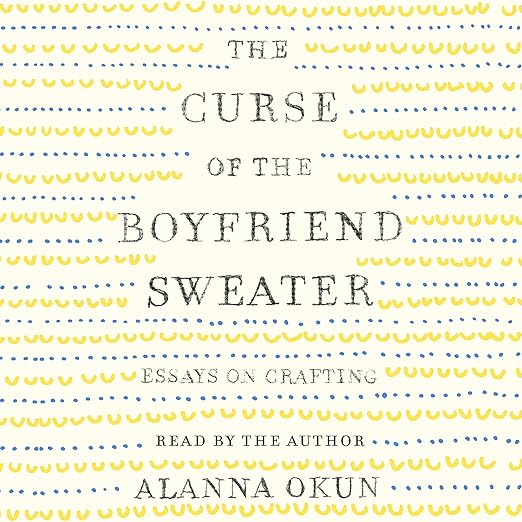
I'll be honest: I am not a knitter. I own no yarn, I have never experienced the particular dread of Second Sock Syndrome, and I approached The Curse of the Boyfriend Sweater with the same mild skepticism I bring to any memoir organized around a hobby I don't practice. What I found, about twenty minutes in, was that Alanna Okun had made the knitting almost entirely beside the point. Or rather, she'd made it the precise and irreplaceable vehicle for everything else she wanted to say about anxiety, grief, relationships, and the specific comfort of making something with your hands when you cannot control anything else in your life.
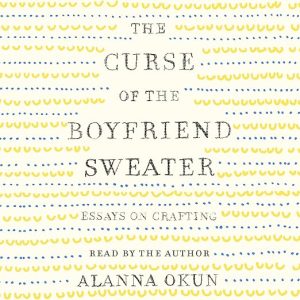
AudioFile Magazine's review on the cover is accurate and worth repeating here: Okun's narration is "lightly poignant and occasionally tongue-in-cheek" and it enhances rather than merely delivers her writing. This is an author reading her own memoir, which is always a gamble. Authors are not always narrators. But Okun has an ear for the rhythm of her own sentences, and there's an ease and self-awareness in her delivery that makes the essays feel less like polished artifacts and more like something she's saying directly to you, with a wool sock in her lap.
Okun Narrates the Sweater Curse and Her Grandmother
The essays here are organized loosely around projects and the emotional conditions under which they were made. The titular boyfriend sweater opens the collection with a piece of folklore that crafters apparently know well: knit someone a sweater and the relationship will end before the last stitch. Okun investigates the legend through her own romantic history with exactly the right amount of self-awareness. She's not naive about the folklore's psychological function, the way it gives crafters a story to tell about failed relationships instead of facing the more complicated truth, but she doesn't dismiss it either.
The essay about her grandmother is the collection's emotional core. Okun's grandmother was her knitting teacher, and the loss of her is threaded through the whole book in ways that only become clear as the essays accumulate. The observation that making a hat for a newborn baby is about appreciating the beginnings of life, which sometimes helps make peace with the endings, is the kind of line that sounds like a platitude until you hear Okun deliver it in the context of her grandmother's death, and then it becomes something else entirely.
Funny, Specific, and Never Just About Yarn
The reviewer who called this "the most relatable read" and noted that she'd never written a review before picking it up at the end of a breakup is capturing something real. Okun's gift is for finding the universal in the specific without ever losing the specific. The chapters about anxiety, about the compulsive quality of craft as a management strategy, could have been written about any repetitive physical practice, but Okun keeps them rooted in the texture of knitting needles and yarn weights in a way that prevents them from becoming generic self-help.
The humor is genuine and not forced. The chapter apparently titled "Things I've Used Knitting Needles for Besides Knitting," which drew laughs from at least one reviewer who was otherwise ambivalent, is representative of Okun's ability to be funny about the ways craft culture takes itself seriously. The book never condescends to crafters, but it's also not hagiographic about the practice. Okun sees the absurdity and loves it anyway.
A Youthful Voice in a Loosely Linked Collection
One reviewer noted that the writing style sometimes reveals its author's age and generational vernacular in ways that felt slightly distancing. This is a fair observation. Okun was a young journalist when she wrote this, and the voice carries marks of that context. For readers who are significantly older, some of the cultural references and rhetorical habits may feel like they belong to a specific moment rather than a timeless one.
The collection is also explicitly structured as a collection rather than a continuous narrative. If you prefer your memoirs to build toward a unified argument or arc, this may feel too loose. The essays circle the same emotional territory from different angles rather than moving through it in sequence, which is a deliberate structural choice but one that will suit some listeners better than others.
Even Non-Crafters Will Relish This Memoir
Non-crafters who like intimate, essay-driven memoirs should not be put off by the subject matter. The knitting is context, not prerequisite. If you've enjoyed books like Samantha Irby's essay collections or anything in the vein of personal, humor-inflected memoir about learning to live inside your own anxiety, this will feel familiar and worthwhile.
Crafters, obviously, will find an additional layer of pleasure in Okun's specific vocabulary and the accuracy of her descriptions of the physical world of yarn and needles. But the AudioFile assessment that "listeners need not be knitters or crafters to relish" this material is correct, and at under five hours, the time investment is minimal even if you come in skeptical.
- Read by: Okun reading her own work is the defining feature of this audiobook. Her lightly self-deprecating delivery makes the essays feel like conversation rather than performance.
- At its heart: Craft as anxiety management, grief and making, female friendship and inheritance
- Vibe: Cozy, honest, and occasionally surprising
- Short version: A short, warm listen that earns its place even for non-crafters, carried entirely by Okun's voice and her gift for turning domestic detail into something larger.
Common Questions
Do you need to be a crafter or knitter to enjoy this audiobook?
No. AudioFile Magazine made this point in their original review, and it holds up. Okun uses craft as a lens for essays about anxiety, grief, relationships, and the need to make something with your hands. The knitting is specific and evocative but not exclusionary.
How does Alanna Okun's self-narration compare to a professional narrator reading her work?
It's one of the audiobook's genuine strengths. Okun has a natural ease with her own sentences and a self-deprecating delivery that a professional narrator would struggle to replicate. She knows exactly where the jokes land and where the weight falls.
Is the book structured as a single narrative or as separate essays?
Separate essays organized loosely around projects and the emotional circumstances of making them. The collection builds cumulatively, especially around the theme of her grandmother, but it doesn't follow a strict narrative arc.
Is The Curse of the Boyfriend Sweater appropriate for listeners who are dealing with grief or loss?
Yes, thoughtfully so. Grief, particularly the loss of her grandmother, is central to the book, and Okun handles it with honesty and without false resolution. It's the kind of memoir that acknowledges loss without trying to fix it.