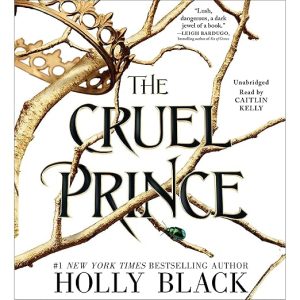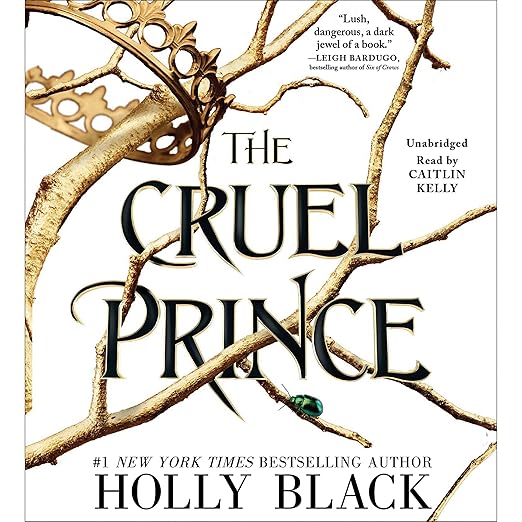
- Performance: Twelve and a half hours delivered by one reader, in a book where almost every line is somebody concealing something from somebody else.
- What it covers: a mortal girl in a faerie court, sisters split by loyalty, ambition without magic, cruelty mistaken for courtship
- Feel: Sharp, cold, compulsive
- Our call: The strongest political fantasy on the young adult shelf, provided you understand you are buying scheming rather than swooning.
Three paragraphs of this record's description are not description at all. They are the book talking: of course I want to be like them, they're beautiful as blades forged in some divine fire, I hate him so much that sometimes when I look at him I can hardly breathe. Nobody marks them as an excerpt and nobody needs to, because they are the most honest thing on the page. That voice is exactly what the audiobook is selling across twelve hours and thirty-six minutes, and a buyer who responds to those lines has already made the decision.
Unlabeled Excerpts Sell the Book's Real Voice
Jude was seven when her parents were murdered and she and her two sisters were carried off to live in the High Court of Faerie. Ten years later she wants nothing so much as to belong there, mortality notwithstanding, and most of the fey despise humans on principle. Prince Cardan, youngest and wickedest son of the High King, despises them with style. To win a place at court she has to defy him and take the consequences, which run to palace intrigue, deception, and the discovery of what she turns out to be willing to do.
A four-star from February 2026 describes the entry point accurately: the story is captivating from the start, action arrives immediately, and the mortal-world sequence where Madoc comes crashing in and takes the girls' mother and father upends everything inside a few pages. That opening is the book's great structural advantage. Most court fantasies spend an hour building a world before anything happens in it. This one commits an atrocity in the first chapter and lets the world assemble itself around the wreckage.
Something this record gets right deserves saying, because so many records do not. The series fields are filled: The Folk of the Air, volume one, stated plainly, so a buyer knows precisely where they are standing before paying. The copy still calls it a stunning new series on a listing dated January 2018, which by now is archaeology rather than a claim, but the structural information a reader actually needs is present and correct.
Kelly Balances Jude's Contempt and Longing for Cardan
A five-star filed from Canada in December 2025 makes the practical case better than a summary could: the book keeps that reader up later than intended because of one more chapter, over and over. That property is what a twelve-and-a-half-hour file most needs, and here it comes from structure rather than from manufactured cliffhangers. Black ends chapters on decisions instead of on threats, which is a harder trick to pull off and a considerably more addictive one.
Caitlin Kelly handles the reading, and the demand is unusual for the shelf. Jude's account has to hold contempt and longing inside the same sentence, frequently about the same person, without letting either one win. Tip it toward sarcasm and the wanting disappears; tip it toward swoon and the book becomes the romance it spends twelve hours insisting it is not. Test a scene with Cardan in it, since those are where the register has to do both jobs at once, and where a reading either finds the balance or misses it entirely.
Underneath the faerie apparatus this is a political novel, which is why it outlasts its shelf. Jude has no magic, no glamour and no protection whatsoever, so every advantage she acquires is procured: by watching, by leverage, by being willing to do the thing nobody expects a mortal girl to do. Court fantasy usually hands its protagonist a power in the first act. This one hands her a disadvantage and builds the entire plot out of what she does about it.
Political Fantasy or Bully Romance? Readers Disagree
Readers on this page disagree about what kind of book this is, and the split is worth settling before you start. A five-star from March 2026 warns explicitly that many readers arrive having been told it is a romance and leave disappointed, insisting it is political fantasy and that the romance belongs to later volumes. A January 2026 five-star calls the series a favorite fantasy romance and cautions that this book opens as a bully romance, a trope some readers treat as an absolute dealbreaker. That is one against one, a split rather than a verdict.
The sharpest close reading in the column is a three-star from March 2021 that came away admiring the technique more than the book. It credits Black with a decent though not exceptional prose style, a genuine knack for describing clothing, and research into archaic vocabulary that lends the world texture, singling out the food as drawn from both imagination and history. Then it stops. Admiration for surfaces without much engagement underneath is a fair account of what a reader gets when Jude fails to land for them.
Small carelessness runs right through the presentation. The topical tag reads Literature and Fiction, which conveys nothing about faerie courts or court politics to anyone browsing a catalog. The description carries a pair of unconverted hyphens sitting where a dash belongs. And no content note appears anywhere, on a book whose own copy promises the discovery of a capacity for bloodshed and a civil war threatening to drown the Courts of Faerie in violence. A young adult shelf plus no guidance is a combination worth a parent's attention.
This Volume Wants You to Understand Jude
Court intrigue with a mortal at the center is the pitch, and anybody who likes political fantasy where the protagonist earns every inch should take it. It suits readers who want a heroine who is not especially good, listeners who came to fantasy from the adult end and want the same machinery moving faster, and anyone who has been told repeatedly to start this series and wants to know whether the opening volume justifies the noise. It does.
Arrive expecting a love story and this volume will frustrate you, whatever the online consensus promised. Readers who need a protagonist they can admire should look elsewhere, because Jude is built to be understood rather than liked. Parents buying for a younger teenager should weigh the cruelty first. Politics comes first and feelings later, and the volume delivers both in that order.
Does the audiobook finish its own story or stop mid-arc?
The record marks it as volume one of The Folk of the Air, and the copy closes on a dangerous alliance with civil war threatening. Nothing on the listing states how the volume itself resolves, so expect an arc that concludes while leaving the larger conflict open for the books that follow.
Who is Cardan, and how central is he?
The copy calls him the wickedest of the High King's sons, and the fey Jude hates above all the others. Structurally he is the obstacle standing between her and any position at that court, which makes him central long before he becomes central in any other sense.
Does the audiobook explain the rules of Faerie as it goes?
It has to, since Jude is mortal and learning them herself. The copy establishes that the fey live forever and despise humans, and the rest arrives through her position at court. No glossary or accompanying material appears on the record, so context carries the whole load.
Would this audiobook work for someone who does not usually pick up young adult?
Yes, on the strength of its politics rather than its age category. The court maneuvering, the leverage and the cost of every alliance would sit comfortably in an adult fantasy. What marks it as young adult is the age of the cast and the school setting, not the ruthlessness.