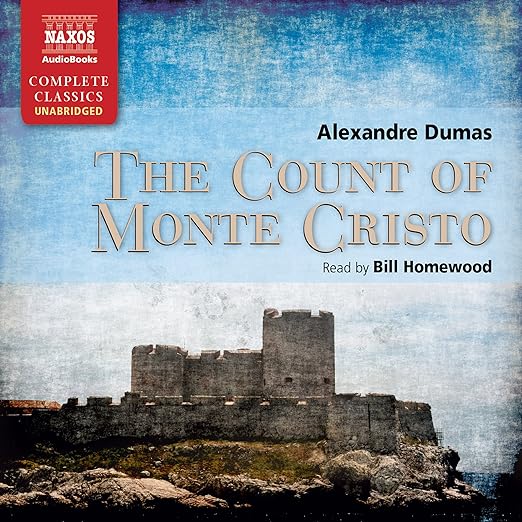
Edmond Dantes enters the Chateau d'If with a captaincy waiting for him and a wedding set for the next day, and he leaves it as somebody else entirely. That reversal is the engine of the whole novel, and this audiobook gives it a running time of fifty-two hours and forty-one minutes. Naxos AudioBooks issued the recording in August 2011 with Bill Homewood credited as the only reader on the record. One voice takes Dantes, the rivals who invent the treason charge against him, the jailers who keep him, and the drawing rooms he walks back into decades later.
Naxos AudioBooks put a single actor in a room with a very long book and let the prose carry the weight. That is a defensible choice for Dumas, whose dialogue does most of the characterization anyway, but it is also an enormous amount of work for one set of vocal cords. Fifty-two hours is less a performance than a residency. How that load gets distributed across dozens of speaking parts is the question a buyer would most want answered, and the listing answers nothing about it. A sample would settle it in ninety seconds; the page does not offer one.
What the description does supply is a compressed version of the setup: the arrest on the eve of the wedding to Mercedes, the treason charge trumped up by jealous rivals, the years in a cell near Marseille, the escape, the revenge. It calls Dumas a master storyteller and files the Count among the masked avengers and caped crusaders of literature, which is publisher language rather than analysis. It is not wrong about the shape of the thing. Redemption arrives last, after a great deal of patient cruelty has been paid out in full.
Bill Homewood's name is the only performance information the record carries. Nothing states which English translation is being read, and for a French novel that exists in several competing versions, that gap has consequences: fifty-two hours of Dumas are fifty-two hours of somebody's English, and the page does not say whose. Nothing states whether the reading is complete or cut, either. The running time argues hard for complete, but a listener committing two full days deserves that word written down rather than deduced from a clock.
Buss and Printings Crowd Out Homewood's Reading
Fifty-two hours and forty-one minutes is the strongest argument this listing has, and the review column makes the case without meaning to. Two of the five written responses treat length as the central obstacle: one lists the book at twelve hundred pages, another counts more than a thousand and admits that certain chapters are heavy going. Neither complaint lands the same way against a recording. The stretches that read as ballast on paper pass differently when somebody else is doing the reading and your hands are busy.
Robin Buss turns up in the review column, and the mention is worth flagging because it belongs to a different product entirely. A buyer in the Netherlands writes about a Penguin clothbound printing, calls the Buss text the most readable English version available, and hopes the publisher will give it a more elaborate treatment one day. That is a print recommendation parked on an audio listing. It tells you which translation one reader prefers and nothing whatsoever about which one Homewood reads.
Mercedes is the reason the betrayal happens at all. One review sets it out plainly: her cousin Fernand, in love with her, tells the police that Edmond belonged to a conspiracy the review breaks off before naming, and the wedding turns into a prison sentence. A domestic motive dressed as a political one is why the revenge half of the book cuts the way it does. Fifty-two hours leaves room for that souring to happen slowly, which is the only speed at which it works.
Mistagged as Anthologies and Short Stories
Anthologies and Short Stories is the tag this listing carries. For one continuous novel running past fifty hours, that is not a trivial filing error. It puts the record in front of people hunting for something short and hides it from the people who want exactly this. Treat the genre label as noise; the literature and fiction category is the one that fits. Nothing else on the page suggests a collection, and the description plainly describes a single unbroken story running from a harbor in Marseille to a reckoning years afterward.
Gabe Galper is named inside the second review as its author, while the account that posted it belongs to Adam Galper. The body is a school assignment reproduced whole, header fields and all, listing title, author, genre and page count before it stops mid-sentence and never reaches its argument. It is a genuine reader's response and also a homework template. A shopper skimming a wall of five-star grades should know which of those they are counting, because the star weighs the same either way.
Nothing in that column was written by anybody holding this recording. A Penguin clothbound, a leather Barnes and Noble printing, a translation preference, a homework template, and a comparison with the 2002 film directed by Kevin Reynolds: five responses, five paper objects. The 4.6 badge is real, and it is a badge earned by a novel rather than by an edition. Read it as a verdict on Dumas, which it plainly is, and not as a verdict on Homewood's fifty-two hours.
Stalled Print Readers Get a Second Chance
Listeners who started this novel in print and stalled somewhere in the middle are the obvious audience, and so is anybody facing a long stretch of driving, walking or repetitive work, because that is genuinely what fifty-two hours asks for. Readers who love a patient revenge structure, where the trap is built slowly and sprung slower, will find the format suits the material. Anyone who has seen an adaptation and suspected it was leaving things out is correct, and this is where the missing parts live. Screen versions compress by necessity; a recording of this length has no reason to.
Skip it if you need to know your translator before committing, because this page will not tell you, and fifty-two hours is a long time inside a text you cannot identify. Skip it too if a solo reading of a cast this large sounds like a strain rather than a feat, since one voice is all the record promises. Everyone else should treat that running time as the feature it is rather than the warning it resembles.
At a Glance
- Narration: One credited reader, Bill Homewood, for a novel with dozens of speaking parts, and no translator named behind that English.
- Themes: Wrongful imprisonment, revenge built across decades, money and rank in 19th-century France, redemption that arrives late.
- Mood: Patient and cold-blooded, a slow burn measured in years rather than chapters.
- Verdict: The best format this novel has, if you can accept an unnamed translation and a single voice for fifty-two hours.
Frequently Asked Questions
How long is The Count of Monte Cristo audiobook, and is it the complete text?
The recording runs fifty-two hours and forty-one minutes. That length points strongly toward an unabridged reading, since very little could be cut and still fill two days of listening, but the listing never uses the word unabridged. Naxos AudioBooks credits Bill Homewood as the sole reader and leaves the question of completeness unstated.
Do the customer reviews say anything about this audiobook recording?
None of them do. The five written responses cover a Penguin clothbound printing, a leather-bound edition bought in Brazil, a school book report, a plot summary and a comparison with the 2002 film. Every one describes a printed object or the story itself, so the 4.6 badge reflects the novel rather than the reading.
Is this audiobook a reasonable first encounter with Dumas?
Yes, with one caveat about scale. The story is famously front-loaded with setup before the revenge machinery starts turning, and fifty-two hours is a serious commitment for a first try. Anyone who has stalled on the printed novel will find the audio format removes the obstacle two reviewers name directly: sheer page count.