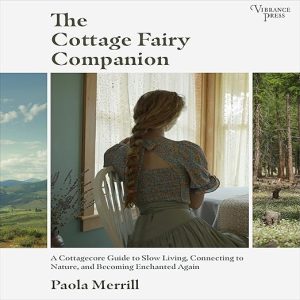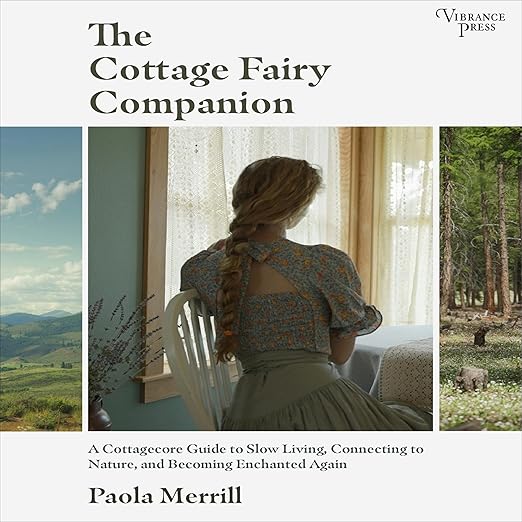
I came to The Cottage Fairy Companion on the recommendation of a reader who described it as the antidote to a week that felt like it had no edges. I understood what she meant the moment Paola Merrill's voice came through my headphones. This is an audiobook that does something specific and does it with intention: it slows you down. At just over two hours, it is not trying to overwhelm. It's trying to interrupt.
Paola Merrill is the creator behind the YouTube channel The Cottage Fairy, where she documents life in a rural mountain cottage with the same unhurried attention she brings to this book. She left a hectic urban life for a slower one, and The Cottage Fairy Companion is partly a record of what that transition taught her. But the book is careful not to present her particular choice as the only path. You do not need a cottage in the countryside to find the practices she describes useful. That accessibility is not a marketing claim, it's structurally embedded in how she writes about mindfulness, seasonal living, and the small acts of making that anchor her days.
Merrill's Calm Voice Matches Unpretentious Beauty
Having Merrill narrate her own book is not just a production choice. It's the right one. Her voice carries the same quality as her YouTube presence, calm without being sleepy, warm without being saccharine. A reviewer who described the channel's tone as unpretentious beauty captured something accurate. Merrill is not performing cottagecore. She is describing a practice that is genuinely hers, and the audio format transmits that authenticity in ways that print might not.
The prose itself, described by multiple readers as meditative, is not merely atmospheric. Merrill moves through seasons, through activities like gardening and making tea, through the texture of a day spent attending to small beautiful things. One reader who had recently relocated from urban California to a rural property wrote that Merrill's writing articulated exactly what she had been struggling to name about her own sense of disconnection and gradual reconnection. That kind of specific resonance is what separates this from generic wellness content.
Coquito Recipes and Wreaths From Fallen Branches
The book is organized seasonally, following the natural calendar in a way that reinforces its core argument: that paying attention to cyclical time rather than continuous-progress time changes how you experience daily life. Each section contains a mix of personal reflection, practical suggestion, recipes, craft projects, observations about what a particular season asks of you, and what Merrill calls the lessons nature teaches about beauty through both good times and bad.
One reader noted making the coquito recipe from the book for the holidays; another was inspired to make a seasonal wreath from available branches. These are not incidental details. The practical elements are deliberately included to give the listener something to do with the ideas rather than just absorb them as aesthetic. For a book about the value of making things by hand, that integration feels considered rather than perfunctory.
Small Print Complaints the Audiobook Sidesteps Entirely
The brevity is the book's most interesting structural choice. At two hours and eight minutes, this is not a comprehensive guide to anything. It does not teach you how to garden or preserve food or build a life in the countryside. What it does is create a temporary shift in attention, a kind of recalibration that works best, I think, if you let it rather than trying to extract a checklist from it.
A reviewer noted that the font in the physical edition is very small, which made reading uncomfortable rather than relaxing, a real limitation of that format that the audiobook sidesteps entirely. The audio version is not a substitute for the accompanying PDF, which includes original illustrations and photographs that are clearly part of Merrill's visual aesthetic, but the narrated prose stands completely on its own. You miss the images. You gain something in return: the book delivered in its creator's actual voice, which is its own kind of primary document.
Listen if You Feel Overscheduled and Rushed
Listen if you follow the Cottage Fairy YouTube channel and want to spend time with Merrill's writing in her own voice. Listen if you are going through a period of feeling overscheduled and want two hours that feel genuinely different in texture. Listen if the cottagecore aesthetic speaks to you, or if you're interested in slow living as a philosophy rather than a trend.
Skip if you want practical instruction, how-to content with step-by-step guidance. This is contemplative rather than instructional. Also skip if two hours feels too short to be worth your time in this format; the book rewards return visits more than a single sitting.
At a Glance
- Performance: Paola Merrill reads her own work, and her soft, unhurried delivery is inseparable from the book's effect, this is one of the rare cases where author-narration is not just appropriate but essential.
- What it covers: slow living, seasonal attunement, finding beauty in ordinary surroundings
- Feel: Quietly enchanting, like an afternoon with no agenda
- Our call: A short but genuinely restorative listen that works best in small doses rather than in one sitting, treat it the way it asks you to treat life.
Before You Listen
Is The Cottage Fairy Companion audiobook worth listening to if you've never watched the YouTube channel?
Yes, the book works independently. Familiarity with Merrill's channel gives you additional context and makes her narration feel like an extension of something you already know, but the audiobook introduces her voice and perspective clearly enough that prior knowledge is not required.
How does Merrill's self-narration compare to a professional audiobook narrator for this kind of material?
Merrill's voice is not trained in the technical sense, but it is deeply authentic to the material. Her calm, unhurried delivery is part of what makes the book work as an audio experience, it matches the content's intent rather than performing it from the outside. Listeners who've found her YouTube presence compelling will hear the same quality here.